
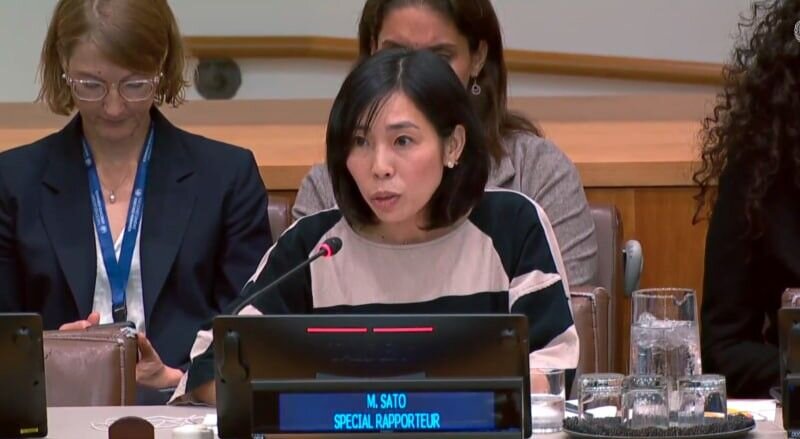
TEHRAN – Mai Sato, the United Nations Special Rapporteur on the situation of human rights in Iran, described the recent 12-day war against Iran as a “clear and blatant violation of the United Nations Charter” and warned that it would have devastating effects on human health and the environment.
In her report to the UN General Assembly’s Third Committee, Sato said the joint Israeli-US military attack had caused untold suffering to the Iranian people, which she noted “deserves redress and compensation.”
According to reports, Israel launched a series of military attacks against the Islamic Republic of Iran on June 13, targeting several locations including nuclear facilities. The United States later joined the attack, attacking nuclear facilities monitored by the International Atomic Energy Agency (IAEA).
“These attacks should never have happened,” Sato said. “They posed the risk of catastrophic humanitarian and environmental impacts that could destabilize the entire region.”
Sato stressed that the use of force by Israel and the United States is a “clear violation of international law and the United Nations Charter.”
The report highlighted the human cost of the conflict, noting that around 1,100 people have been killed, including women and children, and that hospitals, schools and civilian infrastructure have also been targeted. One of the most controversial attacks was on Tehran’s Evin Prison, which reporters described as “unjustified”.
In addition to the casualties, Sato said the war has displaced millions of Iranians and severely disrupted medical care for vulnerable populations. “Pregnant women had no access to antenatal care or emergency medical care,” she noted, adding that the humanitarian situation remained dire.
Iranian officials say the June 12 Israeli airstrikes violated both international law and Iran’s national sovereignty, hitting Tehran and several other cities, including major nuclear facilities. A large number of scientists, military personnel, and civilians are reported to have been killed.
The United States joined the operation in the early hours of June 22, carrying out direct attacks on nuclear facilities in Fordow, Natanz, and Isfahan.
In retaliation, Iranian forces launched a large-scale missile attack on Al Udeid Air Base in Qatar, the main headquarters of the US Air Force and a strategic command center in West Asia.
The conflict ended on June 23 when the US president announced a ceasefire agreement between Iran and Israel. The Islamic Republic of Iran reiterated that it had not initiated hostilities and declared that it would stop responding if Israel ceases its illegal aggression.