
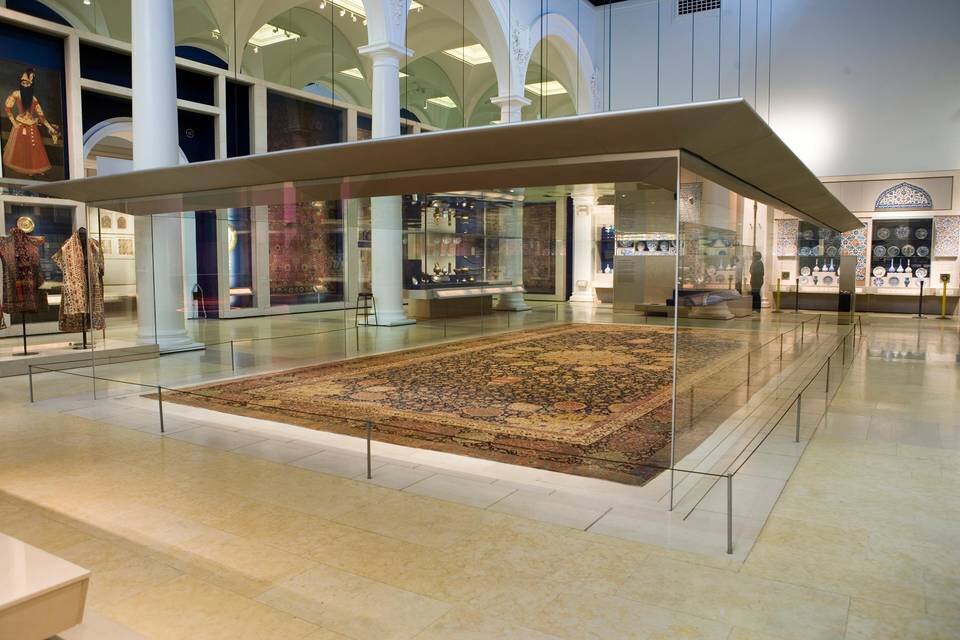
TEHRAN – Two monumental 16th-century Ardabil rugs – woven at the Safavid court for the shrine of Sheikh Safi al-Din Ardabili – are now thousands of miles from their home, housed separately at the Victoria and Albert Museum in London and the Los Angeles County Museum of Art (LACMA).
Once a matched pair and one of the finest products of Iran’s golden age of carpet weaving, these pieces were removed from the Ardabil shrine in the late 19th century after earthquake damage and sold abroad. Today they are famous as centerpieces in Western museums, but in Iran only modern copies are on display in Ardabil.
Both carpets, commissioned between 1539 and 1540 during the reign of Shah Tahmasp I, bear identical signatures attributed to Maqsud of Kashan, who probably designed and supervised the project at the royal workshop in Tabriz. It also includes Hafez’s poem, “I have no escape in this world but your threshold/Nowhere else for my head to rest but this door.”
The pair belong to a period when court-supported workshops and skilled designers made carpet weaving one of the most famous arts of Safavid Iran. Many of the masterpieces from that time now remain in international museums rather than in Iran.
The larger and more famous example is now in the Victoria and Albert Museum in London, which describes it as “the world’s oldest dated carpet, and one of the largest, most beautiful and historically significant”.
The colorful carpet features a unified design built around an expansive yellow medallion, flanked by two hanging lamps and surrounded by intricate swirls painted with natural dyes. The dense pile has approximately 5,300 knots per 10 square centimeters and contains an estimated 26 million knots in total.
The V&A points out that the carpet was still inside the shrine when British visitors saw it in 1843. Some 30 years later, after an earthquake damaged the building, the carpet was sold to a Manchester company and finally put up for sale in 1892. The museum purchased the rug in 1893 for £2,000 after designer William Morris admired its “incomparable perfection”.
In the late 19th century, London’s carpets underwent a major restoration, during which parts of both of the original Ardabil carpets were used to complete them, further altering their integrity. The work is currently displayed in a custom-built display case in the V&A’s Jameel Gallery, which is briefly illuminated to preserve its colour.
LACMA holds the second surviving carpet, measuring 718 x 400 centimeters. The carpet has been described as “spectacular” and is woven from wool pile on a silk base.
Like the London carpet, the LACMA carpet is engraved with the date 946 AH (1539-1540) and the signature of Maqsud of Kashan. The museum explains that the pair was a royal commission from Shah Tahmasp, probably for the temple of his Safavid ancestors at Ardabil.
LACMA’s explanation emphasizes the carpet’s common origin, noting that its exceptional size, quality, and inscriptions indicate that it was produced in the Tabriz Royal Manufactory. Its composition reflects the medallion and lamp design of the London carpet, but the Los Angeles version has undergone less restoration and is displayed closer to its original proportions.
Currently, Iran only preserves a modern replica in the Sheikh Safi al-Din al-Dabiri Museum.
Millions of people visit this temple in London and Los Angeles, but they are far from the shrine where it was created nearly five centuries ago.
morning