
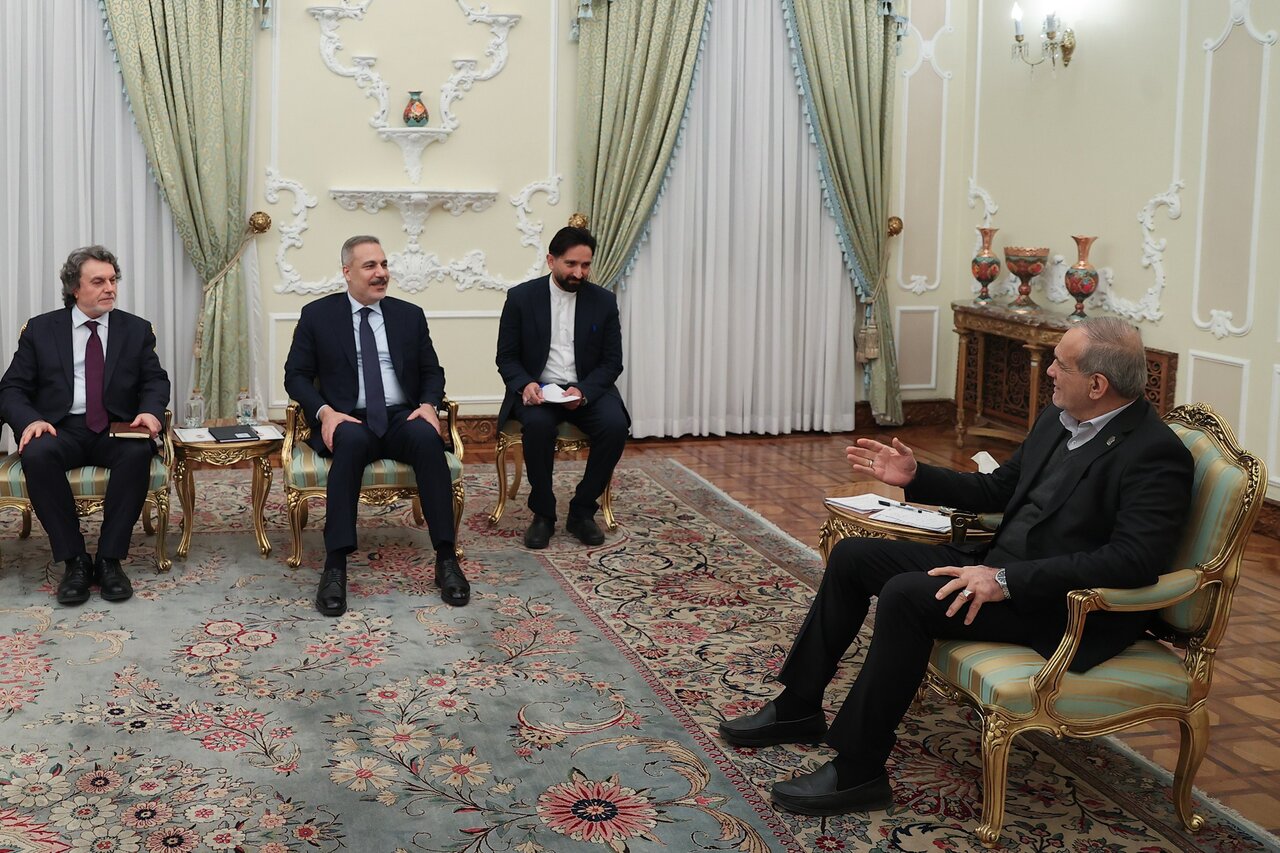
TEHRAN – Targeting $30 billion in trade ties between Iran and Turkey, Tehran and Ankara pledged to transform their historical and cultural ties into a stronger economic partnership, as President Masoud Pezeshkian and Turkish Foreign Minister Hakan Fidan called for deeper cooperation in trade, transportation and regional security.
The Iranian president met with Türkiye’s foreign minister in Tehran on Sunday night.
Focusing on Iran-Turkey relations, Foreign Minister Pezeshkian called on the foreign ministers and their team of experts to intensify efforts to design new avenues of cooperation, ease bureaucratic constraints, and develop practical proposals for speedy resolution of outstanding issues.
“We are brothers,” he emphasized. “We must expand our relationships. Borders that allow the movement of trade, knowledge and culture will never allow the passage of terrorism and weapons.”
Both sides also emphasized strengthening unity and coordinated action among Muslim-majority countries to prevent external forces from causing a crisis in the Islamic world.
Noting the centuries-old historical, cultural and civilizational ties between Iran and Turkey, Pezeshkian said the bilateral relationship is “deep-rooted and genuine” and has great potential for expansion. He asserted that “no power can cause problems for Islamic countries” if they act through a common will based on solidarity, convergence and exchange of experiences.
Pezeshkian said many regional crises are the product of interventionists who sow divisions to advance their own agenda and prevent the development of Islamic societies. To counter these pressures, he called on Islamic governments to adopt proactive, strategic and cooperative cooperation.
He highlighted Europe’s post-conflict integration as a model, noting that despite centuries of war, European countries had managed to reduce national borders, establish common political and financial institutions, and interconnect trade and transport systems. The Islamic world, which has “much deeper cultural and civilizational commonalities,” could achieve similar progress if it chose to cooperate rather than divide. Expanding economic, scientific and cultural ties could lay the foundations for collective growth in the Islamic world, he said.
Foreign Minister Fidan conveyed warm greetings and a special message from President Recep Tayyip Erdoğan, expressing the Turkish government’s readiness to deepen cooperation across economic, trade and regional issues.
Foreign Minister Fidan praised Pezeshkian’s integrity and commitment to the Muslim world, saying Turkey fully shares Iran’s concerns. He argued that internal divisions were costing Islamic countries valuable time and that “the spirit of the age has reached the point where collective cooperation is no longer optional, but an inevitable necessity.” He urged Islamic countries, including Iran and Turkey, to increase engagement through common, equal and coordinated action, arguing that Islamic countries needed to “lift the weight of division” that hinders the advancement of the Islamic ummah.
Commenting on Iran’s trajectory since the 1979 revolution, Foreign Minister Fidan said Iran’s progress has had an amazing dynamism, “like an arrow shot from a bow.” He also highlighted several joint economic, trade and transportation projects currently underway, noting that President Erdoğan is personally monitoring their progress.
Nuclear issues, Gaza crisis, and border cooperation are the most important topics of the Araghchi-Fidan talks
Prior to this, Foreign Minister Fidan held extensive talks with Iranian Foreign Minister Abbas Araghchi. At a joint press conference, Foreign Minister Fidan said that this was his fourth visit to Iran as Turkish foreign minister, and expressed his gratitude to the Iranian government for its hospitality.
He said the meeting was productive and wide-ranging, covering bilateral issues, regional crises, and international affairs. The key points are:
Fidan stressed that issues related to Iran’s nuclear program must be resolved within the framework of international law and through dialogue and consultation.
He reiterated Turkey’s opposition to the “unjust sanctions” imposed on Iran and said Ankara would do everything within its ability to support a diplomatic solution.
He announced Turkey’s readiness to expand border crossings with Iran and said the two countries had held detailed discussions on traffic and border control.
Fidan also mentioned the upcoming opening of the Iranian consulate in the Turkish city of Van, and said that if Araghchi travels for the ceremony, he intends to attend in person.
The ministers also discussed cooperation in gas and electricity, and Foreign Minister Fidan noted that the next meeting of the Iran-Turkey High-Level Cooperation Council will be held soon in Tehran with the participation of the presidents of both countries.
Turkey’s foreign minister stressed that Israel’s aggression has heightened concerns across the region, and said the international community must fulfill its responsibilities.
The two ministers also exchanged views on the Russia-Ukraine conflict, with Fidan saying Turkey remains in touch with all parties and supports efforts to resolve the crisis.
Also, during their official meeting early Sunday, Mr. Araghchi and Mr. Fidan expressed satisfaction with the long-standing strong relationship between the two countries and reaffirmed the commitment of the two leaders to expand cooperation in all fields.
Both sides also reviewed the dire situation in Gaza and the West Bank, stressing the need to stop the genocide of Palestinians and hold the occupying regime accountable. The two leaders further discussed developments in Syria and Lebanon, condemned the ongoing Israeli military actions, and called for urgent international measures to stop violations of international law.
The ministers also discussed multilateral cooperation in international organizations, the Iranian nuclear issue, and the conflict in Ukraine.
The Turkish foreign minister also met with Ali Larijani, secretary of Iran’s Supreme National Security Council, on Sunday.
During the meeting, the two sides exchanged views on a range of important security issues in the region. Their discussion focused on the latest developments in Syria and Gaza and the role of the Zionist regime in causing instability in recent regional developments.
Both sides emphasized the importance of close cooperation between Tehran and Ankara in managing and mitigating regional crises.
In the early afternoon, Foreign Minister Fidan met with Iranian Parliament Speaker Mohammad Baqer Qalibaf. The two sides discussed bilateral cooperation, regional issues, and the need for coordinated efforts between the two countries’ legislative bodies to support government-level agreements.