
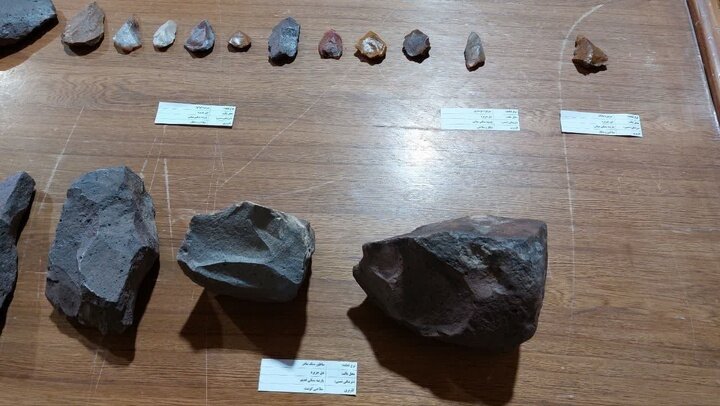
Tehran – Ahmad Barabadi, manager of the Cultural Heritage Division of South Holasan, has announced the identification of the first sample of the Akeirian industry, including a handshake that dates from around 500,000 years ago. He added that new windows can be opened to understand the history of human settlements on the plateau of eastern Iran.
According to Milas Aliya (CHTN), Barabadi mentioned the importance of these discoveries, adding that a recent exploration that began 50 years after the Paleolithic archaeological activity of the Khounik caves achieved the presentation of different layers in 13 ditches from ancient sites.
Based on a preliminary assessment, he said the objects associated with the mid-Paleolithic period were 100,000 to 200,000 years old, and the upper artifacts of the Paleolithic period were more than half a million years old.
However, the final age decision requires detailed laboratory studies at trustworthy centres, allowing the data to be scientifically documented, he noted. These findings could mark a new chapter to understand the course of human evolution on Iranian plateaus, he added.
Archaeologist Ali Sadray, who led the exploration team, also said that a sample of the Akeirian industry, including a hand-shaped axis that ranged from about 500,000 years ago, was first identified in eastern Iran.
He said that the Achulean industry, which was identified early in Iran’s western part and elsewhere in the world, is now establishing its location in eastern Iran on a map of early human cultural and technical dispersal, through this identification.
He added that an archaeological quest had begun as of the month of Iranian TIR to support the Cultural Heritage Sector of South Khorasan, and is now in its final stages. He continued that various stone tools, central Paleolithic bayonets, and evidence of interglacier settlements so far have been found.
Mohammad Nasiri, representative of Ferdows, Tabas and Sarayan counties at Majlis, also visited this ancient site and highlighted the need to protect these artifacts.
He said this precious legacy is part of the South Holasan identity and ancient civilization, and should be transformed into one of the country’s outstanding scientific and historic tourist attractions with principled plans.
The ancient site of Daqh Jazeera (Dagh Island), which has a region of over 300 hectares in the Isaac district of southwestern Sarayan County, is considered to be the largest Paleolithic site in eastern Iran. Recent discoveries are an important step in rereading the history of human life in the region, allowing us to draw new perspectives on archaeological research and the development of the country’s eastern scientific tourism.
South Horasan is a cultural heritage province and boasts an incredible ability to be presented to domestic and inbound tourists through the media.
The LUT Desert is located in the southeastern part of Iran and is located within three provinces: Karman, Sistanbaruchestan and South Khorasan.
With endless sand dunes and plains, beautiful clear skies and a rich cultural heritage dating back over 7,000 years, Lut Desert (or Dasht-e lut) is a paradise for visitors, combining geotourism, adventure and cultural tourism all in one place.
KD