
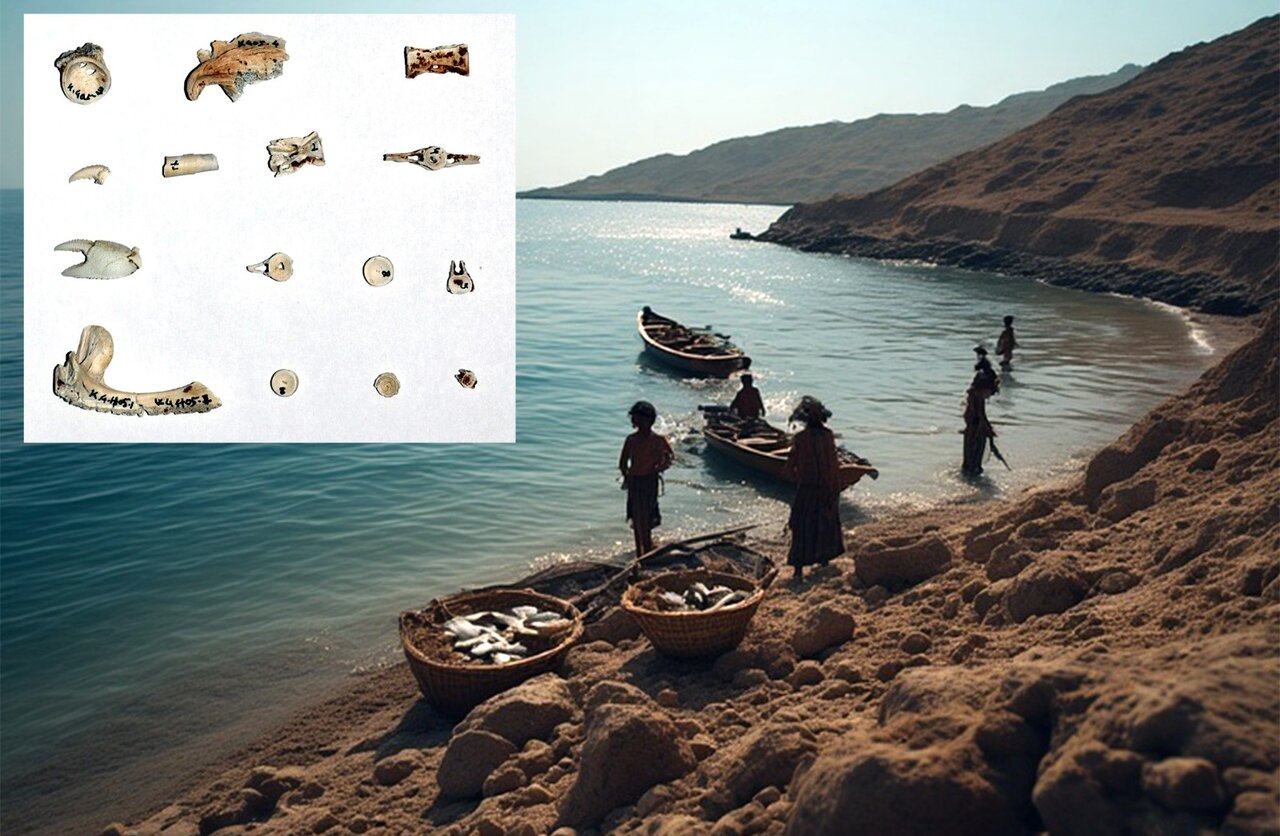
Tehran – Archaeologists working at the Kuparsite in Dashtiari district in southeastern Iran reveal prominent evidence of a 6,000-year-old catch settlement and provide detailed insights into ancient maritime self-sufficiency strategies.
The excavation, led by Dr. Mortaza Hessari, discovered 41 well-preserved aquatic bone fragments along with fishing gear. Based on related pottery, these find dates up to the fourth millennium BC and belong to the broader Calcolithic culture known from the Macran (aka McCollan) and the Balchestan region.
The rest of the bones exhibit distinct slaughter marks from meat processing, indicating that these coastal inhabitants are heavily dependent on marine resources, and that three major fish species have been identified as dietary staples: treabery (Carangidae), sergerers (Saranidae), and possibly tuna (scombridae). Of particular importance is the discovery of fishing hooks and net weights. This provides concrete evidence that organized fishing activities were well established in the area by 4000 BC, and can be traced back to the Neolithic period.
Hessari added that the species of marine species found at this location suggested that these ancient people had more advanced maritime technology than previously thought.
The presence of true offshore fish species indicates that they have the ability to boat-based fishing and travel beyond simple coastline collections.
This discovery is modern with other early coastal human occupations that appear around the Persian Gulf and the Macran Sea, among the earliest known examples of sophisticated maritime adaptations in the region. The archaeological team recognizes the importance of these findings to understand the evolution of early fishing techniques and maritime self-sufficiency practices in ancient Iran.
Hessari also highlighted the important support provided by local governments, particularly Governor Abdraziz Miayee of Dassitz County and Chabahar Cultural Heritage Bureau, in fostering this important research.
Looking to the future, researchers hope that these discoveries will lead to the establishment of a dedicated Macran Cultural Heritage Research Centre to further explore and maintain the region’s rich coastal heritage.
As excavations continue in Koupal, archaeologists expect to uncover more evidence regarding the daily life and maritime practices of these ancient coastal residents. The breadth of discovery is an already restored promise to significantly strengthen our understanding of how early human societies adapted and exploited along the Iranian Macran coast during a critical transition to settling coastal life.
morning