
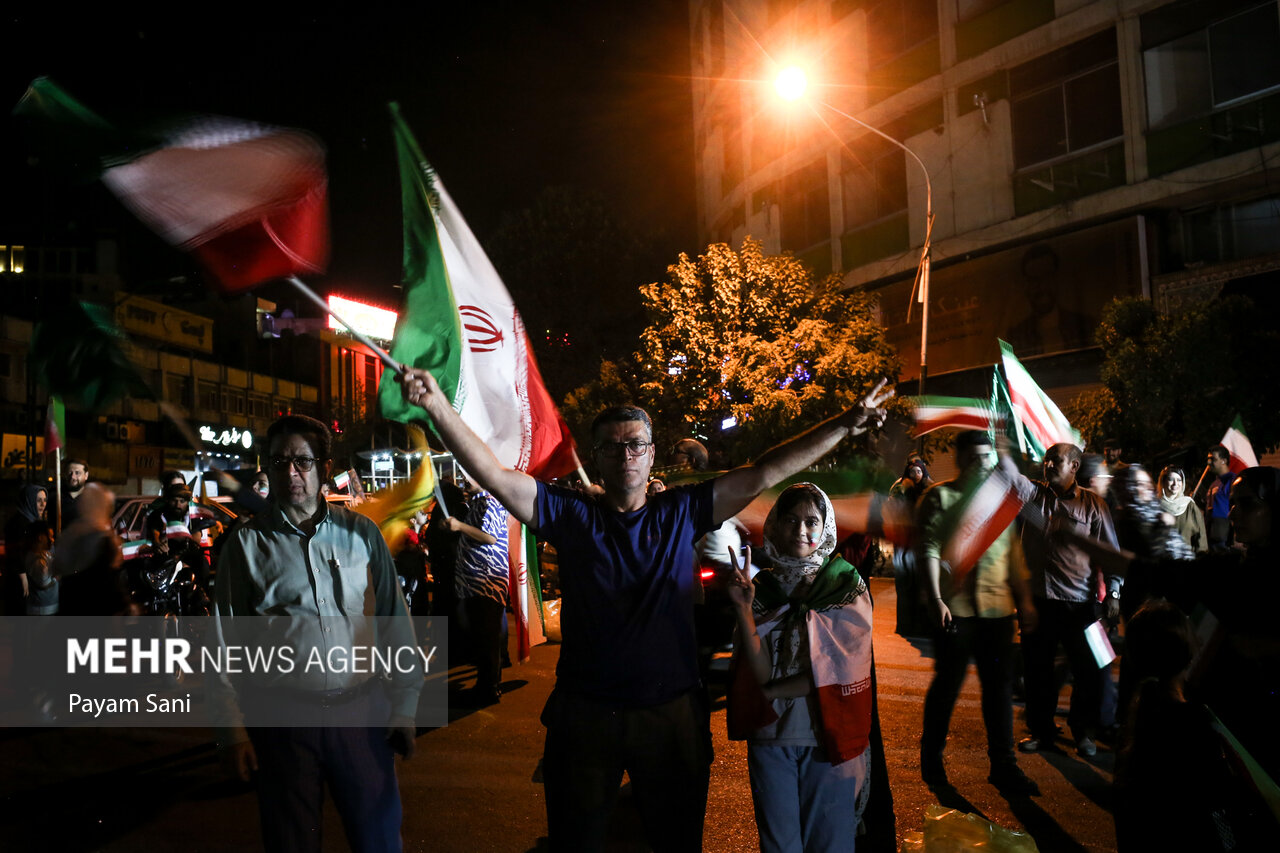
TEHRAN – At least 77% of Iranians say they are proud of the Islamic Republic’s response to the recent Israeli invasion of Iran, according to a recent survey conducted by the Islamic Broadcasting (IRIB) research division.
A national survey conducted in Tehran and 32 other cities in late June 2025 included a sample size of 4,943 people aged 15 and over.
Of the surveyed participants, 51.6% were male and 48.4% female respondents.
With the extent of pride they felt in Iran’s retaliatory missile and drone strike, the drones took a strike in response to the unprovoked illegal attacks of the Zionist regime.
This demonstrates national support for Operation True Promise III, launched by Iranian forces led by the Islamic Revolutionary Guard (IRGC).
When asked about the overall performance of Iranian military forces in response to Israeli invasions, 80.5% of respondents rated it as “completely strong” or “relatively strong.”
The study also assessed public sentiment regarding the performance of Iran’s air defense systems during the recent war. A total of 69.8% of respondents praised their performance, reflecting the strong public’s trust in the country’s military, particularly the air defense forces.
Iranian air defense forces successfully intercepted most of the missiles launched by the Israeli regime, and thwarted the reconnaissance drones deployed by Zionist spy agencies.
More than a dozen Hermes drones have been defeated in different parts of the country, and some reports have shown that at least two F-35 fighter jets have been shot down.
When asked about their feelings regarding the Israeli invasion, which began on June 13th and ended in a one-sided ceasefire declared by Israel on June 24th, 42.1% of respondents said they felt “anger and anger towards the enemy.”
The attacks that sought to own fears and fomental internal discords about Iranian society ultimately had the opposite effect, and instead helped to unite the state’s feelings towards its enemy.
51.8% of respondents said they had “an increase in national security” regarding the impact of Israeli-American aggression against the Islamic Republic and Iran’s response to the country’s national security.
Meanwhile, 21.1% of respondents believed the situation would remain “similar to the past.”
During the war of aggression, Iranians were seen gathering behind the army as they carried out several stages of missile and drone operations against sensitive, strategic targets in the occupying territories, causing serious damage.
According to the survey results, 89.5% of respondents expressed support for further strengthening Iran’s ballistic missile programme in light of the current situation and threat.
Iranian officials have repeatedly argued that the country’s missile program is “unnegotiable” and highlighted its role in national defense. In recent years, Iran has emerged as a global force in missile and drone technology.
Regarding questions about the impact of Iranian military capabilities demonstrated during the 12-day war on preventing future enemy attacks, 76.8% of respondents rated its effectiveness as “very high” or “high”, which helped to prevent future acts of aggression.
The investigation also highlighted the unified effects of war imposed, demonstrated by funerals of millions of people for the military commanders of the Martialists of Tehran, as they gathered together against Zionist enemies.
A total of 79.8% of respondents said that the 12-day war had a “very high” or “high” effect on national unity and unity.
Research shows that only a small percentage of Iranians expressed confidence in Israel’s commitment to a unilateral ceasefire declared after Iran’s missile strike.
Only 13.7% of respondents said the administration was “very” or “very optimistic” to adhere to the ceasefire.
In contrast, 36.1% said they were “somewhat” or “somewhat optimistic”, while 46.5% said they were “not optimistic at all” about Israel’s persistence in the ceasefire.
The investigation also revealed strong public opposition to Western conditions to dismantle Iran’s nuclear industry and limit its missile programmes.
78% of respondents opposed the demolition of the nuclear program, while 85.2% refused to limit missile programs, highlighting strong state support for both Iran’s peaceful nuclear efforts and its defensive missile capabilities.
Regarding the issue of state mobilization, 57.4% of respondents hope to participate “very many” or “many” in future wars against the Israeli regime, indicating that this further reflects a deep sense of national unity and resolve.
When asked whether the US had successfully targeted and destroyed Iran’s nuclear facilities, 45.9% of respondents said the attack was “very few” or “less” successful, while 15.6% said the strike was “at all” successful.
The study also addressed perceptions of foreign digital platforms. A total of 68.2% of respondents thought that apps like WhatsApp, Instagram and Telegram would provide “very” or “many” as surveillance tools for the Zionist regime.
The claims of Israeli Prime Minister Benjamin Netanyahu and US President Donald Trump said their opposition was aimed exclusively at the Islamic Republic, with 79% of respondents “strongly opposed” or “opposed” these claims, indicating a broad rejection of a deceptive narrative that is oriented towards embarrassment and division.
(Source: Press TV)