
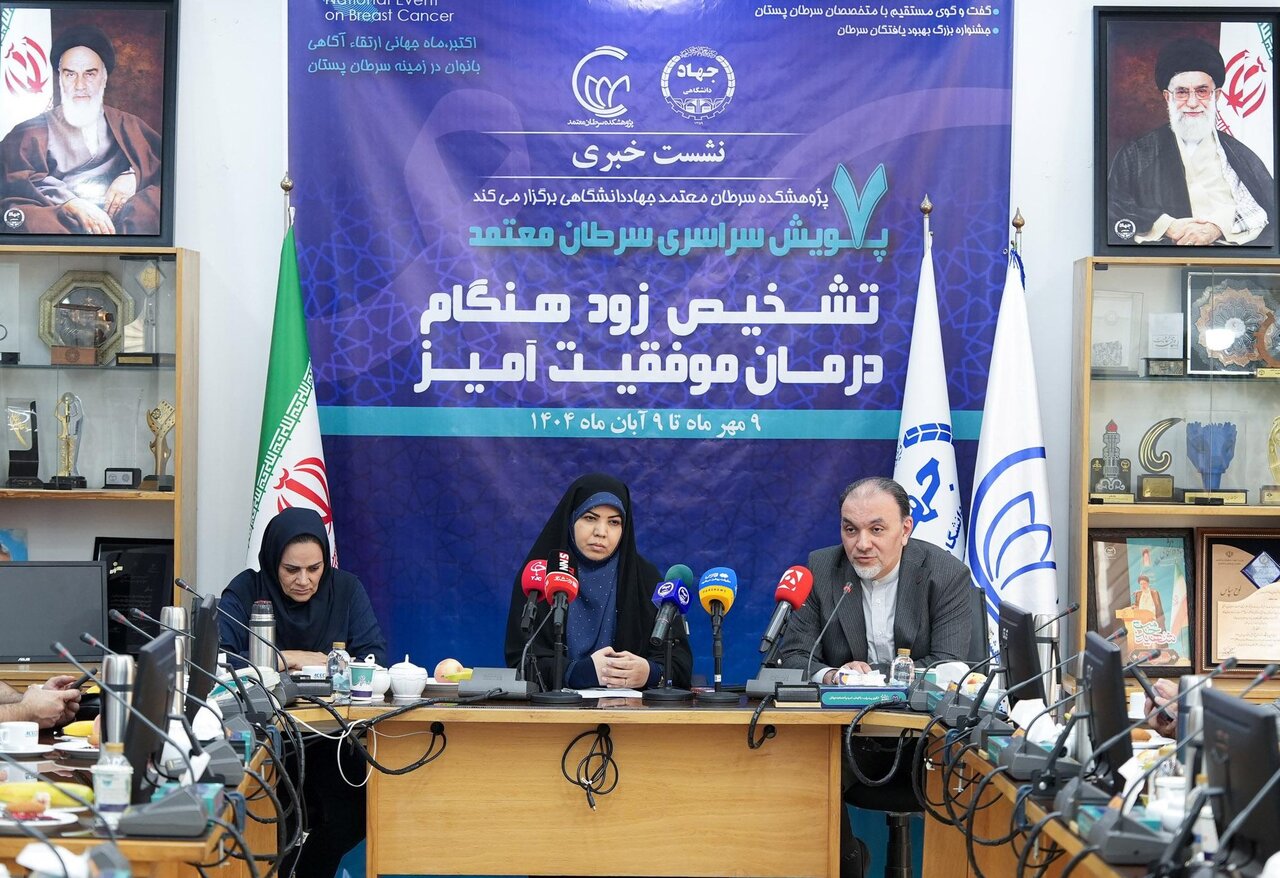
TEHRAN – The seventh nationwide women’s cancer screening campaign has been launched to coincide with October’s World Breast Cancer Awareness Month.
To this end, a press conference was held on Monday, October 13th, at the location of the Academic, Educational, Cultural and Research Center (ACECR) in Tehran, under the auspices of the Iranian National Institute of Cancer (INCO).
The event was attended by Dr. Zahra Sheikh, Vice President of Research and Technology at ACECR, Dr. Ramin Salami Foroushani, Director of ACECR National Cancer Institute of Iran, and Dr. Asiy Olfat Bakhsh, Deputy Director of Research and Education at INCO.
Olfat-Bakhsh announced that a nationwide awareness campaign will be launched in October, adding that free breast examination services for women will be provided in the 2nd, 3rd, 4th, 16th and 19th districts of Tehran in cooperation with ACECR, National Cancer Institute of Iran and Tehran Municipality.
“According to the latest data published by the international GLOBOCAN database (2023), approximately 15,700 Iranian women were diagnosed with breast cancer. Considering the female population at that time (42 million), the incidence of breast cancer in Iran is estimated at 35-37 per 100,000 women,” Olfat-Bakhsh said, highlighting the latest global breast cancer statistics.
“These numbers are derived from reliable international data sources and may vary slightly from report to report depending on the predictive model and estimation method used.”
States with high breast cancer incidence
Elsewhere in her remarks, Olfat-Bakhsh referred to the geographical distribution of breast cancer in Iran, saying: “According to studies published in the past two years, provinces such as Tehran, Alborz, Qom, Yazd, Isfahan, Gilan and Mazandaran belong to the group with a high incidence of breast cancer and are marked in red on the statistical map. This means more than 30 cases of breast cancer per 100,000 women.”
In contrast, provinces such as Ilam, Chaharmahal, Bakhtiari, Sistan, Baluchestan and Khuzestan have lower incidence rates, it added. “These differences may be due to urban and industrial lifestyles, lower birth rates, later first births, and lower physical activity in highly industrialized areas,” she explained.
Lifestyle factors and breast cancer risk
Olfat Bakhsh emphasized that lifestyle is the main factor contributing to the high incidence of breast cancer in industrial areas. “The main factors are poor diet, lack of exercise, older mothers at first birth, and smaller family sizes,” she says.
He also noted that in some developing states, cultural barriers and limited access to health centers prevent some patients from seeking medical consultation, and low reporting rates may be due to underreporting.
Air pollution: an unproven risk factor
Regarding the possible link between air pollution and breast cancer, Professor Olfat-Bakhsh said: “It is true that environmental factors play a role in the development of cancer, but so far there are no direct scientific studies that have established a definitive link between air pollution and breast cancer. Therefore, only factors that have been confirmed by large-scale, evidence-based studies can be considered proven risk factors.”
National awareness campaign held in October
Commenting on the organization’s activities during Breast Cancer Awareness Month (October), Olfat-Bakhsh said: “For the last few years, ACECR Motermed Cancer Institute (MCI) has been organizing a national awareness campaign every October that focuses on awareness, early detection and lifestyle modification. The main objective of this campaign is to equip women with knowledge about prevention methods, early diagnosis and healthy lifestyle habits.”
Training midwives nationwide for breast cancer prevention and screening
In line with the expansion of this national campaign, an educational webinar for midwives across the country was held this year, attracting approximately 400 participants, Olfat Bakhsh added. “The training covered important topics such as the nature of breast cancer, diagnostic and screening methods, and preventive education on women’s health.”
She emphasized the importance of continued education and public awareness, adding: “Awareness is the first step to prevention. The more women know about gynecological conditions and breast cancer, the better the chances of early detection and successful treatment.”
Screening and education program in five districts of Tehran
Commenting on Motamed Cancer Institute’s program in conjunction with Breast Cancer Awareness Month, Olfat-Bakhsh said, “Our program is designed around two main axes: screening and education. In the screening component, in cooperation with the Tehran Municipality, free breast examination services are provided in several districts of Tehran.”
“The program is currently being implemented in the 2nd, 3rd, 4th, 16th and 19th districts of Tehran. Women can contact 88641398 to make an appointment for a free breast examination. These services will continue until the end of October at the Cancer Organization’s Building 1, Vanak Square, South Gandhi Street.”
Free screening service for university and ACECR employees
Olfat Bakhsh added: “Additionally, several organizations and universities have requested the implementation of free testing programs for their employees. As part of this campaign, screening services have been arranged for employees of Al-Zara University, Sharif University of Technology and ACECR.”
Public education and awareness: The heart of the campaign
Olfat-Bakhsh stressed that the goal of this initiative is not to provide mass coverage of the population, but to have a cultural impact.
“We do not claim that we can test a large portion of the population in a month,” she said. “However, this symbolic action encourages all participating women to gain knowledge and share it with their families and colleagues. In fact, these activities help promote a culture of prevention and awareness in society.”
Public education and professional placement in organizations
Regarding the educational aspect of the campaign, she said: “In the public education sector, organizations and institutions with the capacity to host events and cover large audiences can request our assistance in sending Institute experts for on-site training.”
“To date, several major pharmaceutical companies, charities and community centers have worked with us to train their staff and target groups. We aim to expand public education on prevention, early detection and adopting healthy lifestyles for women.”
Collaboration between Tehran City and digital platforms
Talking about the cultural support of the campaign, Olfat-Bakhsh said, “In cooperation with the Tehran Municipality, the Urban Beautification Organization and the Tehran Bus Company, awareness posters were installed throughout the city that convey important educational messages to women.”
She continued, “The institute’s public relations department is also collaborating with companies such as Snapp, Tapssi, and Digikala to run digital awareness campaigns. Additionally, a series of educational videos have been published on the organization’s website and Instagram page to provide women with accurate, science-based information.”
Pink illumination of Azadi Tower: a symbolic message
Highlighting October’s symbolic events, Olfat-Bakhsh said: “One of the most symbolic parts of the campaign is the pink lighting of Azadi Tower, which is the global symbol color for breast cancer awareness. Although it is a small action, it plays an important role in reminding society of the importance of awareness and prevention.”
She also announced that a special ceremony would be held for breast cancer patients and survivors, saying:
“Each year, we invite women currently undergoing treatment or recovery to organize the Breast Cancer Survivors Celebration. Beyond education and information, this event provides hope, emotional support, and a platform for sharing experiences among participants.”
This year’s slogan: “Early detection, effective treatment”
Olfat Bakhsh pointed out that, as in previous years, the campaign’s slogan is “Early Detection, Effective Treatment”.
“Our goal is to strengthen women’s awareness and hope and encourage early detection to become a healthy habit in their daily lives,” she said.
Compliance with international mammography protocols
Underscoring the scientific rigor of screening practices, Olfat-Bakhsh said, “Mammography continues to be performed in full accordance with the latest international guidelines. Some claims circulating on social media that mammography is outdated or dangerous are completely false. In Iran, we follow the standards of the International Society of Radiology and do not deviate from global protocols.”
“The World Society of Radiology updates its protocols every year, and we adhere to the latest recommendations. Current guidelines recommend annual mammography for women over 40 years old, but some countries start screening at age 50.”
difference Screening programs around the world
She further said that in some countries, mammograms are performed every two to three years as part of a systematic national screening program. The government actively encourages women’s participation there, and the health system pays for it.
“There is currently no national systematic breast cancer screening program in Iran. The implementation of such campaigns depends on national health policy. Our role is to act in accordance with international scientific guidelines and not as a government authority,” she continued.
The need for a national cancer prevention and control network
The establishment of a national cancer prevention and control network in Iran could enable routine screening nationwide. However, this will require robust infrastructure, trained human resources and cost-effectiveness within the health system,” Olfat Bakhsh stressed.
From self-examination to awareness
Discussing the evolution of breast health recommendations, she said: “About seven or eight years ago, there was an emphasis on monthly breast self-exams, but subsequent research has shown that this method has limited impact on early diagnosis and, in some cases, increases women’s anxiety.”
“Therefore, the global focus has now shifted to awareness and self-awareness. All women should be aware of new changes in breast tissue, such as lumps, lesions, and changes in skin texture. Early medical attention in such cases is the key to effective treatment,” she added.
“Awareness” is more important than “self-examination”
“Regular monthly self-examinations are no longer necessary. Instead, we recommend that women always be aware of their bodies and immediately consult a doctor if they notice any unusual changes. Increased awareness is more valuable and effective than regular self-examinations,” Olfat Bakhsh concluded.