
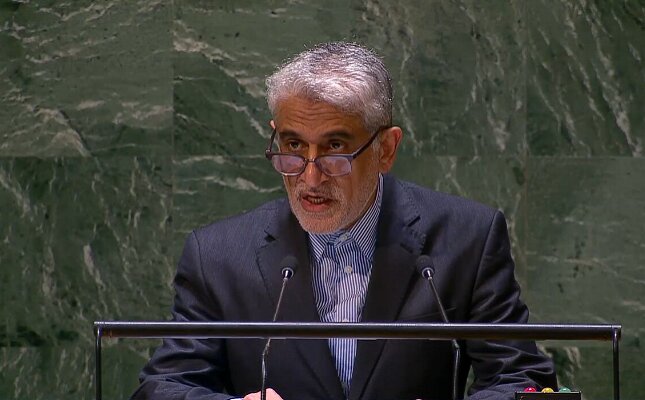
The Iranian ambassador and permanent representative of the United Nations Amir Seid Irabani filed a complaint in a letter to the UN Security Council (UNSC) against the International Atomic Energy Agency’s Director of Approach to the Islamic Republic’s Peaceful Nuclear Activities, Rafael Grossi.
Irabani submitted a letter to New York’s UNSC and UN Secretary-General Antonio Guterres on Friday.
The full letter is as follows:
Based on instructions from my government, I am writing to share your excellence and excellence regarding serious failures and omissions of the International Atomic Energy Agency (IAEA) in order to fulfill his duties and responsibilities under the IAEA Act. In this regard, I would like to draw your attention and the attention of members of the Security Council to:
An official statement made by Director Rafael Mariano Grossi in the period just before the recent attacks by the Israeli regime on the Islamic Republic constitutes a clear and serious violation of the standards of fairness required by his office. Such a statement is not explicitly compatible with the legal obligations and obligations imposed on him under the laws of the International Atomic Energy Agency (IAEA).
Given the repeated, well-documented and clear warnings issued by the Republic of Iran regarding the express threats of the Israeli regime to nuclear and facilities, the Republic of Iran remains within the full scope of the IAEA safeguard and has a peaceful obligation to compensate, for the sake of supervisors, to suppress peaceful conflicts. The obligations and objectives of the agent. Neither the Director nor the agency exempts this obligation. Failure to take effective or deterrent measures in response to these threats represents a negligence of obligations under IAEA law and establishes international legal norms.
The specific legal consequences are the responses of the Director at a press conference held after the opening of the Governor’s Committee on June 9, 2025. When faced with an explicit threat issued by the Israeli regime to Iran’s protected nuclear facilities, the Secretary-General should introduce Israel’s so-called concerns. IAEA General Conference Resolutions GC(34)/RES/533 and GC(44)/RES/444. This omission represents a deliberate failure that endorses and fails to apply binding legal principles within the authority of the Secretary General.
The Director’s actions in the aftermath of the attacks carried out by the Israeli regime further demonstrate the persistent failure to meet the standards of neutrality, objectivity and professionalism that his office needs. His statement to the Governor’s Committee on June 16, 2025 failed to identify Israel as the party responsible for the aggression, omitting a condemnation of illegal targeting of protected nuclear facilities despite Israel’s own declaration of public and atypical intent. This failure to indict or issue accusations of this liability constitutes a violation of the agency’s obligation to maintain the integrity of the protection system and undermine the fundamental principles of the global non-proliferation system.
The continued silence and omissions of the Director in the face of these violations are linked to unprecedented acts of aggression in the history of the agency, by de facto complicity, down to the obligations arising under the statutory liability of the IAEA and related UN Security Council resolutions.
This is not an isolated incident. The Secretary-General previously failed to respond to illegal and escalating actions by the Israeli regime. Following the regime’s unprecedented threat to use nuclear weapons against the civilian population of Palestine and Gaza, the ambassadors of the Vienna Islamic Cooperation Organization (OIC) will work in joint communication with the Director of the Islamic Cooperation Organization (INFCIRC/1165) dated December 15, 2023, urge him to take on a position he has clearly appointed. Despite the clarity and class nature of this appeal, the Director failed to issue official statements or file a formal lawsuit to acknowledge or condemn this serious threat, thereby restraining his liability under the statute.
In contrast, the director has consistently adopted Iran’s political, selective and discriminatory stances towards the Islamic Republic. When Iran legally exercised its sovereignty under Article 9 of the Comprehensive Protection Agreement (CSA), which retracted the designation of a particular inspector, the Director-General responded with immediate and public condemnation. In a report to the Governor’s Committee in November 2023 (GOV/2023/58), he adopted overly serious and accused words, selecting Iran’s Islamic Republic in a way that contradicts, contradicts and contradicts it based on objectivity, restraint and expectations of his office.
The Director’s actions constitute a clear and continuing violation of the legal obligations of neutrality, professionalism and fairness imposed by the IAEA Act. This action effectively undermines the credibility, objectivity, and institutional legitimacy of the institution. The Islamic Republic of Iran argues that these actions are not legally reconciled with the binding obligations of the commander under Article 3 of the Act, and constitutes the independence, integrity and the inability to eliminate the functioning of his office in accordance with most necessary standards.
MNA/IRN