
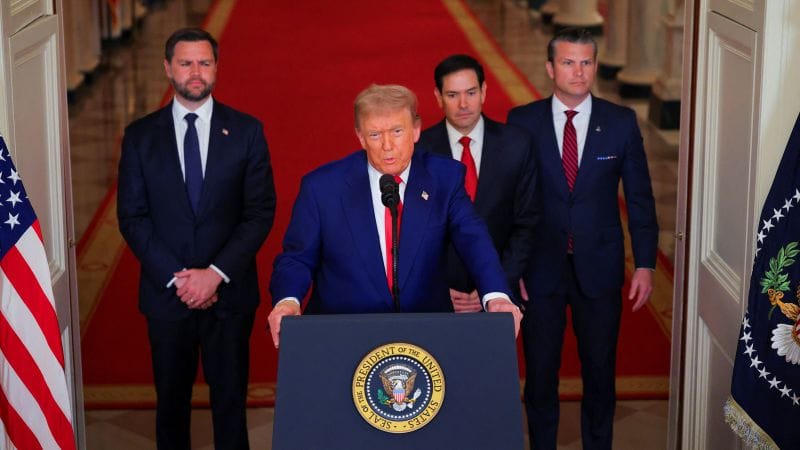
The United States has hit three important nuclear sites in Iran, President Donald Trump said on Saturday evening. The sites are Fordow, Isfahan and Natanz, and are at the heart of Iran’s nuclear ambitions.
Here’s what we know about the three facilities:
Natanz: The nuclear complex, approximately 250km (150 miles) south of the capital Tehran, is considered Iran’s largest uranium enrichment facility.
Analysts say it will be used to develop and assemble uranium enriched centrifuges, a key technology that converts uranium into nuclear fuel.
Natanz has six buildings above ground and three underground structures, two of which can hold 50,000 centrifuges, according to the non-profit Nuclear Threat Initiative (NTI).
According to the International Atomic Energy Agency (IAEA), Iran enriched up to 60% purity in its ground pilot fuel enrichment plant. Weapon grade uranium is concentrated to 90%.
Fordow: Much remains to be seen about the full size and nature of this facility. The facility is located near the city of the sacred city and is deeply buried in a group of mountains. A significant portion of what we know comes from a flock of Iranian documents stolen by Israeli intelligence agency several years ago.
The main hall is estimated to be 80-90 meters (approximately 262-295 feet) below the ground. Israeli officials and the Independence Report said earlier, the United States is the only country that has the bombs needed for its deep attack.
A recent IAEA report suggests that Iran has increased its production of enriched uranium to 60% levels in Fordow. According to experts and the IAEA, the facility includes 2,700 centrifuges.
Isfahan: Located in central Iran, Isfahan is home to the largest nuclear research facility in the country.
According to NTI, the facility was built with support from China and opened in 1984. According to the NTI, 3,000 scientists are employed in Isfahan, and the site says it is “suspected as a centre” of Iran’s nuclear program.
NTI says it “operates conversion facilities and fuel production plants,” as well as “three research reactors supplied by China” and “conversion facilities, fuel production plants, zirconium cladding plants and other facilities and laboratories.”