
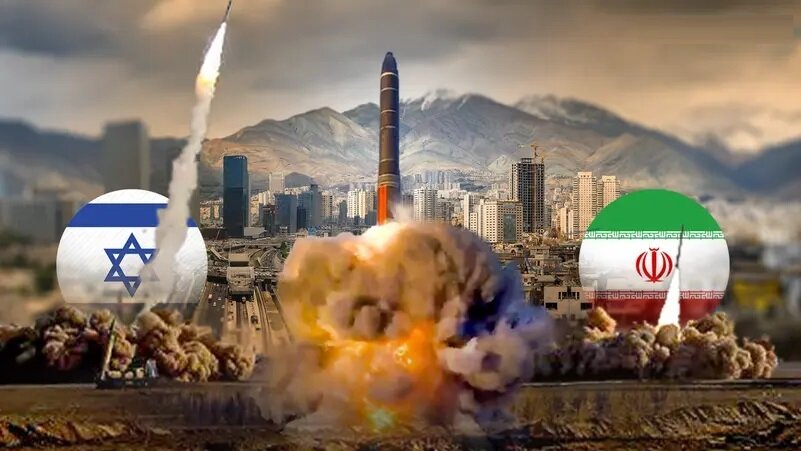
The 12-day war that broke out after the Israeli regime’s brutal attack on Iranian territory was more than just a short-lived full-scale military conflict. Rather, it marked a unique moment that changed the rules of local conflict and changed local deterrence and alliances.
Iran took part in the war in defending its sovereignty and its legitimate right to own nuclear and missile capabilities, and ultimately won. In contrast, the Zionist enemies were defeated in multiple ways. Its reputation was damaged, its weaknesses were exposed, and public opinion was shocked in the country.
The war began with the Zionist decision and ended with the demands of America.
After a long-term threat and growing tensions with Iran, the Zionist regime launched military and offensive operations against certain Iranian sites, scientists and commanders, believing that this shocking attack would force Iranian officials to retreat or remain silent.
However, Iran’s response was not what Tel Aviv had expected. Tehran launched a broad and accurate missile attack on the occupied territory, disrupting the Zionist regime’s air defense system.
Within just 72 hours, the Zionist regime realized strategic mistakes and found itself under the ongoing wave of Iranian missile attacks that disrupt military infrastructure. As a result, Washington-led Tel Aviv launched a series of communications and mediation, quickly establishing a ceasefire and mitigateing the growth of the crisis on the ground.
Iran’s missile strike and the defeat of the Zionist regime
Despite the violent attacks of the Zionist regime in the first few days, Israel has failed to do much damage to Iran’s nuclear facilities or missile capabilities.
On the contrary, the Iranian military has managed to accurately target the military and intelligence news research centres of the Zionist regimes of Negev and Ashdod, along with power plants and air defense radar systems. These missiles entered multiple layers of air defense and entered Tel Aviv airspace. That in itself is an unprecedented event.
The collapse of Zionist oppression: When the iron dome fails
The biggest shock that the Zionist regime faced during this war was the collapse of myths about air defense systems that had been heavily glorified over the past few years.
The war revealed that iron domes and David’s sling systems could not intercept Iranian missiles, particularly those produced in recent years. These missiles collided with key targets of the Zionist regime.
Iran’s internal unity and Israel’s division
One of the major miscalculations of the Zionist regime was the hope of an internal rift in Iran, sought to provoke it through cyber warfare and airstrikes against military and scientific commanders. However, the results were the exact opposite.
Many of the Zionist regime’s spy networks were active within Iran, but Iranian security services were able to dismantle them during the war. The city of Iran has witnessed unprecedented demonstrations in favour of the Islamic Republic’s sovereignty. In fact, this war once again nurtured internal unity in Iran and raised public awareness.
However, in Zionist society, war deepened the rift between military systems and political institutions. Many reports have emerged about tensions between the Army Commander and Prime Minister Benjamin Netanyahu. Furthermore, public pressure on Israeli regime leaders has increased significantly, with extensive demands to investigate the causes of the failure of missile defenses, isolation of Israeli regions, and the collapse of the internal front in the face of war shocks.
Conclusion
Iran’s victory in this war was not due to its high-tech capabilities. Rather, the victory stemmed from a steady resolve to pursue a confident entry into conflict, an improved national solidarity, and a complete independence.
In contrast, the Zionist regime ended the war in a state of instability, in the face of political defeat, internal discord and the collapse of public trust. The Zionists were defeated in a battle they hoped to win decisively, but instead received an unprecedented strategic blow.
MNA/