
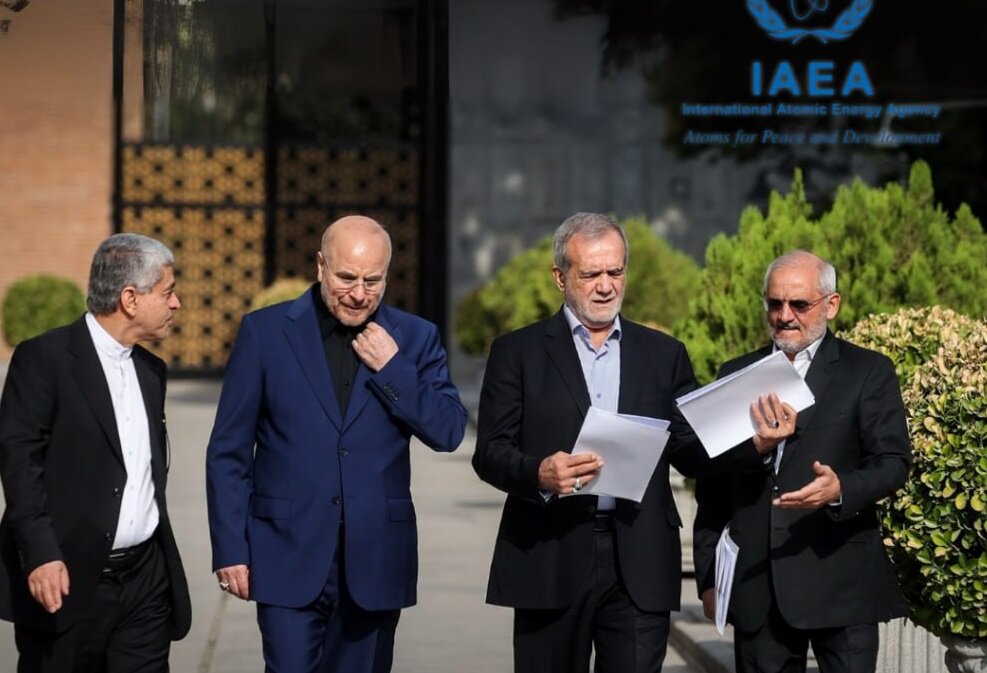
Earlier on June 25, Iran’s parliament (Majlis) approved a bill that suspends cooperation with the International Atomic Energy Agency (IAEA) in response to a politically motivated resolution against the Islamic Republic.
The general and specific provisions of the bill suspending cooperation with the IAEA have been approved by lawmakers, said Alireza Salimi, a member of the Assembly’s Speaker Committee, on Wednesday.
According to a parliamentary resolution, IAEA inspectors will not be permitted to enter Iran unless the security of the country’s nuclear facilities and peaceful nuclear activities, subject to Iran’s highest national security council approval, is guaranteed.
The vote came days after Karibah said he was considering a bill to suspend Tehran’s cooperation with UN agencies.
“Majlis (Iranian parliament) is drafting a plan to suspend cooperation with the institution until concrete assurances regarding the professional attitudes of this international organisation are received,” Karibah said at a public meeting of the parliament on Monday.
Iran is also considering banning IAEA chief Rafael Grossi, who fired fire for promoting Israeli-American attacks on Iran.
Kowsari, a senior lawmaker, said last week he urged the highest national security council to impose a ban on Grossi.
Based on Grossi’s politically motivated report, the IAEA Commission has passed anti-Iranian days before Israeli invasion of the Islamic Republic.
This was the first claim to non-compliance with Iran in nearly 20 years, falsely accusing him of violating safeguards, voting in favor with 19 votes, 11 votes and three countries opposed (Russia, China and Burkina Faso).
The controversial resolution, promoted by the European troika (UK, France, Germany) and supported by the United States, prompted strong condemnation from the Islamic Republic, leading to the announcement of new nuclear facilities and the upgrade of centrifuges to advanced levels to upgrades at the Fordau charging factory.
Analysts said Grossi’s political and biased report and subsequent resolutions promoted a brutal attack by the Israeli regime on June 13, leading to the assassination of several nuclear scientists and a high-ranking military commander.
After Israel’s invasion of the Natanz nuclear power plant in central Iran, the chief of the United Nations nuclear agency has stopped explicitly condemning terrorist laws that had bravely violated international law.
He also refused to condemn the US invasion of three important Iranian nuclear presence, Ford, Natanz and Isfahan, using B-2 stealth bombers armed with large-scale weapon intruders and cruise missiles.
MNA/