
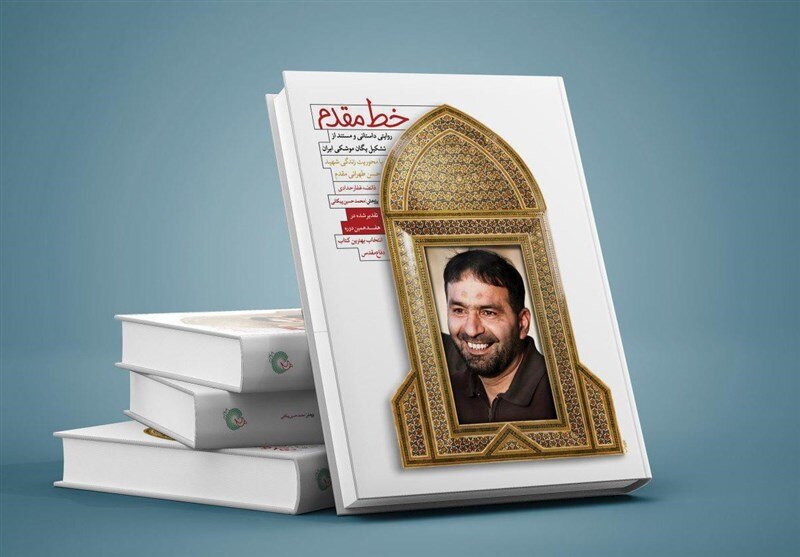
Titled Khatt-e Moqaddam (“The Frontline”), the book provides a powerful account of the early days of Iran’s missile development programme.
A compelling historical story rooted in actual details and personal heritage was released by Shahid Kazemi Publications.
Written by Fa’ezeh Ghafarhadadi, the work combines story-based narration with meticulous historical accuracy, avoiding fantasy and decoration.
It spans the formative years from July 1984 to December 1986, highlighting Mogadam’s role in establishing Iran’s ground missile command within the Islamic Revolutionary Guard (IRGC).
Following the order issued by the late Imam Khomeini (RA), founder of the Islamic Republic, Tehranani Mogadam, who formed the three services branches of the IRGC, was appointed commander of the IRGC’s aerospace forces in 1985.
His lasting commitment to research and scientific advancement laid the foundation for Iran’s indigenous missile capabilities.
His efforts have led to the development of strategic missile systems, including Shahab-1, Shahab-2 and long-range Shahab-3, as well as innovations such as Persian Gulf missiles and sophisticated guidance systems.
Beyond technical milestones, Khatt-e Moqaddam serves as a homage to Mogadam’s character, based on nuance and admiration.
The book explores how battlefield restrictions on cannon firepower have inspired the creation of a forward operational base known as “Khatt-E Moqaddam.”
From the appointment of command to groundbreaking innovation, the story chronicles the foresightful figures in which strategic thinking shaped the doctrine of Iran’s defense.

Available in Persian, the book is ready to become an essential reading for scholars and military historians as well.
Born in Tehran on October 29, 1959, Hassan Tehranni Moghadam joined the anti-shah protester at the age of 19, just before the Islamic Revolution in 1979.
Showing an early interest in weapons, he secretly produced hand-rena bullets for revolutionaries and used them on February 11, 1979 to seize military vehicles.
After the Islamic Revolution, Tehranani Mogadam joined the Islamic Revolutionary Guard Corps (IRGC) and was tasked with protecting the revolution, and held many positions.
He became a key figure in developing IRGC missile and artillery capabilities during the Iran-Iraq wars of the 1980s. This was a role he maintained ever since the end of the war, and was devoted to moving forward with Iran’s missile programme until his death.
On November 12, 2011, General Tehranni Mogadam was killed in a massive explosion in a missile garrison near Tehran, killing several other IRGC officers. At the time, he was preparing for missile tests.
He had been appointed in mid-December 2006 as missile advisor to the IRGC commander and head of the IRGC’s independent organization.
Tehrani Mogadam is recognized as establishing Iran’s missile capabilities and has acquired the father of Iran’s missile program.
He also founded a Hezbollah missile unit when he visited Lebanon in the 1980s.
Tehrani Mogadam established Iran’s missile program during the Iran-Iraq War, and analysts believe in Iran’s defense strategy based on his work on missile capabilities and deterrence to effectively deny military options against Iran’s enemies.
Reported by Tohid Mahmoudpour