
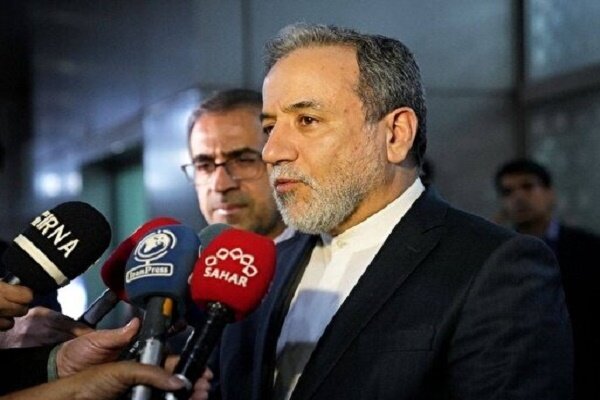
In a detailed interview with Le Monde released Thursday, Araghchi stressed that the US must first change its actions and ensure that no further military strikes against Iran during negotiations.
He said that Iran has always approached negotiations with a commitment to dignity, logic and mutual respect, and that “diplomatic contact and exchange are always ongoing.
“Diplomacy is a two-way street. It was the United States that destroyed negotiations and relied on military action. Therefore, it is important for the United States to accept responsibility for the mistakes and demonstrate a clear change in action. The United States must ensure that it refrains from military attacks during future discussions.”
He emphasized that the US attacks have caused damage to Iran’s nuclear facilities and that the state reserves the right to seek compensation once the extent of the damage is assessed.
“It is our right to request compensation for the consequences of these actions. The assertion that programs will be destroyed and that the state will abandon a peaceful nuclear program aimed at meeting energy, health, medicine, agriculture and developmental needs is a significant miscalculation,” he explained.
Araguchi further argued that programs under constant supervision of the International Atomic Energy Agency (IAEA) and programs implemented in accordance with international law cover more than mere physical structures.
“The indomitable will of the country that has achieved the pinnacle of scientific knowledge is not easily compromised. The IAEA report consistently confirms that Iran’s peaceful nuclear program has not detected a transition to arms activity,” he said.
He said the real damages lie in the impact on the non-proliferation regime, “coupled with the attack on nuclear facilities monitored by the IAEA and the failure of Western countries to condemn it, representing an attack on international law, particularly the foundations of the non-proliferation regime.”
Araguchi stressed that for new consultations, the US must accept responsibility for its actions against Iran. He warned that further sanctions and military threats would undermine diplomatic efforts.
He also addressed proposals from three European countries on the activation of sanctions mechanisms outlined in the 2015 nuclear trade, saying that such moves were equivalent to military attacks and would essentially deny Europe’s role in the debate over Iran’s peaceful nuclear program.
On June 13, Israel launched a blatant, unprovocative act of attack on Iran, assassinating many high-ranking military commanders and nuclear scientists.
On June 22, the United States formally joined the Israeli war of attacks on Iran by launching an attack on the country’s three nuclear facilities in violation of the UN Charter and the NPT.
On June 24, the isolated and abandoned Israeli administration declared a unilateral halt on the attacks announced on behalf of US President Donald Trump.
rhm/