
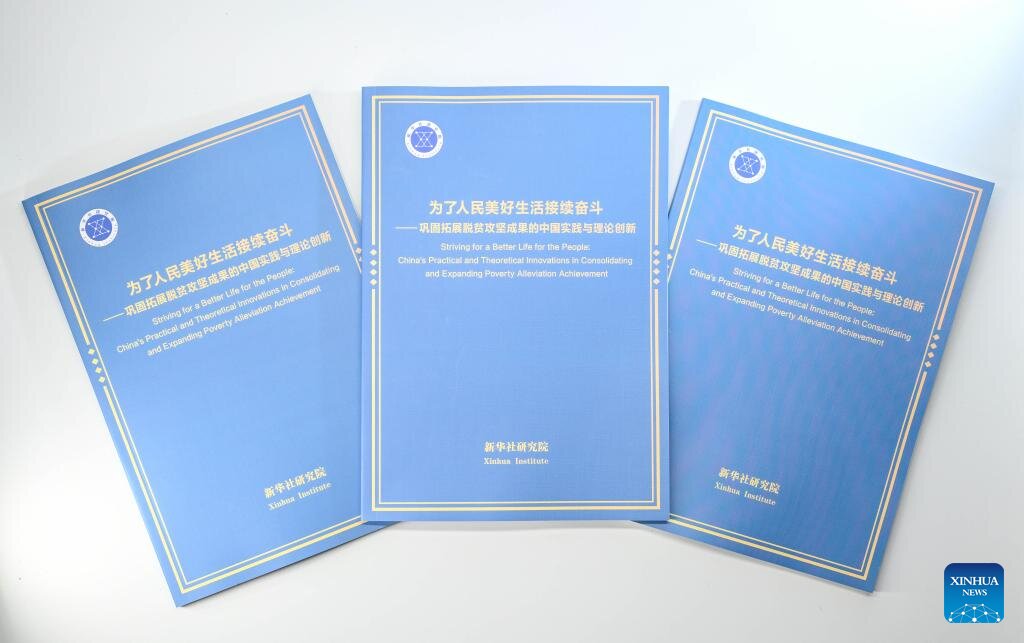
The report, entitled “Practical and Theoretical Innovations in Integrating and Extending the Achievement of Poverty Relief,” was officially launched simultaneously at the Chinese and English Pastors’ Conference at the World Civilizations Dialogue Ministers’ Conference in Beijing, held from Thursday to Friday.
This five-section research report introduces China’s new mission after the eradication of absolute poverty and theoretical and practical innovations in poverty reduction and international cooperation in this field.
The report said in February 2021 China has made continuous efforts to consolidate and expand the country’s five-year past poverty alleviation achievements, and declared a complete victory by eradicating absolute poverty.
2025 is the final year of the transition. Throughout this period, China has firmly supported the final outcome of massive recurrences in poverty.
This is reflected in employment and income. For example, at the end of 2024, the report stated that at the end of 2024, 33.05 million people from poor households were previously engaged in employment.
The per capita disposable income of rural residents in the county that shook poverty last year reached 17,522 yuan (approximately 2,450 USD), an increase of 24.7% in 2021.
“Thanks to the good policies of the country, my life today is impossible without a poverty alleviation campaign,” said Huang Zhongshi, a resident of the island village of Zhongjiang County, Sichuan Province, southwestern China, where he was freed from poverty. “During the five-year transition, our village environment has continued to improve as more industries are developing. We are confident in achieving a common prosperity.”
The report highlighted key practices that integrated and expanded the benefits of poverty alleviation in China, and summarised them in five important aspects.
They include establishing mechanisms to prevent recurrence of poverty through dynamic surveillance and target support. Upgrade your infrastructure to bridge gaps for improved connectivity and integrated urban and rural development. Ensuring stable employment and increased incomes for the rural population through industrial development. Development of a specialized industry with integrated cluster development that benefits farmers. Ensures a robust safety net with targeted assistance programs for those in need.
The report said these practices ensured continuity of poverty reduction policies, stability of support and sustainability of development.
Mamou Daffe, Minister of Handicrafts, Culture, Hotel Industry and Tourism in Mali, said the report is extremely valuable, especially in showing how industrial development leads to people’s prosperity. “Mali is rich in tourism resources, and China’s poverty reduction experience offers important reference value.”
The report stated that the theoretical framework supporting China’s poverty reduction governance is continuously enriched, and its methodological pathways have been steadily refined over the years of practical exploration and empirical verification, and steadily refined through empirical verification, including the implementation of targeted poverty alleviation strategies and effective integration of the expansion of malnutritional inconsistency achievement.
“These valuable experiences are worth learning in the global tropical country,” said Hector Viraglan Sepa of China, a former Ecuadorian trade counselor, expressing his hope that China will share more experiences of poverty governance and demonstrate how to achieve rural revitalization through modern development approaches and effectively reduce poverty.
The report states that China’s success in poverty reduction can be largely attributable to the comprehensive adoption of international best practices and localization and innovative applications of global poverty alleviation experiences.
By the end of 2024, China had provided development support to over 160 countries and jointly carried out the Belt and Road Initiative in over 150 countries. For over three years, the Global Development Initiative has implemented over 1,100 projects, bringing concrete benefits to people in many countries.
The report, led by the vision of a global community that shares China’s international poverty reduction cooperation, emphasized viewing other developing countries as equal “co-creators” rather than “passive followers” in the modernization trend.
“Poverty reduction is not a problem of reducing numbers, but a new form of promotion of civilization,” the report states, adding that China, as a developing country that has raised the largest number of people from absolute poverty, is contributing to the experience of sparking dialogue between civilizations about the nature of human progress.
“China not only solved its own poverty problem, but also made a significant contribution to global poverty reduction and set an exemplary model,” said Pan Herin, a member of the Ministry of Industry, Information and Technology’s Specialist Committee. He said that by studying China’s experience in poverty alleviation among the poor and preventing a return to poverty, poor nations can achieve poverty eradication.
MNA/