
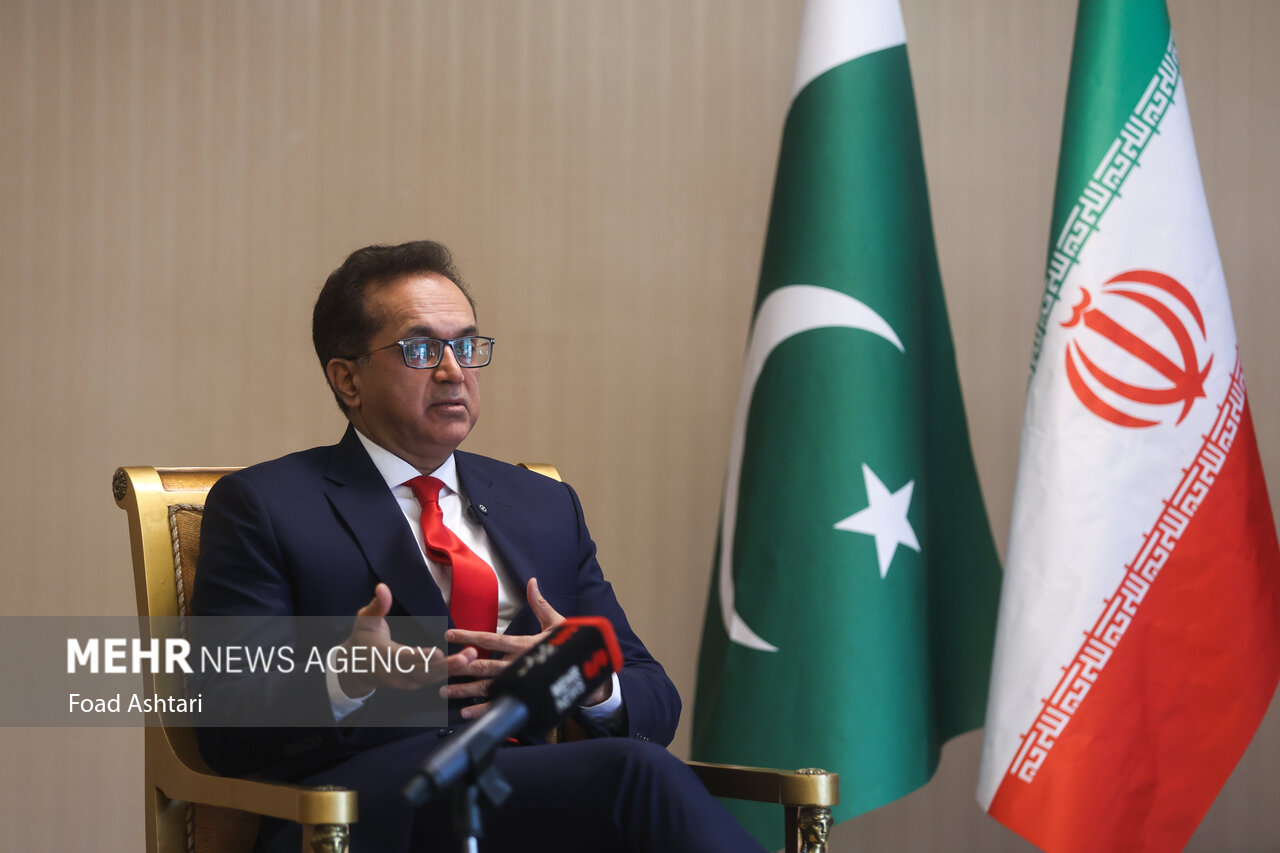
Iran and Pakistan share a rich history of cultural, economic and strategic connections fixed by their common borders and strong people-connections. Their partnership plays a key role in fostering regional stability, economic development and cooperation in multiple sectors, including trade, energy and security.
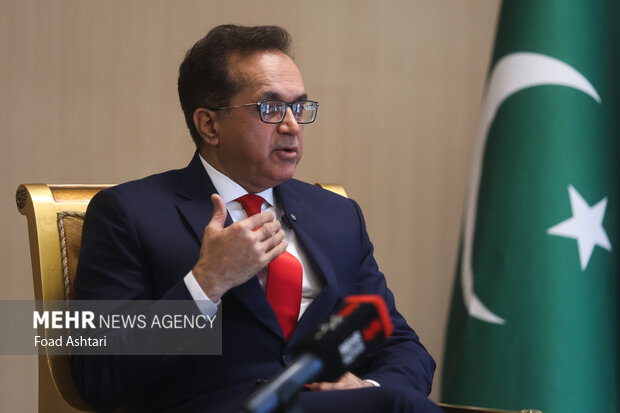
In this exclusive interview with Mehr News Agency correspondent, Pakistan’s Iranian ambassador, Mohammed Mudasir Thu, provided an insightful perspective on the current state of bilateral relations, highlighting both the challenges faced and future opportunities. The discussion also explores collaborations to strengthen regional peace and prosperity.
What is the most important axis of Iran-Pakistan’s bilateral relations?
As you know, Iran and Pakistan have deep ideological, historical, cultural and geographical connections. We are great nations, great people. Iran’s history and civilization dates back two to five hundred years ago, and Pakistan was created on August 14, 1947.
Pakistan has emerged as a robust country with very strong influence both in regional and global systems.
There is a very strong relationship between the two countries at all levels. Political, diplomacy, trade, military and security levels.
I think this relationship has become much stronger and deeper over the past two years. People in Iran and Pakistani travel extensively throughout the year for religious purposes and to promote economic connections between people.
What are the existing challenges in bilateral economic relations?
Every bilateral relationship has both opportunities and challenges, but most importantly, Pakistan’s honorary prime minister, Shebaz Sharif, and Iran’s honorary president, Masoud Pezeshkian, remain engaged primarily to each other. In addition, foreign ministers of both countries
Senator Mohammad Ishak Dal and Abbas Aragchi have been touched on a regular basis, with deep political and diplomatic negotiations constantly underway between the two countries.
There are also many trade mechanisms and the Joint Economic Committee is an important forum to be held next month.
So I think the ability to address challenges and commitments is very strong between the two countries.
From my perspective, what I have over two years needs to make the most of the potential of the relationship.
Iran and Pakistan must focus on economic development, create trade-free zones, and connect the trading community.
How did sanctions affect Iran-Pakistan’s trade relations, particularly in the energy sector?
I always see opportunities, opportunities are very strong and trade relations are increasing. There is a great interaction between the business communities of both countries.
There is a mechanism known as the Joint Border Trade Commission. There is an interaction between border authorities, and they are trying to promote infrastructure at the border.
Let’s focus on the opportunities we have. The challenges are always there, but how we move forward is very important.
Can joint projects such as the Iran-Pakistan gas pipeline and the China-Pakistan economic corridor lead trilateral cooperation between Iran, Pakistan and China?
Look at the geography. China has 1.49 billion people, Iran has 92 million people, and Pakistan has 255.21mion people. With local ties, it offers a great opportunity to reach out to Central Asia, Europe and Africa. Iran and Pakistan enjoy unique geographical positions. China and Pakistan have a strategic partnership, with Iran and Pakistan enjoying historic ties.
In the future, I think we need to consider how this geographical and demographic potential can bring these three countries closer to the region, not just the three countries. If there is trade facilitation, the entire region will benefit.
We have Central Asia, and of course we have a very large development capacity in this region. Pakistan’s development capabilities and investment in Iran are enormous.
And China has experienced an incredible experience of economic development that has never been seen in human history in the past few millennia.
So, a collective approach allows us to connect countries, which is extremely beneficial.

How do Iran and Pakistan contribute to regional stability, particularly with regard to Afghanistan? What measures have been taken?
I think there is a good interaction between Iran and Pakistan’s security agencies in terms of how to deal with drug trafficking, drugs, illegal migration, and cross-border border crime.
We have lived in challenging regions over the past decades and although this region has seen significant issues, we know that both Iran and Pakistan leadership have a very clear approach to strengthening interaction.
What position does Iran hold in Pakistan’s security strategy?
You are next to our border and a 900-kilometer border. We enjoy deep cultural connections, but that’s very important. In international forums like the United Nations and OIC, we regularly collaborate and support each other. Similarly, many development initiatives can collaborate on local geography, which is important.
I think Iran has a unique position for Pakistan. I think Pakistan has a unique position for Iran, likewise. We support each other. We know that when India attacked Pakistan and when you joined the war, our leadership expanded full cooperation. Pakistan was one of the first countries to immediately seek Iran’s self-defense under international law and the moral constitution.
What about Pakistan’s attitude towards the Israeli regime’s recent 12-day war against Iran?
We strongly condemned it. You know there are many countries that didn’t blame it. Pakistan denounced it strongly. Then, of course, we told you that we fully recognized Iran’s right to self-defense under the UN Charter. We expanded all diplomatic support in all international forums, including the Arab League, the OIC, and the United Nations. Our foreign minister and the prime minister were closely involved with Mr. Araguchi. Our Prime Minister was closely involved with Mr. Pezeschkian. At the leadership level, there was a great deal of interaction, and at the diplomatic level, Pakistan supported Iran at all forums.

What do you think about the future relationship between Iran and Pakistan?
I am very hoping. I’ve seen it over the past two years and this relationship has become very strong. Our Prime Minister dedicated his time to visit Iran twice and held a very good meeting with Iranian leaders, including the president, the supreme leader. It was a very broad interaction. Mr. Aragut has traveled to Pakistan many times. Military leaders are in regular contact. Our Field Marshall and Chief of the Army, General Asim Munier, was here and he held a very good meeting in Iran to ensure we cooperate for regional stability for the peace of the region. Therefore, the interaction between Iran and Pakistan is a guarantee of regional security. It is for the entire region, not just for these two countries.
Interview by Marzieh Rahmani