
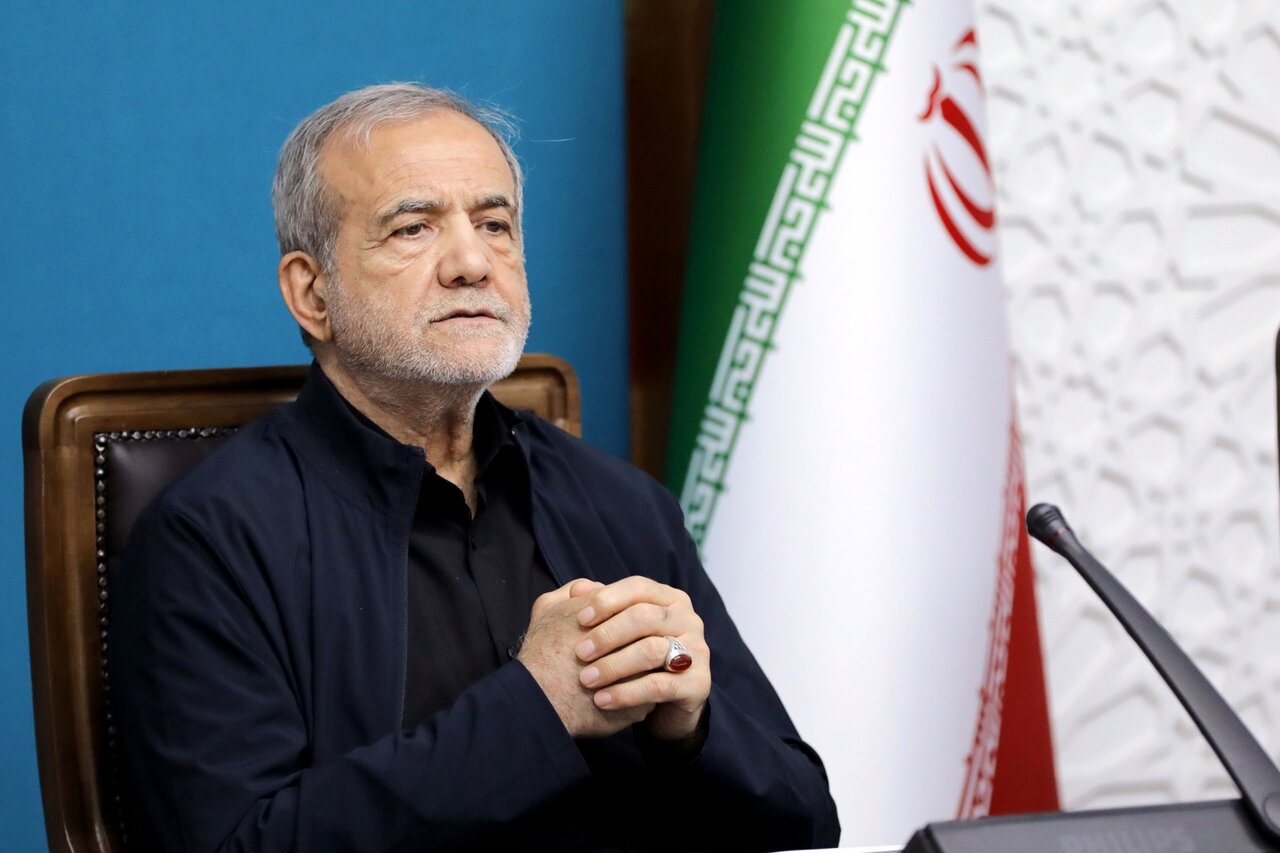
Following the signing of 12 memorandums of cooperation with Pakistani officials, President Masuud Pezeshkian said, “I am pleased to be in my second home, dear Pakistan.
He continued that amid the 12-day terrorist attacks by the Zionist regime and the United States, the positions of governments, parliaments, political parties and respected Pakistan’s respected scholars defending and supporting Iran’s Islamic Republic are extremely encouraged.
The president expressed his sincere gratitude for Pakistan’s support for Israeli attacks on Iran, highlighting the deep roots of friendship between Iran and Pakistan, and the strong religious, cultural and spiritual ties between the two countries.
He emphasized that promoting neighbouring relations is a central principle of Iran’s foreign policy, adding that Iran views Pakistan as a brother state as well as a neighbour.
Emphasizing the joint commitment to deepen relationships in all areas, Pezeschkian said he believes that in a short period of time, bilateral trade can be easily increased from the current $3 billion to $10 billion covered.
Referring to the 12 memorandums of cooperation signed between the two countries, he noted that important agreements have been reached in political, economic, trade and cultural fields that promote and strengthen relationships between trade, culture, tourism, transportation and academic exchanges.
High-ranking Iran and Pakistan officials have signed 12 cooperative documents before leaders of both countries, covering a variety of areas including science and technology, transportation and transportation, economy and trade, tourism and agriculture.
When President Masuud Pezeshkian made an official visit to Pakistan on Sunday, senior officials from both countries signed the agreement after holding a joint meeting aimed at promoting and paving the pathway for the development of cooperation between the two countries.
The areas covered by these agreements include tourism, agriculture, judicial and legal cooperation, industry, science and technology, transportation and transportation, cultural heritage, trade and economic cooperation.
The signed documents provide a framework to promote knowledge exchange, promote expansion of trade capabilities, strengthen interaction between people and people, and promote regional synergies between the two countries.
He highlighted Iran’s resolve to continue contacts and consultations to implement these agreements, adding that the development and equipment of border markets that expand the expansion of railways, roads and oceans, promoting trade, and establishing joint economic zones were key needs of bilateral relations, and constructive discussions were held in these areas.
Pezeschkian also pointed out that the talks focused on strengthening bilateral cooperation to secure borders and ensure peace for the residents of border towns, given the threat posed by terrorist groups in the border region.
The Zionist regime fought a war of aggression against Iran on June 13, attacking Iranian troops, nuclear power and residential areas for 12 days, but the US launched a military attack on three nuclear sites in Iran, Natanz, Fordau and Isfahan on June 22.
Iranian troops carried out a powerful counterattack shortly after the attack. The Islamic Revolutionary Guard Aerospace Force implemented 22 waves of retaliation missiles against the Zionist regime as part of Operation True Promise III, which caused significant losses to cities throughout the occupying territories.
In response to the US attack, Iranian forces fired waves of missiles at Aldead Air Force Base in Qatar, the largest US military base in West Asia.
The battle was suspended due to a ceasefire that came into effect on June 24th.
MNA/6549966