
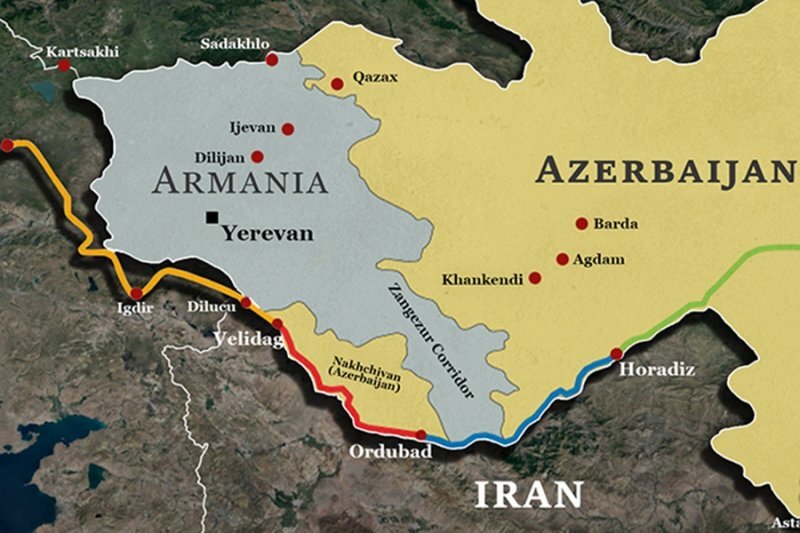
Recently, many Azerbaijani media have been trying to portray the signature of an agreement in Washington between Ilham Aliyev and Nikol Pashinyan. However, the initialized text of the 17 article agreement has some legal ambiguities that could hinder effective implementation and lead to future disputes. One of these ambiguities is that while this transaction recognizes Armenian sovereignty over the Zangezur corridor, it will lease this corridor to the United States.
The ambiguity and challenges are not only related to the contract document called the “Trump Route for International Peace and Prosperity” (Tripp), but there is also ambiguity in the points mentioned by Aliyev and Pashinyan to begin the peace process.
As always, Donald Trump’s media team boasts that the agreement is a achievement by Donald Trump and that they are seeking to nominate the US president for his next Nobel Peace Prize. This is despite the fact that many media and analytics websites in the US and Europe argue that effective implementation of contracts is a critical challenge.
For example, some geopolitical observers at Oxford Analytica warn that the challenge of changing Azerbaijan’s undefined customs mechanisms in border regions, as well as the ambiguous military presence, could hinder progress towards reconciliation. The analytics website also points out key factors in Iran’s attitudes and rates comments by the leader of Ali Akbar Velayati in the hallway as important. An analysis by Oxford Analytica states that Armenia ensured that Iran’s direct land connections remained intact. However, Iran is concerned about broader strategic outcomes. This is because, from a Tehran perspective, this corridor is a way to increase the influence of the US and Israel in the region.
Three issues in a short statement:
1-In the recent summit in Washington, the first and second major document was an agreement on the establishment of peace and interstate relations between Azerbaijan and Armenia. The agreement, signed by Foreign Ministers Jeyhun Bayramov and Arrat Mirzoyan, recognizes the need for further efforts towards final ratification.
According to the Oxford Analytica Report on the Agreement, the parties also agreed to dissolve OSCE Minsk Group, a longtime mediator of the Nagorno-Karabakh conflict. The dissolution is a central demand for Azerbaijan and represents a concession from Yerevan. Yerevan had insisted that he would only agree to such a step after the formal signing of the peace treaty.
The agreement includes refraining from using force against these principles, but certain interpretations of these terms in the context of Nagorno-Karabakh’s conflict remain undefined. This could lead to a dispute over the territorial situation and the scope of sovereign claims.
The agreement requires that all interstate claims be resolved, but does not expressly state the definition of what constitutes an “interstate claim.” This could lead to differences of opinion about what past complaints are covered by the agreement and what they are not.
The contract establishes a committee that oversees implementation, but the structure, authority and decision-making process of this committee are not detailed. This could lead to paralysis or conflict with the authorities of the committee.
2. Ambiguity regarding dispute resolution:
This agreement prioritizes direct consultations to resolve disputes, but there is no specific process for initiating or carrying out these consultations. Furthermore, the agreement does not clarify what constitutes a “acceptable outcome for both parties.”
The contract states that if consultations fail, it seeks other means of dispute resolution, but does not specify what those meanings are. This lack of details can lead to differences in opinion regarding the appropriate forum or process to resolve future conflicts.
The contract does not have any specific mechanisms for implementing important provisions, such as border boundaries, prisoner exchanges, and refugees return. This could lead to delays and conflicts during the implementation phase.
3. Ratification and Constitutional Issues:
The validity of the contract depends on domestic ratification by both countries. The ratification process on potential constitutional challenges, particularly in Armenia, remains a point of potential competition.
The provisions of the contract must be compatible with the respective constitutions of Armenia and Azerbaijan. Contradictions can lead to legal challenges and further complicate the implementation process.
In conclusion, the legal ambiguity of the agreement and the lack of detailed mechanisms for implementation could pose major challenges in the future. Analysts and reports available online on the Internet show that careful consideration and clarification of these ambiguities is important to ensure a lasting and stable peace between Armenia and Azerbaijan. Therefore, this can be said that the so-called Tripp serves the geopolitical ambitions of the United States and its president rather than the stability of the region of the Caucasus.
MNA/6561051