
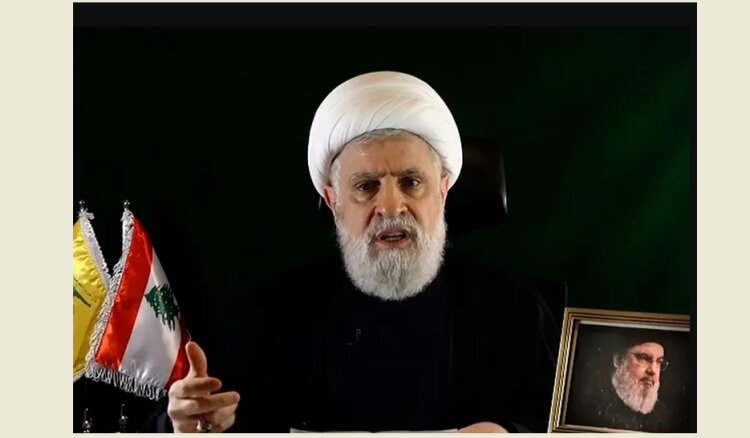
The recent speech released by Hezbollah’s Executive Director Sheikh Naim Qassem on Aaaain’s Day is considered a turning point in Lebanon’s political and security conflict.
This was one of Hezbollah’s most explicit and decisive positions in the face of internal and external pressures over disarming.
These statements were presented as final arguments against the Lebanese government and international supporters of the disarmament programme, as well as revealing the deep layers of the region’s political strategy, national identity and the equation of power.
Strategic Warning
“Resistance will not abandon its weapons while the attack continues. We are sure we will fight and win the Battle of Kalbala if necessary. We are united with the Lebanese Stand, or the event will explode beyond responsibility, and you are the only one who will be responsible.
When external pressures and rushing domestic decisions are combined to disrupt Lebanon’s defense equation, this stance shows that Hezbollah is ready to pay the heaviest possible price for its survival and continued role.
Naim Qassem clearly outlined the principles. The issue of weapons of resistance is not a simple political option, it is a matter of existence and survival. In other words, attempting to disarm without a defensive alternative plan is merely opening the gates of the country to enemies that have always wanted to undermine Lebanon. This is what goes beyond emotional slogans to bring his speech to the level of strategic warning.
Hezbollah Chief warns against instigation
In his speech, Naim Qassem noted that the government acted against his previous commitment, including the Minister’s statement and the text of the President’s Oath.
These documents clearly highlighted the need to develop national security and defense strategies, but instead of designing such strategies, the government suddenly shifted to disarming resistance.
The meaning of this action is merely a departure from the logic of national partnerships and coexistence agreements. In a system like Lebanon, based on a delicate balance of clans, removing the fundamental elements is not reform, but rather disrupting the equation of survival.
Hezbollah’s enemies tried to present this stance as a threat to civil war, but a closer look shows that Naim Qassem spoke of instigation rather than war. He warned that the outcome of the government’s decision could draw the country into an internal crisis, and the responsibility for this lies with the government itself, which succumbed to external pressure. This distinction between “the threat of war” and “the warning of agitation” is very important. Because it distinguishes between crisis agents and warning observers.
What role does the Lebanese army play in such an equation?
On the one hand, the Army is obliged to implement government decisions, while on the other hand, practical actions against resistance can put the system in a catastrophic crisis.
In other words, the crisis ball has been thrown into the Army courts, and there is a risk that the Army will be drawn into internal conflicts.
Beyond domestic actors, foreigners can clearly see the hands of others. Recent experiences show that Israel has never given up on military defeat and is constantly seeking indirect ways to strike resistance. Netanyahu’s welcome to the Lebanese government’s decision shows that Tel Aviv has now found its tool in the official structure of the Beirut government. In parallel, pressure from the US and some Arab countries has also been used, as well as designing a Lebanese political atmosphere to put resistance in a difficult position.
Hezbollah Message
In the face of this danger, Hezbollah is about to send two messages at the same time. First, resistance is ready to protect its weapon to its final breath, and there is no compromise on this. Second, despite this decision, there is a desire to prevent internal conflicts and there is still time to reconsider government decisions. The duality of resolve to maintain weapons and the desire to avoid incitement are the complex balance points that Hezbollah is trying to convey to the domestic community and external stakeholders.
Looking deeper into this situation, we can say that Naeem Qassem’s speech has kind of redefined the concept of “Govornment-Resistance.” He emphasized that resistance is not an alternative to the state, but rather a complement and partner. Therefore, elimination of resistance not only reduces the country’s defensive capabilities, but also essentially takes away the true state of sovereignty. In such a reading, the weapon of resistance is part of the Defense equation, and not a factor for it.
Of course, this logic is rejected by opponents of resistance. They view resistance as a parallel force on governments that prevents the integration of state exclusive rules. However, Lebanon’s earthly reality shows that without the presence of resistance there is no balance of deterrence against Israel. Past war experiences alone are sufficient to show why a large part of Lebanese society continues to emphasize the need for resistance to exist.
Outlook
Since the signing of the TAIF Agreement (1989), there has been international pressure that international pressure, particularly from the US and Israel, would disarm Hezbollah. The agreement that ended the Lebanese civil war called for a monopoly of arms at the hands of the government, but Hezbollah was exempt from this clause due to its role in resistance to Israel.
In recent weeks, efforts to disarm Hezbollah have left Lebanon’s future in the frontiers. The upcoming days are decisive. The Army will need to present plans to implement the government’s decision by the end of this month, with US representatives coming back to Beirut to raise the pressure.
Naim Qassem’s remarks present two main scenarios in Lebanon. It’s the Civil War or national dialogue. The Civil War scenario warned by Naim Qassem could be when disarmament plans are being forced into force. Due to the history of civil war (1975-1990) and the structure of vulnerable sects, Lebanon has a high capacity for instability. The presence of approximately 20-25% of Shiites in the Lebanese army as the forces responsible for implementing disarmament complicates this scenario. The possibility that a part of the Army will depend on or participate in Hezbollah could lead to the collapse of national institutions.
In this environment, Lebanon is between two paths. It’s either to go back to rationality and rethink decisions that could drag the country into deep by, or to fall into a vortex of instigation that is not easy. Naim Qassem’s story about the battle of “Karbara” is not a threat, but rather a rationale for the level of compliance with resistance to that principle. This ratiophor shows that Hezbollah considers retreating from the issue of weapons to be a political and national death, and therefore views externally imposed scenarios as existential battles. Meanwhile, government and opposition political movements must recognize that playing with such red lines is not a solution to Lebanon’s problems, but that the outcome is the beginning of a new crisis that encompasses all societies.
By Mohammad Reza Moradi