
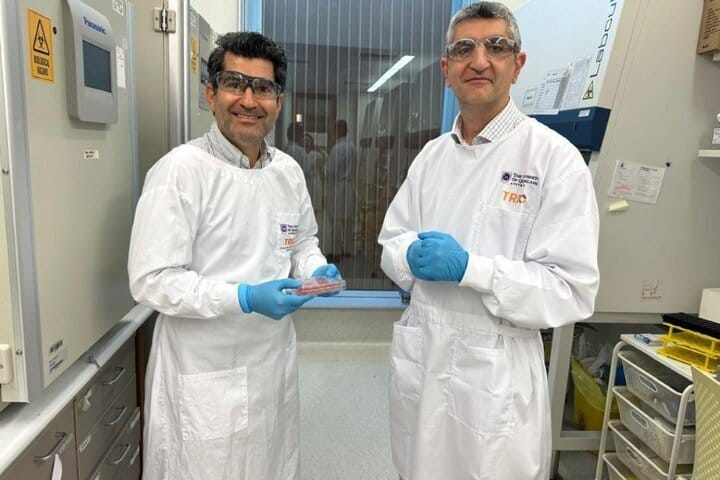
The team who achieved results at UQ’s Fraser Institute are researchers of Dr. Abbas Shafi and Iran’s Professor Chiarash Hoslotehalani, who used stem cells to create replicas of human skin, including blood vessels, capillaries, hair follicles, multiple layers of tissue, and immune cells.
The researchers used stem cells to grow skin with blood vessels, capillaries, hair follicles, nerves, tissue layers and immune cells.
It is the only skin model anywhere in the world with its own blood supply.
It leads to a significant improvement in the treatment of inflammatory skin diseases, burns, and other damage requiring skin grafting.
“This is the most life-like skin model developed anywhere in the world, allowing us to study diseases and test treatments more accurately,” Dr. Shaffy said.
“Until now, scientists have been limited to methods for studying skin diseases and developing new treatments.”
“However, in these skin models, intimately mimicking the real human skin, we can study diseases more closely, examine treatments, and develop new treatments more effectively,” he added.
Dr. Shafiee, who worked with Metro North Health, said recent advances in stem cell research could allow for the creation of 3D skin lab models.
Additionally, Professor Kiarash Khosrotehrani said that manipulated skin can help improve skin graft graft implantation and treatment of inflammatory skin diseases such as psoriasis, atopic dermatitis, scleroderma and other genetic disorders.
MNA