
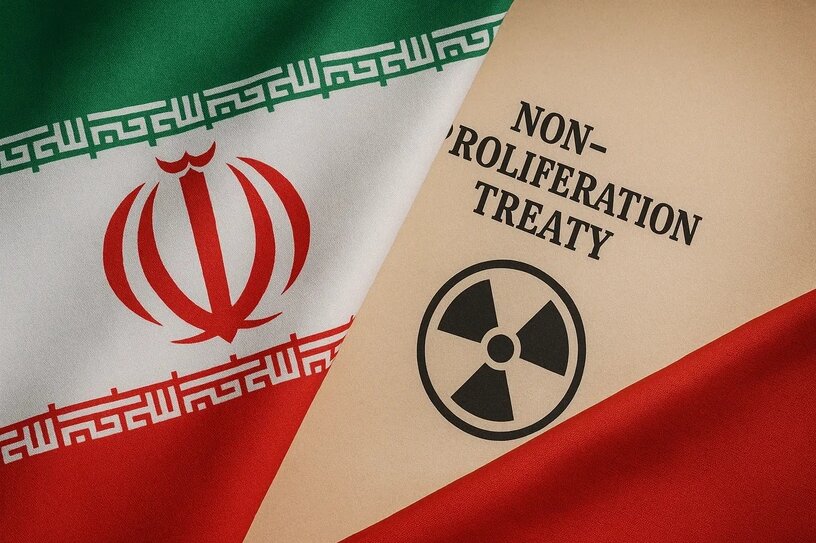
The military attack on Iran’s nuclear facilities in June this year again sounded alarms that pressure had crossed diplomatic boundaries. Not only did it target Iran’s nuclear security, but it also demonstrated that international organizations could not play a role in deterring it, and that peace and stability could not be maintained.
European countries are once again trying to bring Iranian incidents to the Security Council by triggering a mechanism known as “snapback.” After the US withdraws from the JCPOA, the move faces widespread legal criticism as none of the remaining parties have the legitimacy to activate this mechanism.
From an analyst’s perspective, European attempts to restore sanctions under a snapback mechanism are examples of political exploitation of international structures to put pressure on Iran. This is while Iran continues to work with the IAEA beyond its safeguard regime, the NPT and even its obligations.
Depending on these circumstances, proposals are being considered in the Iranian parliament, which considers withdrawal from the Nuclear Non-Proliferation Treaty (NPT) as a strategic option.
As the IAEA Committee meeting approached, discussions on the interaction of Iran’s non-proliferation regime (NPT) with the role of the IAEA within this framework refocused. While Iran consistently emphasized the peaceful nature of its nuclear programme and demonstrated a significant level of transparency and cooperation with the institutions, recent developments have raised fundamental questions about the effectiveness, fairness and even legitimacy of international institutions associated with this regime.
Iran’s Parliament Speaker Mohammad Bagh Gallibahu said in this respect it is clear that the three European countries that have not fulfilled their commitments under the JCPOA have no right to activate the mechanism of paragraph 37 of the 2015 nuclear trade. He added that deterrent measures need to be taken to impose costs on this illegal move by European parties in order to change the enemy’s decision to trigger a snapback mechanism by illegally starting the process of reviving the solution. He emphasized that a unified decision by the Islamic Republic of Iran on the issue will soon be announced and implemented.
NPT under the shadow of the inaction of a major power
The NPT is based on three pillars: nuclear non-proliferation, nuclear disarmament, and peaceful use rights of nuclear energy. However, reviews of the performance of treaties over the last few decades show that the balance in implementing these three principles is very impaired.
Nuclearly armed states have not only failed to fulfill their disarmament obligations, but they continue to expand their arsenals. Furthermore, one of the inevitable rights of members under Article IV of the Convention – cooperation in transferring peaceful nuclear knowledge and technology to countries that lack this expertise – is often restricted or ignored by Western countries for political reasons.
IAEA: Neutral observer or political actor?
From an international law perspective, the IAEA is obligated to implement monitoring and surveillance of a country’s nuclear programme based solely on technical and legal standards. However, multiple reports and double standards for specific countries have exposed agents to accusations of politicization and deviations from its professional framework. In Iran, even when Tehran voluntarily worked with the institution beyond its commitment, we have repeatedly witnessed the introduction of the issue to the Governor’s Committee and the adoption of a biased position against Tehran.
The silence of the agency in the face of obstruction and military attacks on Iran’s nuclear facilities was also questionable, reinforcing the perception that the regulatory body has sometimes been transformed into a tool of political pressure.
Right to withdraw: Legal options, not threats
According to Article X of the NPT, if its material interests are threatened, members may withdraw from the treaty by providing official notice. This is not only a national right, but also a perception of geopolitical complexity and the possibility of a crisis in international relations. From this perspective, a potential withdrawal by a state from a treaty is not necessarily considered a violation of international regulations, nor is it considered a legal act in response to the unfair performance of existing structures.
Naturally, if Iran invokes this legal right, such a decision is not a conflict with the international order, but a response to its inaction.
Beyond the Nuclear: A wider scope of Western demands
Importantly, the conflict between Iran and several Western governments is not limited to nuclear issues. In addition to the discussion of enrichment, Tehran has been asked to stop missile programs and cut ties with regional resistance groups, and in some cases, they may even be forced to modify its governing structure in the future.
In the observer’s view, this level of demand cannot be justified either within the framework of the NPT or within the logic of equal interaction between nations. Rather, it is a clear attempt to impose fundamental change on the power structure and policy making of independent countries.
The need to redefine interactions with NPTs
It is natural that some countries question their continued membership when one of the main pillars of the treaty, one of the commitments to disarming the military, is completely ignored, and another pillar, a peaceful right to use, is limited by political interpretation.
Iran has attempted a path of involvement, transparency and cooperation over the past few years, but the results have included increased pressure, increased sanctions and even military action by some actors.
In these circumstances, reassessing the level of agency engagement or careful consideration of legal options, such as withdrawing from the NPT, should not be considered a threat, but as part of the balance of action in response to inaction in the international system.
MNA/6581043