
“The document and its continuation are subject to no hostile actions taken against Iran’s Islamic Republic. If, for example, the so-called snapback mechanism is activated, the implementation of this document will also be stopped,” Araguchi told Iranian media on Tuesday.
“Snapback” refers to the automatic recovery of UN sanctions against Iran. This is a mechanism based on UN Security Council resolution 2231, which approved the 2015 nuclear agreement between Iran and six world powers.
On August 29, France, Germany and the UK (E3) triggered a countdown of automatic returns on UN sanctions, including a comprehensive arms embargo and Iran’s major banks and shipping restrictions.
Iran condemned the move, saying the three countries were affected by the US, which withdrawn from the JCPOA in 2018.
Araghchi said the new agreement with the IAEA took into account new conditions that emerged after the US attack on peaceful US nuclear sites.
“As one of the NPT members, we have always worked with the institutions under our previous contracts. Our programme was peaceful and under the supervision of the institution.”
“However, after the (US) attacks, conditions changed, and consultations with government agencies emphasized that cooperation cannot continue as before and that a new framework must be defined.”
The Iranian minister said that he was at the heart of the agreement “we are officially aware of the new conditions that have emerged,” and that cooperation between Iran and the IAEA must take place within a new framework.
He said the document acknowledges that Iran’s security concerns are “legal and must be considered.”
Noting that the laws of the Iranian parliament are “explicitly” permitted in writing, Aragut said that cooperation with the agency will take place within the framework of the law and will fully cooperate with Iran’s highest security council.
He said the new contract does not grant access to IAEA inspectors, and that the format of inspections and access that the IAEA should have will be determined in future consultations.
“Overall, I can say that the new step has taken in the right direction,” the Iranian minister said.
Araguchi said the new step would “eliminate the pretext entirely and disarm those who tried to exploit the situation for their own goals.”
He expressed his hope that the agreement “opens the way for a diplomatic solution.” Araghchi said that on this point the other side must also be “honest and serious.”
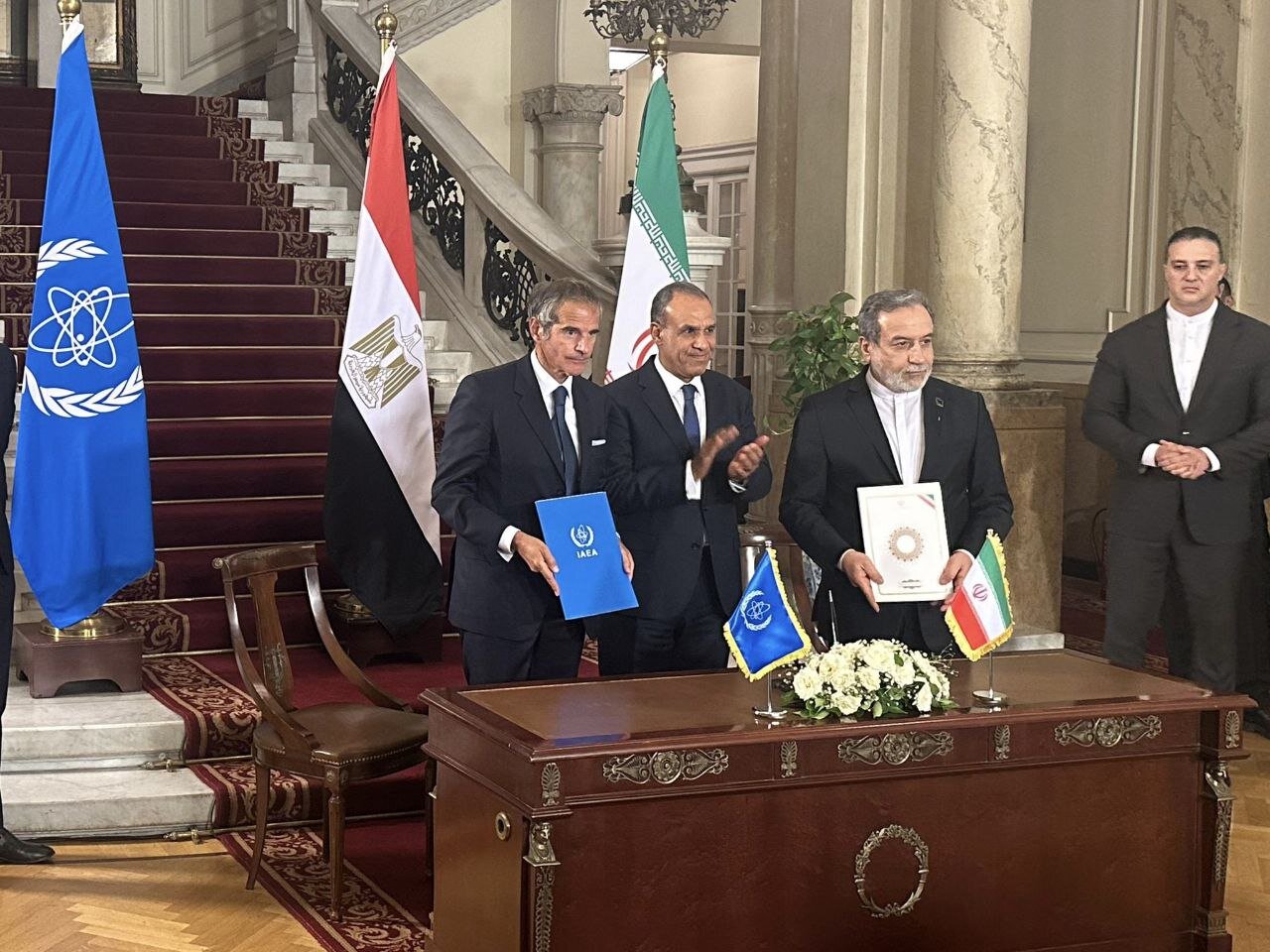
The agreement was signed on September 9th with the IAEA Director-General of Cairo Rafael Grossi.
The agreement comes after the Islamic Republic halted cooperation with the IAEA after the aftermath of an attack by the US on major Iranian nuclear facilities in June.
The suspension came into effect in line with a law passed by the Iranian parliament, which was passed in protest in an anti-Iranian resolution ratified by the IAEA under Western and Israeli pressures used by invaders to justify the attack.
MNA