
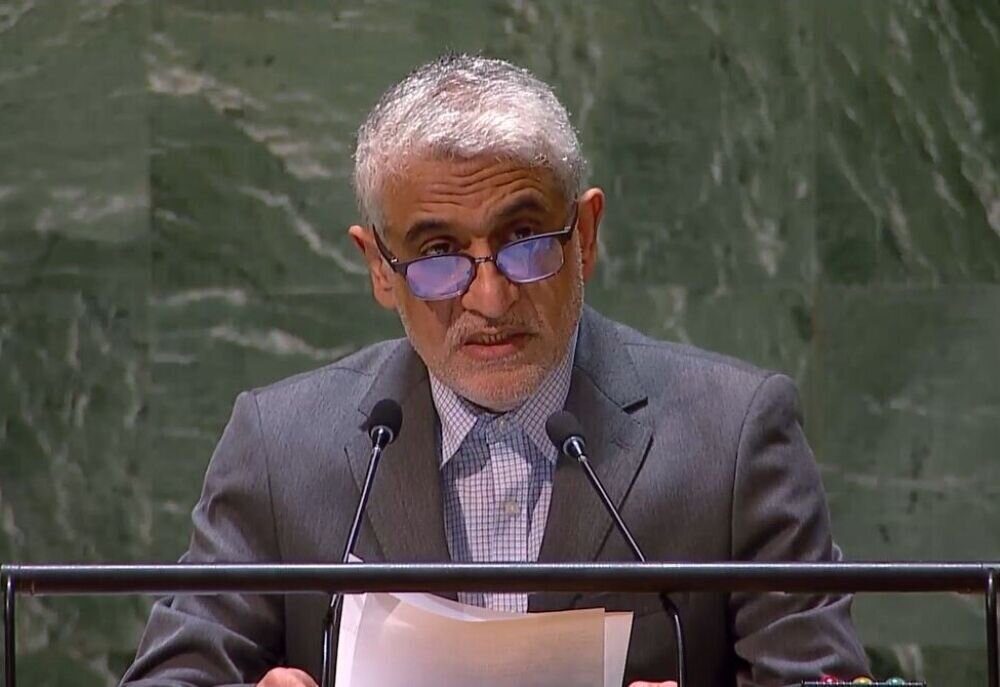
The UN’s Iranian ambassador said the future of Afghanistan must be determined by the Afghans themselves and belong to them, and the externally imposed solutions are sustainable and unacceptable. He added: “The current authorities are an objective reality of the Afghan scene, and the international community has no choice but to interact with them.”
Here is the full text of Irabani’s speech at the United Nations:
Statement by
He is Amir Said Irabani
Ambassador and permanent representative
Iran’s Islamic Republic to the United Nations
Before the UN Security Council briefing
Regarding the situation in Afghanistan
New York, September 17, 2025
Thank you, President, for convening this meeting.
SRSG Ms. Otunbayeva thanked me for giving me such a valuable briefing.
We listened carefully to the statement submitted by Hanifa Girowar.
president,
Iran’s Islamic Republic has expressed deep sympathy and solidarity between Afghan people and the authorities after the recent devastating earthquake. In this regard, Iran is ready to immediately expand its humanitarian aid to support the affected population and continue to support Afghanistan in overcoming the consequences of this tragedy.
Please note the Secretary General’s latest report (S/2025/554). It provides up-to-date information on the situation in Afghanistan, including the political and humanitarian activities of the United Nations.
In light of the report, I would like to emphasize the following points:
First, as Afghanistan’s immediate neighbour, he has reconciled over 900 kilometres of common borders and hosted millions of Afghan refugees for decades. To this end, Iran is actively involved with the de facto authorities of Afghanistan through bilateral and regional initiatives. He has also been constructively involved in the Doha process under the auspices of the United Nations and has played an active role in working groups.
Secondly, Afghanistan’s future is Afghanistan-led and must be owned by Afghanistan. Enduring solutions can only emerge through a comprehensive political process that reflects the ethnic and political diversity of the country, respects its sovereignty and guarantees the rights of all Afghans, especially women and girls. Solutions imposed from outside are neither viable nor sustainable.
Third, the de facto authority (DFA) is a real reality, and the international community has no choice but to engage with them. Constructive and practical engagement is essential to addressing the ongoing humanitarian and economic crises that continue to threaten regional stability. In this regard, we emphasize that humanitarian assistance should not be politicized. Sanctions should not be used as political leverage to interfere with economic stabilization or involvement with de facto authorities. Afghan assets frozen abroad should be released unconditionally to serve the people. Similarly, the travel ban exemption mechanism for designated Taliban individuals should not be politicized or exploited for narrow political interests by council members. Its full restoration is essential as it is an important tool to promote dialogue and advance a comprehensive and constructive approach to the Afghan situation.
Fourth, Iran has been carrying a disproportionate burden for decades, hosting millions of Afghan refugees and migrants, often with inadequate international support. This humanitarian responsibility places great costs on our society, places a serious burden on our resources and infrastructure, creating complex security and cross-border challenges. These pressures have been further strengthened in the wake of Israel’s attacks on Iran. Iran could not continue to take on this responsibility alone, and therefore had no choice but to return illegal Afghan residents to their homelands. It is important to note that Iran is actively involved with the de facto authorities throughout the return process to ensure that the conditions of safe and dignified interest are met.
president,
Iran strongly supports the emergence of Afghanistan as a peaceful nation, including terrorism, conflict, independence from drugs, unity. We will reaffirm our unwavering commitment to a stable and independent Afghanistan and will continue to work closely with our local and international partners towards this end. Afghanistan must help eradicate terrorism, dismantle all terrorist groups without exception, and adopt comprehensive measures to prevent the use of their neighbours, regions and subsequent territories.
And finally, President Unama plays an important role in addressing the challenges of Afghanistan, reaffirming his support for its mission and effective implementation.
thank you.
MNA/