
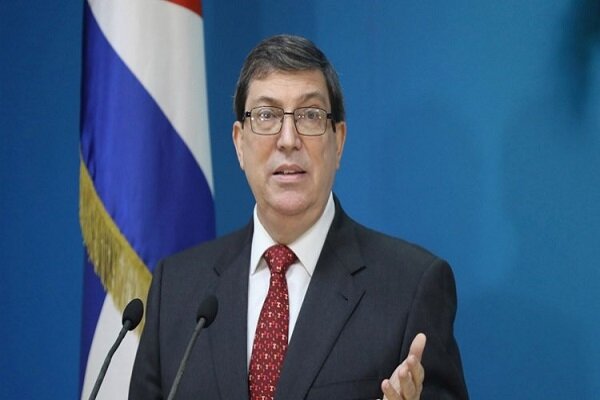
Cuban Foreign Minister Bruno Rodriguez has denounced the recent UN Security Council vote on snapback sanctions against Iran. In his post on Saturday’s X, Rodriguez rejected the decision, pursuing the nuclear program peacefully, saying it would undermine Iran’s sovereignty, further eroding the stability of the Middle East.
During the Security Council session on September 19, both China and Russia joined in strengthening criticism of the European Troika (UK, Germany, France) for efforts to reabsorb sanctions against Iran under the snapback mechanism of UNSC Resolution 2231.
China (via the UN’s representative FU Kong) criticised the snapback push as “unfair and irrational” and argued that E3’s initiative lacked legitimacy as it ignored key procedural and diplomatic frameworks. Fu said the action could overturn years of negotiation progress, raise tensions, undermine the possibility of trust with Iran and put peace efforts at risk. He emphasized that diplomacy and dialogue remain the only viable path forward.
Russia, through Ambassador Vassily Nebenzia, declared that Europe lost its legal basis to launch a snapback, claiming that E3’s claims misuse the JCPOA dispute resolution mechanism. According to Russia, the resolution presented by South Korea failed to comply with the legal requirements of resolution 2231, and European efforts represent political rather than diplomatic moves.
The proposal to officially lift protections from South Korea’s sanctions failed to secure the necessary nine votes. Only four states, China, Russia, Pakistan and Algeria, were supported, nine people opposed and two abstained. The results underscored the lack of broad international support for the European push, while allowing snapback sanctions to proceed under the letter of mechanism.
Countries including Cuba, China, Russia, Pakistan and Algeria have publicly expressed their opposition to not only the legal validity of the snapback initiative, but also the broader ethical and diplomatic implications. These reactions suggest that Iran’s position is increasingly supported in non-Western forces.
Through a statement at the United Nations, Iran and its allies argue that the deployment of European snapbacks is not being carried out in good faith. Critics say E3 members skip or avoid the conflict resolution process, ignore Iran’s cooperation with the IAEA, and treat snapbacks as political weapons rather than legal guardians. China’s Fu Cong explicitly warned that such unilateral measures risk nullifying long-standing diplomatic work and trust.
Similarly, Russia described European efforts as counterproductive, claiming that such a move could push Iran towards a retaliatory or defensive stance. Moscow and Beijing have proposed a technical extension of JCPOA and Resolution 2231, citing the need to purchase time for diplomatic involvement rather than repeating the cycle of sanctions and conflict.
MNA