
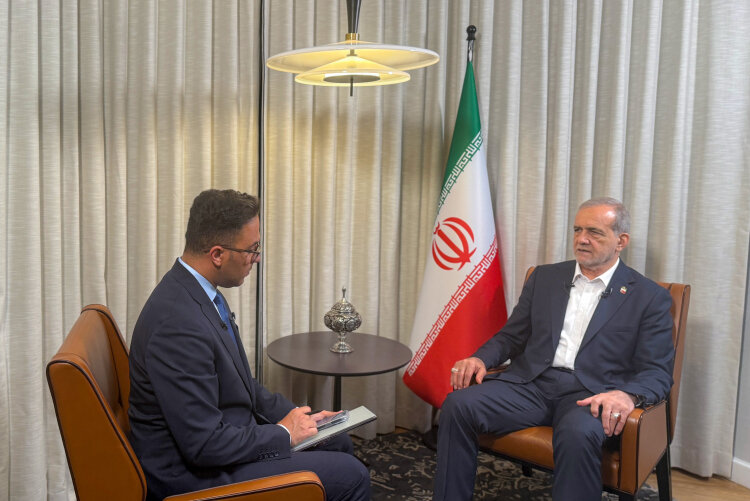
In a recent interview with Qatar’s Al Arabian TV Network on the sidelines of the 80th session of the UN General Assembly in New York, President Pezeshkian discussed regional and international issues, particularly focusing on snapback mechanisms and Iran’s commitment to the nuclear deal.
In an interview, President Pezeshkian emphasized the importance of clarifying Iran’s stance on the international community. He criticized the UN Security Council’s approval of snapback mechanisms, claiming it was based not on existing laws but on pressure exerted by the United States and certain European countries. “We complied with the agreement we signed, but it was the United States that violated it,” he said.
Pezeschkian also worked on a recent agreement reached with the IAEA through Egyptian mediation. He said the agreement established a framework for cooperation and “announced that we are ready to engage with the IAEA.” He expressed his willingness to negotiate with the United States, noting that it was the United States that refused to engage in the debate.
When asked about the possibility of a dialogue with the US, Pezeshkian questioned the American intentions and recalled that the US allowed Israeli attacks on Iranian facilities while negotiations were underway. “A country that does not respect humanitarian principles cannot claim that it is ready for dialogue,” he argued.
He mentioned the European proposal, but it was not really effective. He said, “Give us rich uranium, and we will give them three months to discuss other issues. But why should we hand over the enriched uranium?
When a dialogue takes place, it should encompass the whole problem, not just abandoning the assets and waiting. ”
Regarding the actions of the Israeli regime in the region, he firmly stated that Iran never tried to cause anxiety in the region. It is the Israeli regime that pursues such actions. He emphasized that Iran’s goal is peace and cooperation with his neighbors, saying, “We have expanded our hand of friendship to all countries in this region. Today, many countries in this region know that we actually act on Islamic brotherhood. But the problem is that they (Israels) do not want peace in the region, and anxiety is more profitable than peace and stability.”
Pezeshkian also said it had fostered unity within Iran, reflecting the impact of the recent conflict incited by the Israeli regime. The attack strengthened the country’s social capital, he said, and that Iranian people gathered together in response to external attacks.
Looking ahead, Pezeshkian expressed confidence in Iran’s resilience to external pressures and said he believes that through cooperation, solidarity and unity, Iranians can resolve their problems.
In response to questions about decision-making in Iran regarding the nuclear issue, the president said: “The country’s key policies will be decided by the Supreme Leader based on consultations between the National Security Council and the politician group. However, the final words and decisions will be made by the Supreme Leader in accordance with the Constitution.”
He emphasized the importance of faith in God and the need for Muslims to unite against a common threat, saying that if Muslims come together as brothers, the Israeli regime will not allow them to act with immunity.
In conclusion, Pezeshkian reaffirmed Iran’s commitment to peaceful dialogue and cooperation, noting that Iranians are ready to broaden their friendship in all Muslim countries.
MNA/President