
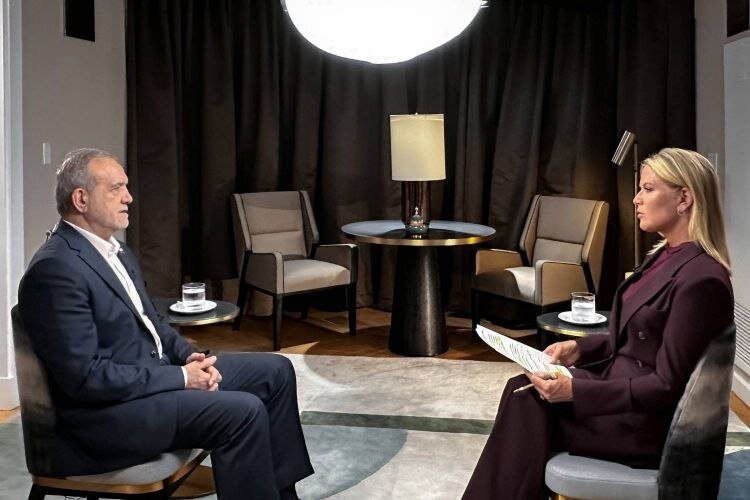
Pezeschkian made his remarks in an interview with Fox News on September 28th in New York to address the 80th session of the UN General Assembly.
When asked about nuclear weapons, the president said the Islamic Republic would not allocate nuclear weapons locations to its doctrine. “We are ready to assure the world that we do not seek nuclear weapons in any way. However, the actions taken against us by them (the Israeli regime and the United States) have been against all their commitments and principles.”
In response to questions about enrichment of up to 60% of Iranian uranium, Pezeschkian acknowledged that such levels may not be necessary for regular energy use. However, he emphasized that the enrichment occurred under strict international surveillance before the US unilaterally violated its 2015 nuclear deal.
The President said, “It was the United States that withdrawn from the Joint Comprehensive Plan of Action (JCPOA), an agreement under which surveillance was undertaken.”
Pezeshkian said, “After the US withdrawal from the JCPOA, European companies that came to Iran to cooperate were forced to leave one at a time. They did not meet the commitments they made.
Elsewhere in his remarks, Pezeschkian discussed the future of his relationship with the United States, saying, “Now there is a general distrust that arises from our domestic distrust and injustice on the other side. This distrust has led to our distrust, in particular his excellence. Encourage the uncertainty within our country and region.”
Addressing questions about why Iran continues to invest in nuclear power instead of focusing on domestic welfare, stressed that it is US sanctions and hostility, not Iran’s peaceful nuclear activity that has hurt the economy.
“Of course we want a better economy. However, since the beginning of the Islamic Revolution, the United States has tried to prevent Iran from becoming independent. Initially, it promoted tribal and ethnic conflicts and supported Saddam Hussein’s war against Iran.
He reiterated that Iran’s nuclear program is always peaceful and intended to meet scientific and energy needs.
Referring to the 12-day war imposed by the Israeli regime, the president said: “The 12-day war of attack has strengthened our country’s strength and unity, as evident from the special respect that our athletes, scientists, university students and students present flags and anthems at international forums.”
Pezeschkian expressed hopes for peace and security in the Middle East, adding that the Israeli regime should change its current trajectory, and emphasized that the administration could not carry out human rights abuses without US approval.
He emphasized that the Israeli regime is violating laws that are unacceptable under any international framework. “In addition to targeting our institutions and respecting scientists, it attacked our people. Unfortunately, the Zionist regime does not adhere to the framework of international law and is supported by certain countries. This is absolutely unacceptable.
When asked about reports of Israeli invasions within Iran and intelligence news projects, Pezeshkian pointed to Tel Aviv’s offensive policies, saying, “This clearly shows that the Zionist regime is an invader. This regime operates outside the framework of international law, indicating that it truly is the origin of unrest in the region.”
Responding to questions about the future of the region and the ability of the Israeli regime to coexist with neighboring countries, Pezeshkian said the issue depends on the actions of the Israeli regime and how it treats the people of the region.
He emphasized that the issue cannot be simply resolved through discussion, affirmation or denial, adding that the continued conflict and deep hostility that occurred among the people of the local community do not easily dissipate.
“If Israel wants to stay in the region, it must observe a legal and humanitarian framework,” Pezeschkian said.
When asked about allies in Iran’s regional allies, such as Hamas, Hezbollah and Yemen’s Ansarrah, the president dismissed Western claims that these groups act out of extremism, emphasizing that the resistance was a natural response to Israeli oppression.
“Why do we have Hamas? Why do we have Hezbollah? Do they act out of insanity? Certainly not. When people are driven out of their homes, their homes are destroyed and faced with daily humiliation, humans will respond,” Pezeschkian said.
He strongly rejected the narrative that Iran promotes instability through a “proxy,” claiming that Tehran merely supports a oppressed state.
In his remarks, Pezeshkian emphasized the friendly relations between Iran and his neighboring countries, saying, “The relationship with his neighboring countries has improved dramatically. They thought Iran was the source of regional instability, but we declared that we are friends and brothers with all our neighboring countries, respect the territorial integrity and do not interfere within international boundaries, the world.”
“The Zionist regime is the one who has destabilized the region. The regime attacked other countries, not Iran. We are not attacking, we are not attacking the country. We are just protecting ourselves,” he added.
The president also stated, “Iran believes dialogue is more effective than war. Dialogue is the best way to resolve issues within the framework of international law. If these laws are ignored and the state is forced to impose a will, and should cooperate and essentially cooperate on international frameworks and agreements, then conflicts forcefully impose their will.
The president also addressed the issue of women’s rights and highlighted their active role in both Iranian society and the government.
“In Iran today, women enjoy far more freedom than outsiders believe. In my administration alone, five women hold senior positions. We will continue to work for the equal rights of all, including women. The Western intelligence report about Iran is very different from the reality of everyday life,” Pezeshkian said he invited observers to visit Iran and witnessed reality.
MNA