
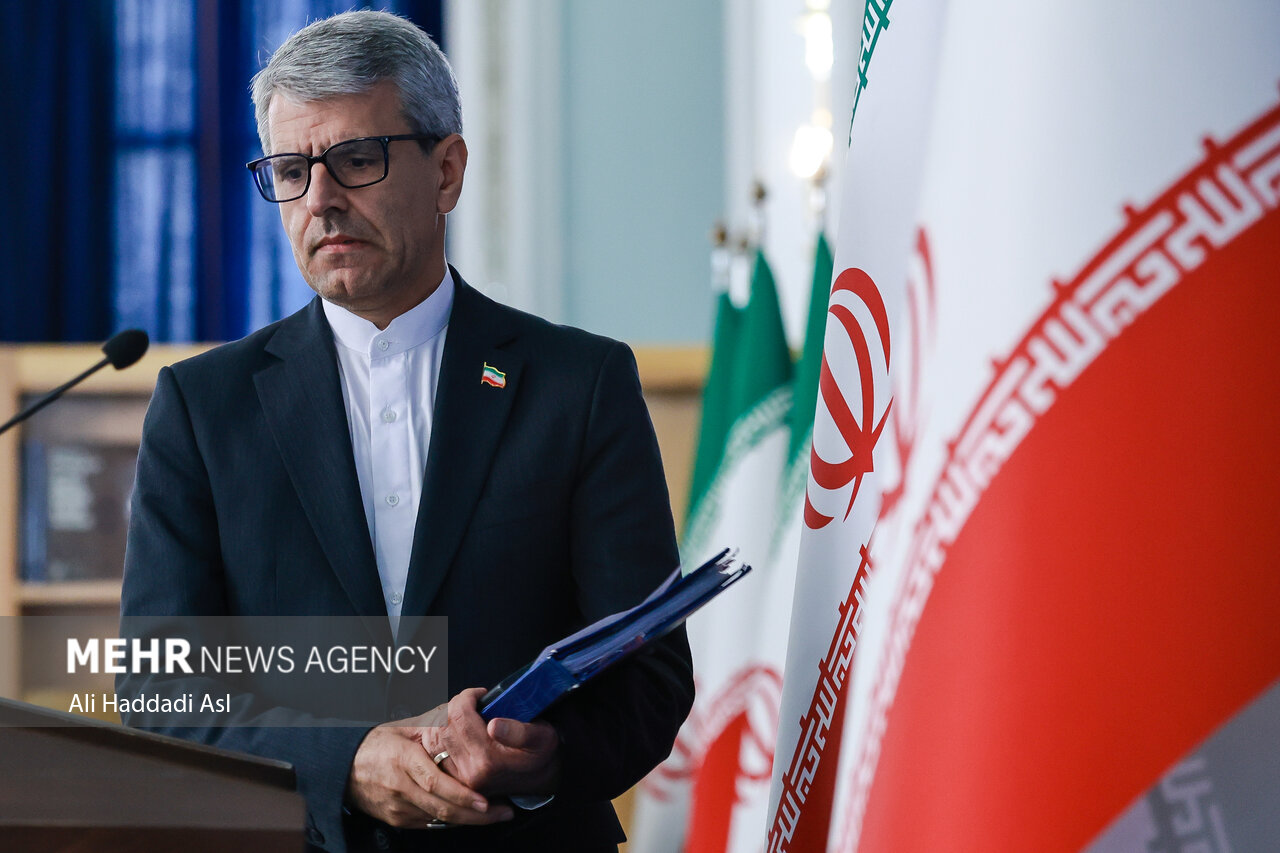
Speaking on a weekly presser on Monday, Esmail Baghihai condemned the recent actions of three European countries involved in the nuclear talks, describing their stance as “irresponsible and obstructive.”
He said that the European troika (UK, France, Germany) had misused the JCPOA’s conflict resolution mechanism to impose US demands on the UN Security Council, but the prerequisites for Iran’s participation in negotiations were completely unreasonable.
According to a spokesman, Iran has engaged in constructive dialogue with the International Atomic Energy Agency (IAEA) under its commitment to conservation, reaching a new framework of cooperation that will satisfy the institution. Initially it was welcomed by Europe, but the three countries later rescinded their support.
“Their unfair circumstances left Europeans unable to serve as negotiation partners,” the spokesman said, adding that “future negotiations are certainly different from the past.”
He said the actions taken by the three European countries were driven by stubbornness in implementing US demands rather than rational calculations or consideration of legal aspects, and ignored the interests, priorities and credibility of these countries as parties to the JCPOA.
Iran’s position on the issue is supported by China and Russia, he continued, adding, “Russia, as a permanent member of the Security Council, quickly pointed out the illegality of this action. Iran has also formally expressed protests and criticism regarding the Secretariat’s actions at the Security Council.”
“Based on this reasoning, the actions of the three European countries do not create legal obligations to UN Member States. It is expected that in order to maintain the principles of the UN Charter, they will refrain from complying with this illegally imposed action by these three European countries regarding the structure of the Security Council,” Baghaei emphasized.
Referring to an Iranian delegation’s recent visit to New York, Baghey referred to a meeting held on the sidelines of the UN General Assembly, saying, “We had a candid and detailed discussion with the UN Secretary-General. This meeting specifically addressed the actions of European European countries who misunderstood the reason why the JCPOA’s dispute was false because it misunderstood the UN’s illegal solution. Illegal.”
“All resolutions adopted between 2006 and 2010 regarding Iran’s nuclear issue were passed without consensus or at least opposition from permanent members of the Security Council. However, at least two permanent members are opposed to the reinstatement of the sanctions resolution that clearly shows a lack of consensus. In fact, it is a one-sided move.
“According to Resolution 2231, all restrictions related to Iran’s nuclear program should expire by October 18th, and the nuclear issue should be removed from the council’s agenda,” he emphasized.
Elsewhere in his remarks, senior Iranian diplomats looked at the attacks carried out by the Israeli regime and the United States in June. He emphasized that Iran holds the Zionist regime and the US responsible for illegal attacks on the integrity of its peaceful nuclear facilities and territorial integrity.
The IAEA report, and the misuse of issuing resolutions by the European Governor and the US to the Governor’s Committee, he said, created an excuse for these actions, adding that although the IAEA report does not provide evidence of a circumvention of Iran’s nuclear program from a peaceful path, the agency was expected to promptly condemn Zionist actions and US actions.
He further explained that the IAEA resolution and the UN General Assembly prohibit attacks on the country’s peaceful nuclear facilities. “It is hoped that recent events will serve as lessons for the institution and all related parties, and will prevent political misuse of the institution’s technical authority,” he cited.
Baghaei reiterated that Iran is always asking the IAEA to focus solely on technical obligations and mandate, and avoid positions that suggest influence by the US or certain Western countries.
Elsewhere in his remarks, Baggie told reporters that at this stage Iran had no plans to negotiate with Washington, focusing on examining the impact and consequences of actions received by the European troika and the US. “Diplomacy continues as a contact-based and consultation-based process, with decisions being made based on national interests and priorities each time Iran determines that diplomacy is effective,” he continued.
He said that statements from US authorities, which have expressed pride in violating criminal cases against Iran, would only increase the US international liability. “Understanding illegal activities does not lend legitimacy to the United States, it reaffirms the international community and the Iranian state that the United States is a subject of law violations that fails to comply with accepted global rules.”
MNA/