
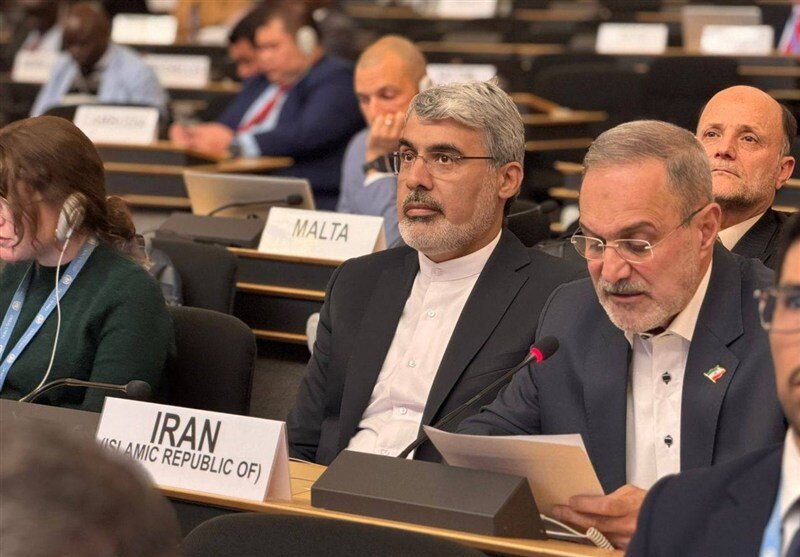
Speaking at the 76th Executive Committee of the Office of the United Nations High Commissioner for Refugees in Geneva on October 7, Iran’s Deputy Minister of Interior and Head of the Organization for Social Affairs, Mohammad Batayei, said that Iran has supported Afghan refugees for more than 40 years, providing them with education, medical care and shelter, despite facing economic sanctions and limited resources.
He also criticized the declining UNHCR budget and insufficient aid to Iran, and called for increased international cooperation and concrete plans to facilitate the voluntary return of displaced Afghans to their homeland.
Below is the text of his speech.
Mr. Speaker, Mr. High Commissioner, and honorable colleagues.
First of all, I would like to note the ongoing human catastrophe in Gaza and the heinous massacre of Palestinian civilians by the Zionist regime, which has resulted in the displacement of millions of people. It is the responsibility of the international community to unequivocally and unconditionally condemn the unrestrained bombing of schools and hospitals and the killing of civilians. We pay our respects to the victims of these atrocities, especially UN personnel in the region, and unequivocally condemn these crimes. The Zionist regime has killed hundreds of Iranian citizens in despicable attacks against the Islamic Republic of Iran. The regime must be held accountable for illegal and criminal acts by members of the international community.
The Islamic Republic of Iran has hosted large numbers of Afghan refugees and displaced persons for more than 40 years, and faces many challenges in this regard. These include, among others, economic burdens, overpopulation, pressure on infrastructure, reduced resilience of host communities, security concerns, health challenges, educational burdens, social tensions, and negative environmental impacts.
Billions of dollars are spent each year to provide food, housing, education, and medical services to foreigners in the country, including illegal Afghans. As an example, each student in Afghanistan who benefits from various educational services costs $1,500. In addition to that, the government provides education to all illiterate people of all ages. This has increased the literacy rate from about 5 percent to nearly 70 percent.
Temporary solutions cannot provide a sustainable solution to the refugee problem. UNHCR and the international community must redouble efforts to facilitate and speed up the return of displaced persons to their countries of origin.
As the High Commissioner has repeatedly emphasized, the burden and responsibility of hosting refugees must be shared by the international community. There is no doubt that the idea that a single country should shoulder the burden and cost of hosting and managing millions of refugees and displaced persons is neither realistic nor just. It is extremely regrettable that the principle of burden sharing is not being followed in relation to our country, and it is worth noting that this situation cannot continue. It is of grave concern that UNHCR’s budget has been cut by 20 percent, from $10.6 billion to $8.5 billion, even as the number of displaced people worldwide is estimated to rise to 136 million. In that light, we will continue to closely monitor the situation with great concern.
The challenges in the region are becoming increasingly serious as UNHCR’s budget suffers from cuts. We note with disappointment that the UNHCR Tehran Office’s budget for 2026 remains at $140 million. These numbers are simply insufficient to address our challenges. Such allocations stand in sharp contrast to the millions of dollars spent by Iran in providing health, education, and other services to Afghan refugees and displaced persons despite severe resource burdens and limitations imposed through Unilateral Coercive Measures (UCM).
Recognizing the importance of this principle with respect to UNHCR’s current policy on international protection, we note that UNHCR’s approach in Iran has led to the prolonged stay of foreign migrants in the country, which is directly contrary to the interests of frontline countries such as Iran, whose social structures are under severe pressure and are heavily affected by foreign migration.
Dear colleagues, I respect you.
The international community is clearly retreating from sharing responsibility. Iran’s assistance to refugees and displaced persons cannot continue indefinitely. Serious and step-by-step planning for sustainable solutions to these issues, including facilitation of returns, must be at the forefront of international cooperation and shared responsibility.
Finally, I would like to express my gratitude to High Commissioner Filippo Grandi for his recent active visit to the Islamic Republic of Iran. As he approaches the end of his term, we express our sincere gratitude to him for his dedication and leadership. We also express our hope that UNHCR will continue to play a constructive and important role in supporting host countries and advancing sustainable solutions for refugees. We call on UNHCR to adopt a fair and needs-based budgeting model that truly reflects the disproportionate and overwhelming burdens suffered by major host countries.
thank you.
MNA/TSN