
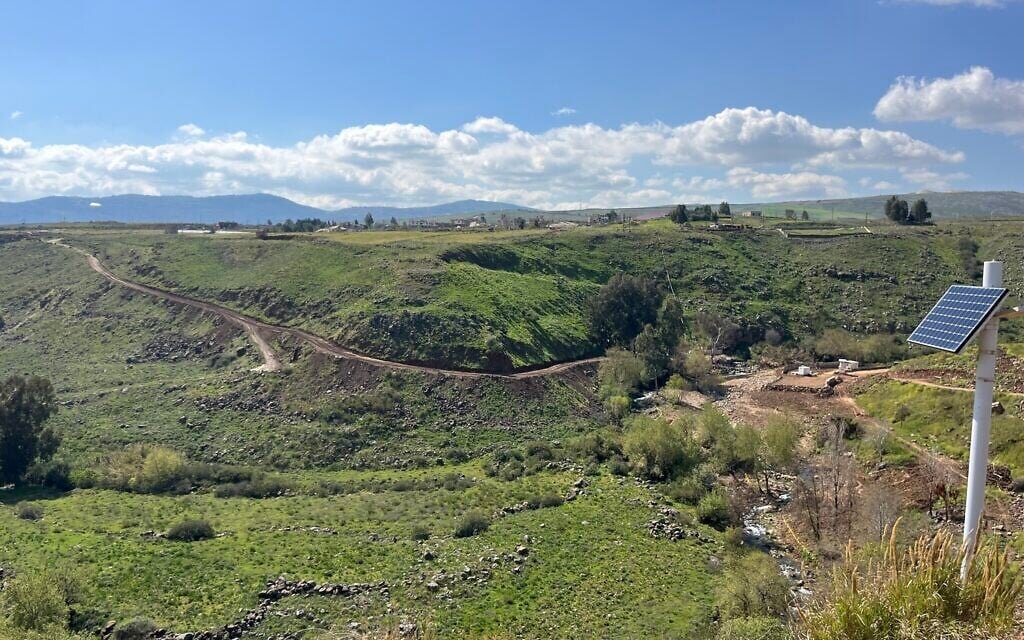
In the Lebanese border village of Houla, 55-year-old Fidaa Fawaz witnesses the same unforgettable scene every morning, according to Xinhua news agency. It turns out that an Israeli rifle was pointed in her direction from less than 700 meters away.
“Half of the house is gone,” she says. “We can’t walk far. There are landmines and Israeli soldiers point their guns at us without warning. Hula used to be lively, but now it’s quiet and uneasy.”
Two years after the war with Israel, Lebanon’s southern border has been transformed by devastation and military control. More than 30 towns and villages were almost completely destroyed, and about 100,000 residents were evacuated to safety in the north, according to official data.
The changes can be seen from the first section of the road south of Marjayoun in southern Lebanon. The asphalt turns to gravel and then mud, and shell fragments are scattered. The once-bustling route is now carved out by craters and bulldozed fences. Houses stand in ruins, some completely erased from the map, and others left behind as empty shells.
A World Bank report released in March 2025 estimated that the year-long conflict between Hezbollah and Israel has destroyed around 45,000 homes and generated between 20 million and 35 million tons of debris across southern Lebanon. The report estimates that the total cost of recovery and reconstruction will be approximately $11 billion.
According to Lebanese military officials, Israel currently controls a border area of about 850 square kilometers, stretching from Shebaa Farms in the east to Nakoura in the west. The Israeli military has drawn new “red lines” around several villages, prohibiting residents from approaching or crossing certain areas. Main roads connecting communities were destroyed, cutting off access and deepening isolation.
Boundaries and topography have changed in the affected villages (Kafr Qira, Adaise, Houla, Markaba, Rumeish, Maes al-Jabal, and other eastern regions). “Israeli troops are stationed on five strategic hills and other occupied areas have completely changed the border map,” a Lebanese officer told Xinhua. “A region once full of life has been transformed into a military zone under surveillance and control.”
In Kafr Qira, 30-year-old Adel Seet tries to adapt to a life stripped of the essentials. “Daily life has become almost impossible,” he says. “There is no electricity, and water is delivered by tanker at a price that is unaffordable for most households. Agriculture, the lifeblood of the region, has all but disappeared. Fields have been destroyed and large tracts of land have been bulldozed.”
He looked across the hill where his family once planted tobacco. “Markets have closed, jobs have disappeared, young people have migrated to the cities, and unemployment has skyrocketed. Poverty has become our daily reality.”
Further west, in Aita al-Shaab, local estimates put the destruction rate at 85 percent. Leila Choukir, 22, surveys what’s left of her home. “I was born here, but I don’t know if I’ll stay here,” she admits. “There is no work, no school, no electricity. We live cut off from the rest of the world. Even the roads that connected us to other villages have been bulldozed and we feel trapped. My heart is here, but my future may lie elsewhere.”
The effects of war go far beyond national borders. Cities such as Tire, Sidon and Nabatiës are hosting thousands of displaced families, straining their already fragile economies. Schools are crowded with displaced people and hospitals are struggling to cope with the growing number of patients with limited resources, according to data from internal security forces.
A ceasefire brokered by the United States and France has largely held between Israel and Hezbollah since November 27, 2024, ending months of cross-border clashes related to the Gaza war that broke out in October 2023. But Israel continues to carry out regular attacks in Lebanon, saying it is targeting the Hezbollah threat, while maintaining forces in five major locations along the Lebanese border.
On Wednesday, Lebanese President Joseph Aoun renewed his call for Israel to withdraw from occupied territory in Lebanon.
“If Israel does not withdraw and stop its daily acts of aggression, the situation will remain unstable and the military’s plans to ensure that only legitimate security forces are armed will face serious obstacles,” Aoun said in talks with European Union officials in Beirut.
MNA