
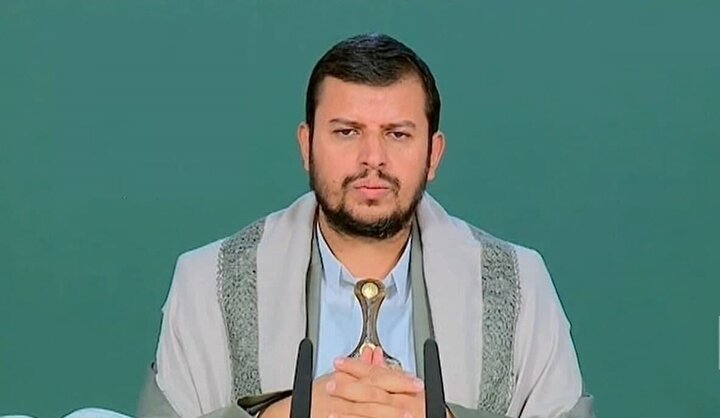
In a televised address on Thursday to mark the second anniversary of the Al-Aqsa flood operation, Abdul Malik Al-Houthi reiterated Yemen’s full support for the Palestinian people.
He referred to the devastating aspects of the Gaza war, noting that 11 percent of Gaza’s population had been killed or injured in brutal attacks by the Israeli regime and the United States, a statistic unprecedented in modern times.
He called these crimes the “crimes of the century,” noting that more than 1,000 mosques, 95 percent of schools, and even 40 cemeteries had been destroyed and more than 2,000 bodies stolen.
The Houthis strongly condemned the attacks targeting journalists, aid workers and civil defense forces in Gaza, stressing that the Zionist regime is targeting “all strata of the Gazan people with unprecedented brutality and crime.”
It added: “The Zionist regime has committed unprecedented crimes, deliberately killing children and women, starving Gazans to the point that powdered milk has been placed on the banned list, and destroying water sources and health networks to keep people thirsty.”
Leader Ansarullah pointed to Israel’s continued aggression since the beginning of its occupation of Palestine.
“For two full years, we have witnessed the Israeli regime’s genocide against the Gaza population, the main targets of which were the most lethal weapons, including American bombs,” he said.
Elsewhere in his remarks, he described the Al-Aqsa flood operation as a turning point in the Palestinian people’s path of jihad, noting that the operation was a “natural reaction to the Zionist regime’s 75 years of crimes against the Palestinian people.”
“Prior to Operation Al-Aqsa Flood, the enemy aimed to completely eliminate the Palestinian issue, and its ultimate goal was complete control of Palestine and the implementation of the Greater Israel Plan.”
He also warned of the dangers of the Zionist project in the region, which he said was aimed at “destroying the dignity, independence and identity of the countries of the region and forcing the peoples of the region to serve the interests of the American and Israeli regimes.”
The term “Greater Israel” has been used to refer to areas occupied by Israel since the 1967 Arab-Israeli War, including eastern al-Quds, the West Bank, the Gaza Strip, Egypt’s Sinai Peninsula, and Syria’s strategic Golan Heights.
Early Zionist thinkers such as Ze’ev Jabotinsky, widely regarded as the ideological forerunner of Israeli Prime Minister Benjamin Netanyahu’s Likud party, extended this vision to present-day Jordan.
The idea of a “Greater Israel” is a core tenet of Likud’s political heritage, which is rooted in revisionist Zionism.
Israel began the Gaza massacre on October 7, 2023, after a historic operation in which Gazan resistance fighters stormed an Israeli base and captured hundreds of Zionists.
Since then, Israeli military attacks across Gaza have killed more than 67,000 Palestinians, mostly women and children.
MNA/Press TV