
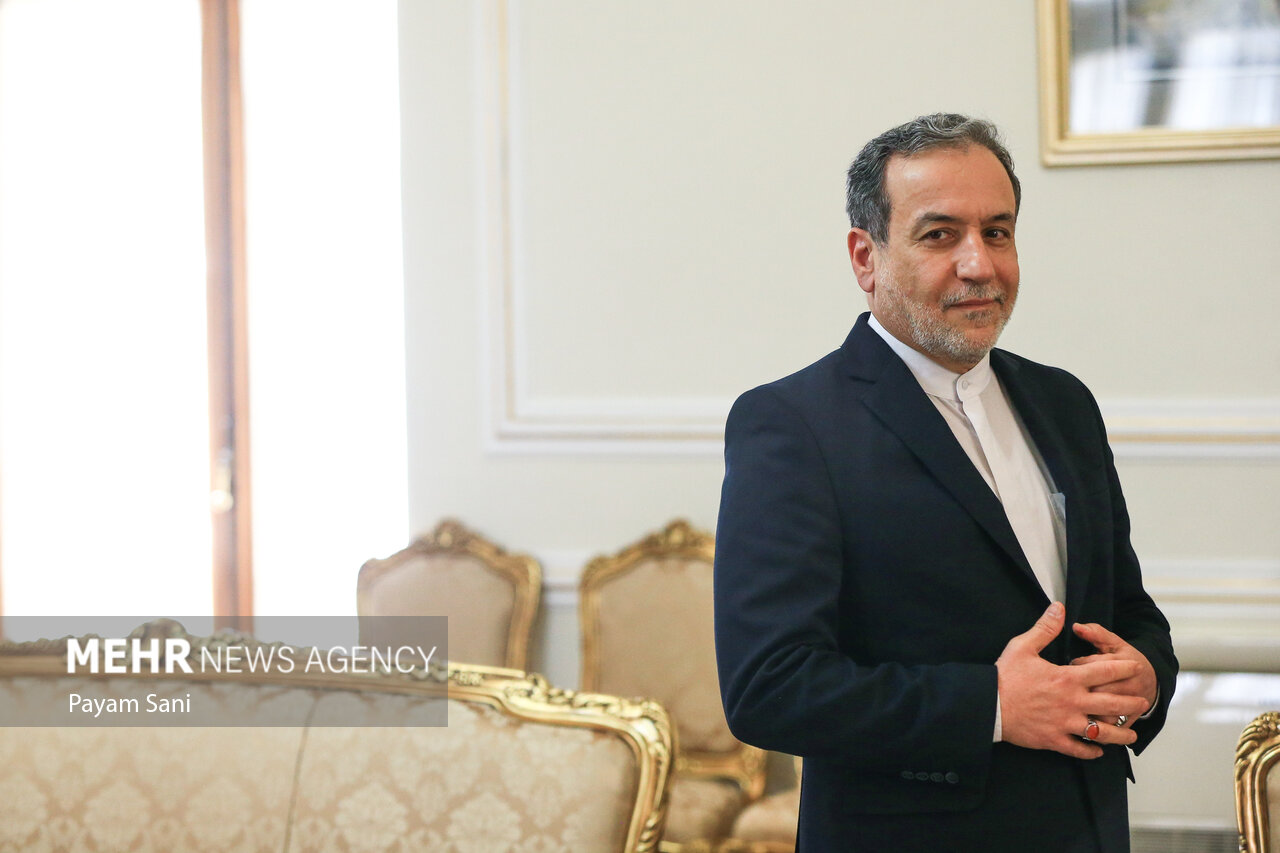
Speaking in a television interview on Saturday night, Seyyed Abbas Araghchi referred to the ceasefire in Gaza and said that the Iranian government has always supported any plan that would lead to stopping the genocide in Gaza and had repeatedly stressed in international forums that serious action must be taken to stop these crimes.
He further stated that he has no confidence in the Zionist regime and that Iran has issued the necessary warnings on this issue and it is only natural that it will continue to do so.
The Foreign Minister added that although the first phase of the ceasefire is currently in place, it should be noted that more than 50 percent of the Gaza Strip remains under Israeli occupation and there are doubts as to whether the regime will fully withdraw.
Regarding the Foreign Ministry’s statement on the ceasefire in Gaza, Araghchi said: “This is not a moderate position, but a pragmatic position. We support stopping the genocide, providing aid to the Gaza population and ensuring that their rights are protected.”
“This position is pragmatic,” he stressed, adding: “We are also warning of the machinations and treachery of the Zionist regime with regard to past agreements and agreements currently in place. There are aspects of the existing program that give us these warnings.”
He said Trump’s interpretation of the Foreign Office statement was his own. “There have been no negotiations or messages exchanged with the United States.”
“At various points in the past, the United States has tried to bring together different issues, but we have always made it clear that our negotiations with Iran are exclusively about the nuclear issue and we have never negotiated with Americans or other parties on other issues, especially resistance,” Araghchi said.
Referring to Donald Trump’s recent statements regarding Iran’s participation in the Abraham Accords, the foreign minister said: “Trump usually expresses in different ways what he wants to achieve, but the basis of the Abraham Accords is fundamentally dangerous and inconsistent with the Islamic revolution and the ideals of the Iranian state. Therefore, such an event can never occur.”
Mr. Aragushi continued, “The current U.S. administration has repeatedly shown that its position and claims are constantly changing. This has been amply experienced in negotiations with Iran. Regarding Gaza, President Trump’s statements also indicate that President Trump The plan that has been presented, although promises have been made, has serious doubts.Every time I speak to foreign officials, many regional foreign ministers express skepticism, including all regional officials and those involved in ceasefire negotiations. Others are talking only about the first phase, and it is clear that after this phase there will be a more severe phase that American and Western officials are not committed to.
Regarding messages from European countries to Iran regarding the snapback mechanism and negotiations, he said: “We have always said that we do not accept a comprehensive agreement, because a comprehensive agreement is the result of comprehensive negotiations, which we have never had before. The negotiations will only be about Iran’s nuclear program.”
“The three European countries should explain why we have to negotiate with them. We had an agreement, the US withdrew, and we reacted to the violation of the three countries. If they did so, Europe would have no role to play, the only recourse they had. We knew that they were ready to start negotiations, but we didn’t know why we should negotiate with them, what actions they could take, and what benefits such negotiations would bring.”
“We currently see no basis to negotiate with these three countries and the concept of ‘trioka’ does not concern us. We do business with European countries and manage our relations with them based on Iran’s interests.”
Continuing on his contact with Witkoff, Araghchi said: “What I refused was a response to an Arab newspaper about a purported phone call between me and Witkoff, which I rejected and continue to deny. I have never made a phone call, but messages are exchanged through intermediary countries.”
Regarding the US position on snapbacks, he clarified: “The US position was that if Iran handed over the 60% enriched material, we would postpone snapbacks for six months. This was an excessive demand, and that is why the New York negotiations were not successful.”
Regarding Mr. Witkoff’s absence from the scheduled meeting, he said: “The request came from the American side, and Mr. Witkoff sent a message. Our response was that if the European countries also participated, we were ready. So we said we were willing to sit around the table and set the terms, but Mr. Witkoff did not attend. Mr. Witkoff insisted on accepting the terms before the negotiations began, but we did not.”
“In New York, in order to have no excuses, we implemented the Cairo agreement, made a reasonable offer, and President Macron also announced that it was reasonable. So we did everything possible without harming Iran’s interests. They have no excuse to claim that the Islamic Republic of Iran did nothing.”
Iran’s top diplomat stressed that if the US wants to return to negotiations, its proposals must be reasonable, balanced and logical, based on mutual interests.
“We are not willing to give up Iran’s enrichment rights, but if they want clarification we are ready to consider it. If the other side respects our rights and presents a proposal based on a balanced formula, we will consider it.”
Referring to the Cairo Agreement with the International Atomic Energy Agency (IAEA), he said, “The Cairo Agreement is currently suspended. We reached an agreement with the IAEA because of changes on the ground. Due to the actions of the three European countries, this agreement has lost its validity. The request from the IAEA will be sent to the Supreme National Security Council for a decision in accordance with the law.”
Regarding Tehran’s research reactor, he said, “It produces isotopic medicines and nuclear medicine, and the fuel stage requires supervision from the authorities. Therefore, it cannot be said that relations with the authorities will be completely severed.”
Araghchi stressed: “If something benefits us, the Supreme National Security Council will decide. For now, the Cairo agreement has been set aside and the demands of government agencies will be considered.”
Regarding negotiations with the United States, he said, “At this point, no one has offered to negotiate.The fate of negotiations with the United States is clear based on the experience of the past year, including with the United States and Europe.”
“This does not mean that we will not consider proposals that are reasonable, fair and balanced and based on mutual respect and equality. We will certainly consider them, and if they are in the interests of the people we will consider them.”
MNA/6619147