
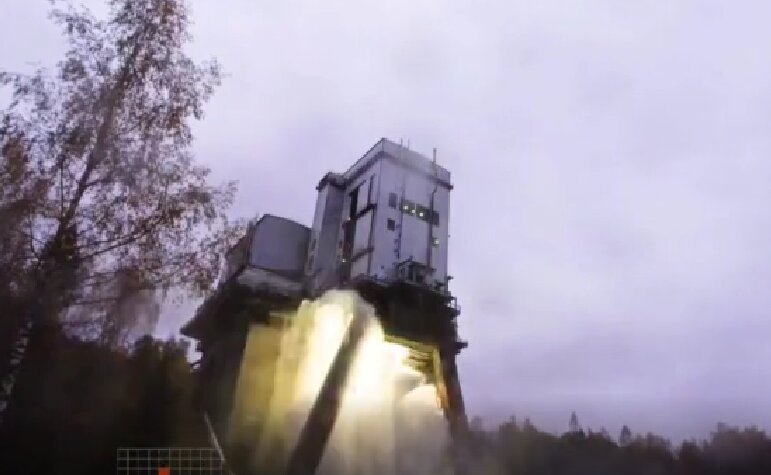
Soyuz 5 is a two-stage intermediate rocket with a payload capacity of up to 17 tons. Designed as a replacement for Proton and Zenit boosters. Roscosmos previously said it planned to carry out the first test launch of the new rocket at Kazakhstan’s Baikonur Cosmodrome in December, with full-scale use expected to begin in 2028.
On Saturday, the Russian Space Agency released a video of the remains of the fire on Soyuz 5’s first stage and announced that the fire was over.
The agency said in a statement that interactions between the first stage and the new RD-171MV engine were checked during the tests. It added that the engine had a thrust of 800 tons and continued to operate for 160 seconds, as scheduled.
Roscosmos previously said designers named the RD-171MV the “Tsar Engine” because it is the world’s most powerful engine and generates power comparable to large power plants, RT reported.
The results of the ground test “enable the start of flight tests and design testing of the Soyuz 5 rocket,” the statement said.
The rocket is intended to carry unmanned spacecraft to various near-Earth orbits under Russia and Kazakhstan’s joint Bayterek program, the agency said.
Last month, Roscosmos chief Dmitry Bakanov announced that Russia plans to build and launch about 1,000 spacecraft and 300 carrier rockets over the next 10 years as part of a national project to strengthen space activities. This will double the number of launches compared to the current pace, reaching up to 30 launches per year.
MNA/