
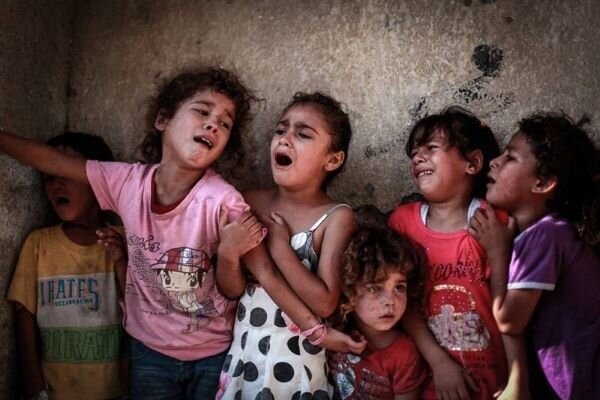
To commemorate the deep suffering in Gaza, the Islamic Republic of Iran has established a day of remembrance for Palestinian women and children lost in the war in Gaza.
The country is facing a humanitarian catastrophe of untold proportions, with countless lives lost under the rubble and severe starvation now threatening survivors.
In response, Iran is united in grief and condemnation, calling for international action against the genocide through official statements, media reports, and public events.
Mehr 25 (equivalent to October 17) is designated as a day to commemorate the massacre of Palestinian children and women.
This day is now permanently etched into the national calendar. For Iranians, it is a day to pause and remember. This date was chosen to reflect the deep sadness and anger felt across the country. This day focuses on the most innocent victims of war. The goal is to make sure the world doesn’t forget what’s happening.
Approximately 67,000 Palestinians have been killed in the two-year Israeli military operation. Thousands more remain trapped and dead under the ruins of destroyed buildings.
This number is so large that it is very difficult to understand. This is more than the population of many small cities. Each person was a person with a family, a home, and a life. The fact that thousands of people are still buried under rubble means that many families are unable to bury their loved ones. This situation has added to the grief of the community. Rescue workers are unable to arrive because the damage is too extensive and equipment and materials are in short supply.
At least 20,000 children have been murdered, equivalent to one child killed every hour over the past 24 months.
Consider that an hour has passed. Meanwhile, a child died in Gaza. This happened every hour of the day and night for two whole years. These children were playing, learning, and sleeping when they were caught up in the war. They lost their future. They lost the opportunity to grow. Their deaths left a huge void in Gaza. Entire generations are being lost. This loss will be felt for years to come.
According to UNICEF, it is estimated that between 3,000 and 4,000 children in Gaza have lost one or more limbs.
These children survived the bomb, but their lives were changed forever. Losing an arm or leg is a major injury. These children now require lifelong medical care. They need a prosthetic limb, a prosthetic limb. They require many surgeries. They also need help learning how to walk and use their hands again. There are few hospitals left to help them in Gaza. There is a shortage of medicines and doctors.
On August 22, famine in the Gaza Strip was officially confirmed by the United Nations-backed global hunger monitoring agency, the Integrated Food Security Classification (IPC) System.
Hunger means there is not enough food for everyone. people are starving. This famine is not caused by a natural disaster like a drought. It’s artificial starvation. This is because the war has disrupted the flow of food, water and aid into Gaza. The United Nations system is trusted around the world, and its verification is a very serious matter. This means that the situation has been officially recognized as catastrophic.
At least 459 people, including 154 children, have died due to hunger, among other causes.
These people did not die from a bomb. they died of starvation. Their bodies weakened without food. Starvation is a slow and painful death. It’s especially tragic for children who need food to grow. Their bodies are small and require adequate nutrition. The fact that 154 children died of starvation shows how broken our food system is. Parents cannot find food to feed their children.
Rates of malnutrition affecting children are increasing at an unprecedented rate. More than 12,000 children were diagnosed with acute malnutrition in July, six times the number recorded at the beginning of the year.
Malnutrition means your body doesn’t get the nutrients it needs to be healthy. Acute malnutrition is extremely dangerous, especially for young children. Their bodies and brains are unable to develop properly. The speed of this increase is shocking. Much faster than anyone expected. In just one month, thousands of children fell ill from lack of food. This shows how quickly the situation deteriorated after months of war.
Nearly one in four children now suffers from severe acute malnutrition, and one in five newborns are born prematurely or with a dangerously low birth weight.
If you see a group of four children in Gaza, one of them is severely malnourished. This child is very thin, weak and will get sick. This is a health emergency for children. The situation is also very bad for newborn babies. If a pregnant mother is hungry and stressed, it will affect the baby. The baby was born too soon. They are also born too small. This puts their lives at risk from the start. They may have lifelong health problems.
On this occasion, Iranian officials strongly condemned the killing of Palestinian women and children. These statements often highlight humanitarian crises and call for international accountability.
Iranian officials are speaking out. They use strong language to argue that these actions are wrong. They call it genocide and a war crime. They say the world must not be silent. They are calling on other countries and international courts to take action. They want those responsible for the genocide to be held accountable for their actions.
State media has featured special coverage, documentaries, and interviews to raise awareness of the suffering of Palestinian civilians, especially children.
Special programs on Gaza are being aired on Iranian television and news websites. You’ll see videos and photos showing what’s happening there. They produce documentaries that tell the stories of Palestinian families. They interview anyone who can explain the situation. The goal is for all Iranians to understand the depth of their suffering.
In some cities, public rallies, marches, or symbolic events are being organized by cultural and political organizations to express support for Palestine and condemn the genocide in Gaza.

Most recently, the 8th International Conference on Solidarity with Palestinian Children and Youth was held in Tehran on October 12, 2025.
More than 100 participants from 32 countries attended the international event held in memory of Mohammed al-Durrah, a Palestinian boy killed by Israeli forces in 2000.
Various rituals are held and Iranians gather in the streets. They hold placards and chant slogans. They are holding the Palestinian flag. They are showing the people of Gaza that they are not alone in their suffering.
Schools and universities may organize seminars, poster exhibitions, and discussions across the country to inform students about the humanitarian aspects of the conflict and the significance of this day.
Mosques and cultural centers may hold prayers and sermons that reflect the plight of Palestinian families, especially during Friday prayers close to the date.
During the service, the preacher talks about Gaza. They talk about the suffering of the Palestinian people. They ask for God’s help and mercy. They pray for peace and the safety of their children. This makes the day feel spiritual. It connects political issues to faith and morality. It comforts people and gives them hope.
Report by Tohid Mahmoodpour