
Iran, China and Russia have joined forces again to block the implementation of pre-JCPOA UN sanctions on Tehran, which were formally reinstated last month but have yet to achieve any practical results due to growing international opposition.
Britain, France and Germany activated a mechanism known as “snapback” on August 28, beginning a 30-day process to reinstate all UN sanctions against Iran. The snapback mechanism was part of the 2015 Iran nuclear deal (officially known as the Joint Comprehensive Plan of Action or JCPOA), which allowed signatories other than Iran to reinstate UN sanctions if they deemed Iran not in compliance with its commitments.
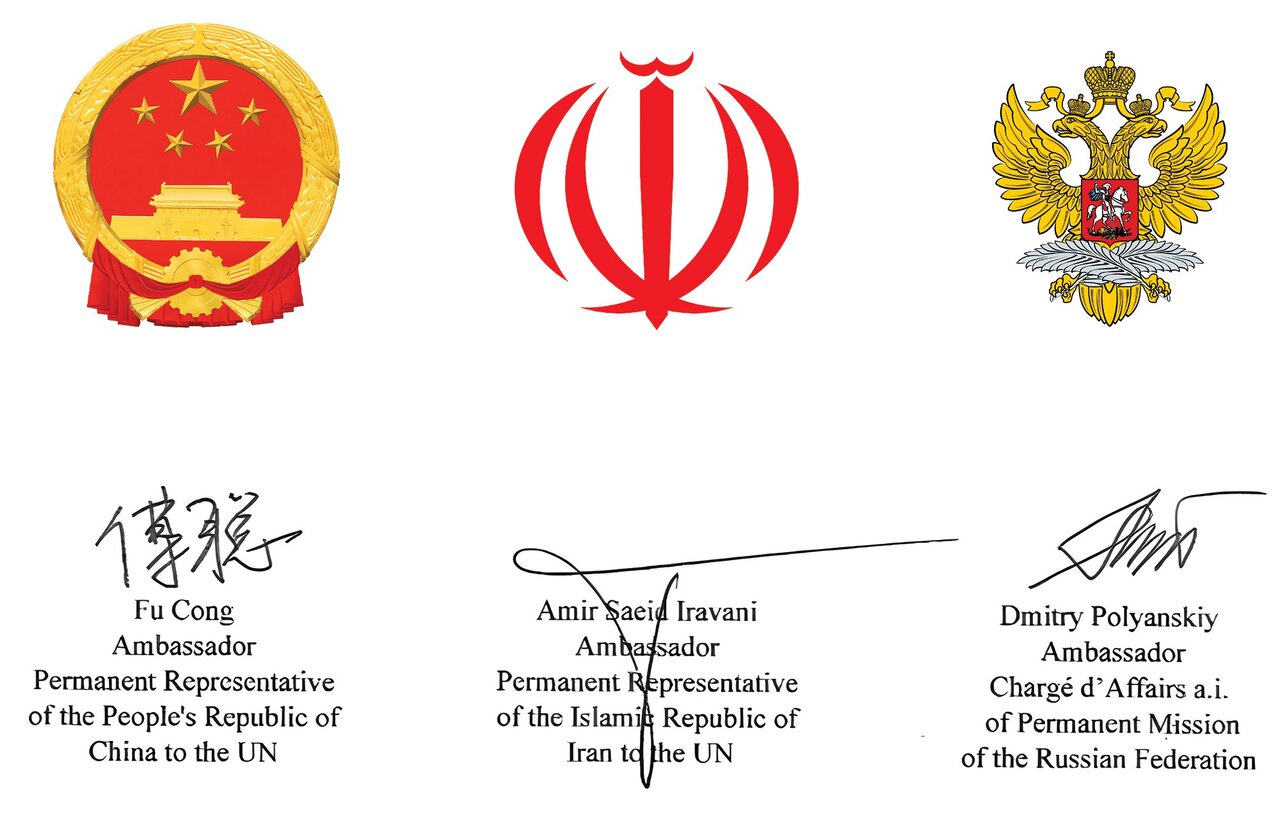
In a letter to U.N. Secretary-General António Guterres on Saturday, the U.N. representatives of Iran, Russia and China said Europe’s decision to trigger a snapback lacks legal basis.
“The efforts of the three European countries to trigger the so-called ‘snapback’ mechanism are legally flawed and lack a legal basis,” the letter to Guterres and Wassily Nebenzia said. “The three European states themselves have violated their commitments under (Security Council) resolution 2231 and have refused to follow the trends set out in the ‘Dispute Settlement Mechanism’ and are therefore not entitled to refer to its provisions,” the letter added.
The JCPOA, signed by Iran, Germany, Britain, France, China, Russia and the United States, aims to limit Iran’s nuclear activities in exchange for sanctions relief. The embargo, which has affected Iran’s economy since 2006, peaked in 2012 under the Obama administration.
However, when Republican Donald Trump succeeded Obama, the US withdrew from the deal and reimposed sanctions on Iran. In 2018, President Trump also issued secondary restrictions that placed unprecedented financial pressure on the Iranian people. Despite repeated promises of relief, European signatories were unable to escape the brunt of U.S. sanctions in the years that followed.
Iran began rolling back some of its JCPOA commitments in 2020 as it became clear that the West was not willing to remain on its side in the deal. On the other hand, he has stated that he is prepared to curb nuclear activities if Western countries lift sanctions, and has held multiple rounds of negotiations. Iran’s last diplomatic efforts failed in June 2025, when Israel and the United States launched attacks on its nuclear, civilian, and military infrastructure, days before new talks with the United States were scheduled to be held in Oman.
Besides the fact that Western countries have broken their own commitments, forcing Iran to renege on some of its commitments, Iran, Russia and China said in a letter to the UN Secretary-General that the expiration of Resolution 2231 is a further reason why a snapback of UN sanctions cannot be implemented. Resolution 2231, the UN resolution approving the JCPOA, expired on October 18th after 10 years.
“Based on the effective Article 8 of resolution 2231, all its provisions expired after October 18, 2025. We reiterate that the full and prompt termination of resolution 2231 amounts to the end of consideration of the Iranian nuclear issue in the UN Security Council and strengthens the authority of the Security Council and the credibility of multilateral diplomacy,” the letter added.
World powers Russia and China have significant support, but at least 120 other countries also support Tehran in its nuclear conflict with the West. Members of the Non-Aligned Movement (NAM) expressed support for the Islamic Republic at a ministerial conference in Uganda last week.
“It’s clear that there are cracks in the international order here,” said political scientist Shuaib Burman. “Iran’s nuclear program has become one of the biggest points of contention between world powers since World War II. The situation and perception of Iran is also very different from 2012, when most of the world agreed with President Obama’s handling of the nuclear issue.”
He added that Iran’s diplomatic efforts and Western countries’ blatant disregard for international agreements over the past decade have changed perceptions around the world. “Russia and China, who wield considerable power in the Security Council, could still block the practical implementation of a snapback even if they cannot legally block it. As a result, other countries may also be reluctant to impose UN sanctions on bilateral relations with Iran.”
MNA/TT