
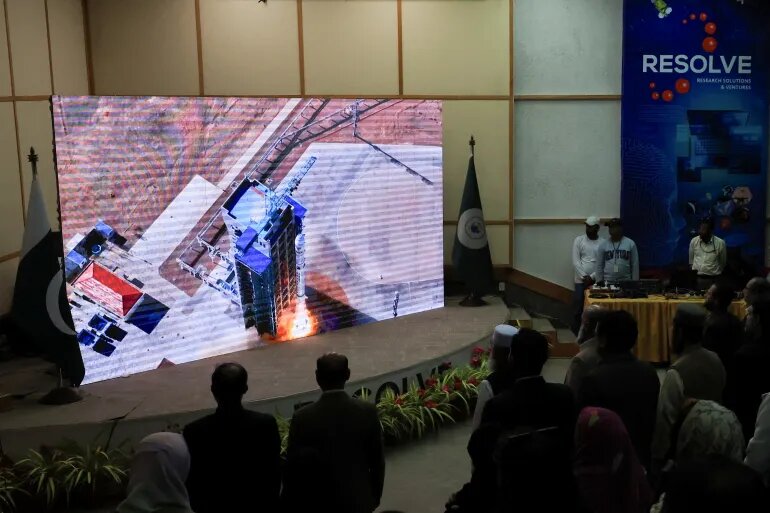
The country’s space agency SUPARCO announced on Sunday the “successful launch” of the H1 satellite from the Jiuquan Satellite Launch Center in northwestern China.
Hyperspectral satellites can detect subtle chemical and material changes on the ground that traditional satellites cannot detect, making them particularly useful for tracking crop quality, water resources, and damage from natural disasters, Al Jazeera reported.
Pakistan’s Ministry of Foreign Affairs said the technology is expected to “significantly improve national capabilities” in areas such as precision agriculture, environmental monitoring, urban planning and disaster management.
The ability to accurately identify geohazard risks will also contribute to development initiatives such as the China-Pakistan Economic Corridor (CPEC), which aims to build infrastructure linking northwestern China’s Xinjiang province with Pakistan’s Gwadar port, he said.
MNA