
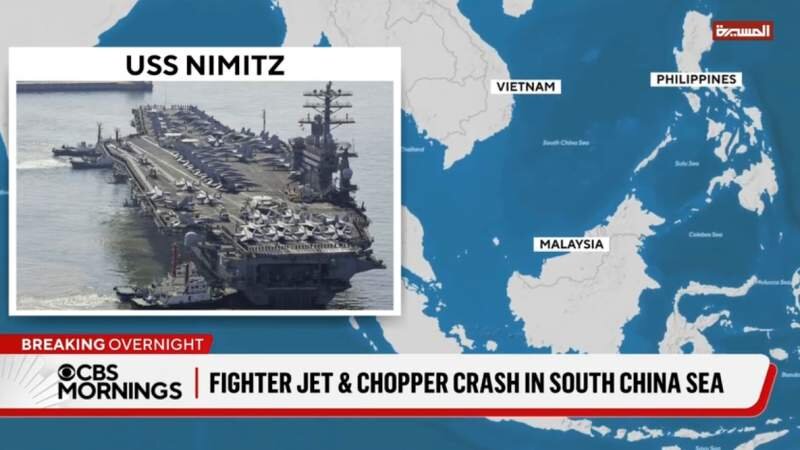
The Naval Research Institute has confirmed that an F/A-18F Super Hornet fighter jet and an MH-60R Seahawk helicopter belonging to the USS Nimitz aircraft carrier crashed in separate incidents days after the carrier departed the region following the U.S. attack on Yemen. The Nimitz entered the South China Sea on October 17th.
Former President Donald Trump called the series of accidents “very unusual” and suggested fuel contamination as a possible cause. “It’s very unusual for something like this to happen,” President Trump said, emphasizing his concerns about operational preparations.
These recent incidents continue a troubling pattern for the Navy, which has lost five F/A-18 aircraft in less than a year. A similar aircraft crashed off the coast of Virginia in August, and the Navy lost two more of its type in April and May during operations from the USS Truman in Yemen.
These operations included intense naval engagements between Yemeni forces and the U.S. Navy in the Red Sea. In December, another F/A-18 operating from the Truman was accidentally shot down by a missile fired from the cruiser USS Gettysburg, U.S. officials said.
The Wall Street Journal recently reported that there is growing concern in Washington about the declining influence of the U.S. Navy, noting that President Trump is personally overseeing a new military project called the “Gold Fleet” aimed at modernizing the Navy to make it more agile and capable of countering modern threats.
The project emerged following an internal assessment that revealed the current fleet was incapable of countering evolving threats, particularly a Yemeni attack in the Red Sea that exposed vulnerabilities in America’s naval defenses.
While some observers see the idea as an attempt to restore the Navy’s prestige lost after a series of failed operations in the Red Sea, other experts question its feasibility and say the plan could take many years to materialize and exceed the Trump administration’s current political timeline.
Operational challenges mount as the U.S. Navy faces increasing demands across multiple theaters, from the South China Sea to the Red Sea, testing the sustainability of current deployment patterns and maintenance cycles. Military analysts have suggested that these incidents may indicate a broader strain on naval resources as the United States maintains simultaneous engagements in conflict zones around the world.
Between May and June, Yemeni forces conducted three successful operations that forced the U.S. Navy to reposition its fleet. The US aircraft carrier Abraham Lincoln attempted to maneuver from a distance deemed safe, but then took a longer route to avoid targets in Yemen and was forced to withdraw on November 12, 2024.
The aircraft carrier USS Roosevelt then participated as an observer without any conflicts, but the aircraft carrier USS Harry S. Truman became the focal point of the operation and faced more than 22 declared targeted attack incidents in less than six months. When the USS Carl Vinson intervened to relieve pressure on Truman, the Yemeni side marked one of its most significant operations to shake up the Pentagon and raise concerns in Western military circles.
These operations mark a significant evolution in Yemen’s missile capabilities, allowing it to challenge what was once thought to be U.S. naval superiority and turning the Red Sea into a testing ground for Western military technology.
MNA