
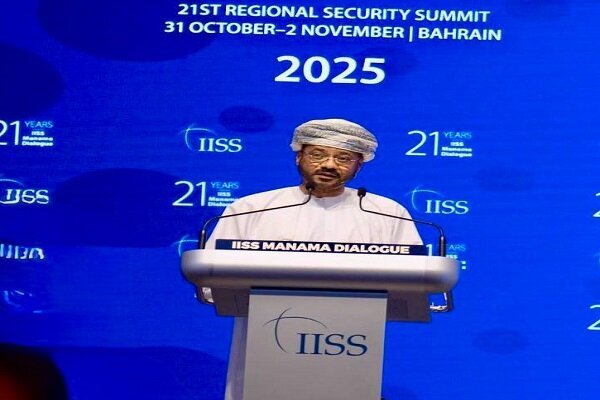
Oman’s Foreign Minister Badr Al-Busaidi, speaking at a roundtable discussion held on the sidelines of the Manama Dialogue, an annual conference organized by the International Institute for Strategic Studies (IISS) in Bahrain, said: “We hope for a resumption of talks between Iran and the United States,” Abash news website reported.
He noted that Oman had hosted five rounds of dialogue between Iran and the US this year, adding: “Just three days before the sixth dialogue that could have turned the tide, Israel launched a devastating, illegal and deadly invasion of bombs and missiles.”
Oman’s foreign minister urged Arab states along the Persian Gulf to prioritize dialogue with Iran and major regional powers that are often seen as rivals.
“The Persian Gulf Cooperation Council has contributed to Iran’s isolation for many years, and this trend must change,” Bousaidi said.
He emphasized that Oman has historically played a mediating role between Iran and other countries, and expressed hope for establishing a comprehensive dialogue mechanism between countries such as Iran, Iraq and Yemen.
Al-Busaidi explained that Iran has been perceived as a threat since the 1979 Islamic Revolution, largely due to concerns that Iran is trying to export the revolution and destabilize neighboring countries. “It was once believed that isolating and containing Iran was the best solution. But from Oman’s perspective, that was never the real solution.” He added that Iran has recently shown signs of tolerance, especially in its relations with Western countries, and has expressed a desire to integrate into the regional order.
“Through constructive engagement with neighboring countries, Iran can demonstrate that it is not a threat, but a committed partner that promotes stability and cooperation in the region,” al-Busaidi said.
Referring to Iran’s stance during Iraq’s invasion of Kuwait in 1990, he said, “Iran showed remarkable restraint. We interpreted this as a sign of readiness for dialogue and supported the idea of a general and comprehensive security framework for the region. In retrospect, if such a framework had been established, events like the 2003 war might not have happened and many lives could have been saved.”
Al-Busaidi concluded that despite these opportunities, the policy of containment has continued and Iran has always been treated as an external threat.
He said there was “no serious effort made to include Iran in discussions about regional security.”
On June 13, Israel launched a blatant and unprovoked invasion of Iran, sparking a 12-day war that left at least 1,064 people dead in the country, including military commanders, nuclear scientists, and civilians.
The United States also entered the war by bombing three Iranian nuclear facilities in a serious violation of international law.
In response, Iranian forces targeted strategic locations throughout the occupied territories, as well as Al Udeid Air Base in Qatar, the largest US military base in West Asia.
On June 24, Iran successfully thwarted the invasion through successful retaliatory operations against both the Israeli regime and the United States.
MNA