
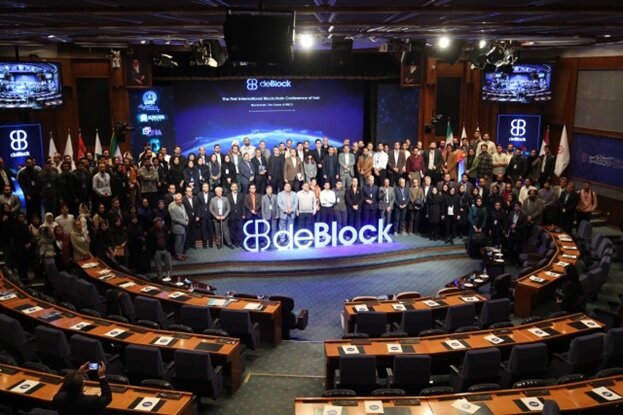
The event, which began with a message from Iranian Parliament Speaker Mohammad Berger Ghalibaf, brought together economists, fintech experts, diplomats, and representatives from BRICS member states to discuss the role of digital assets in shaping the future of Iran and the global economy, and emphasized the need for a national roadmap for cryptocurrency regulation.
Planned and promoted over 18 months, the two-day conference served as a nexus for strategic policy-making, academic research, and technical expertise in the field of cryptoassets and the digital economy.
Ghalibaf: Cryptocurrency is essential for Iran’s future economy
The opening ceremony began with the reading of Ghalibaf’s message by Tehran City Councilor Ali Asghar Qaemi. In his statement, the Speaker of the National Assembly emphasized:
“Cryptoassets are essential to Iran’s economic future,” he said, calling for the development of a national roadmap to guide the development of this industry. “
Regulation without a strategy can lead to instability and capital flight,” he warned, stressing that the Majlis stands ready to work with scientific elites and entrepreneurs to develop forward-looking legislation that harnesses the potential of emerging financial technologies.
Referring to the changing structure of global power and the rise of blocs like BRICS, Ghalibaf added:
“The world economy is moving towards multipolarity. International cooperation within frameworks such as BRICS creates strategic opportunities for states. For the Islamic Republic of Iran, this cooperation provides a means to diversify financial exchange mechanisms and reduce dependence on the traditional financial system.”
He also referred to Iran’s goal of a 10% share of the digital economy in the country’s Seventh National Development Plan, noting that this goal cannot be achieved without the use of crypto assets. The Chair called on the Ministry of Economy and Finance, the Central Bank and the Ministry of Industry, Mines and Trade to take “realistic and concerted action” towards healthy and regulated growth in the sector.
Cryptoassets: A tool for economic independence for BRICS
The central theme of deBlock 2025 was the intersection of decentralized technology and BRICS financial cooperation. Organizers say blockchain and crypto assets have the potential to serve as the technological basis for financial infrastructure in BRICS countries. This concept brings together economists, policy makers, and researchers to explore nontraditional models of international financial interactions.
Pouria Astaraki, founder and secretary of deBlock, highlighted the role of blockchain in the global de-dollarization movement, saying:
“Bitcoin is the first technology market to de-dollarize. Bitcoin’s resilience against the dollar’s dominance symbolizes the emergence of a technology front against US financial hegemony.”
Astaraki announced that over 100 research papers were submitted from around the world, and the top 20 papers were awarded a total of 12 Ethereum tokens (worth over $40,000) in recognition of their contributions to the field.
Representatives from 15 countries attended
According to organizers, the conference was attended by representatives from more than 15 countries, including BRICS member states and Central Asian countries. The wide participation of diplomats, academics, fintech entrepreneurs, and executives from online exchanges added a diplomatic and global dimension to the event and attracted the attention of international media.
Hakim Javadi, head of the Iranian ICT Guild organization, likened the blockchain revolution to the Internet revolution, saying:
“To overcome the economic crisis, we need to move to blockchain. This technology is revolutionizing the concept of trust and transforming traditional economic models.”
Shamseddin Hosseini, chairman of the Parliamentary Economic Affairs Committee, also emphasized that smart governance and achieving the targeted 10% share of the digital economy are “not possible without crypto assets.” He added that technology must improve quality of life and that lawmakers have a responsibility to ensure a safe and transparent regulatory framework for this transformation.
Signed a memorandum of understanding with Trescon Global
The main highlight of the event was the signing of a Memorandum of Understanding (MoU) between deBlock Conference and Trescon Global, a Dubai-based international organizer of major technology events including the World Blockchain Summit. This agreement marks an important step towards deBlock’s internationalization.
Reza Soltani, executive director of deBlock, announced that the MoU aims to facilitate the holding of regional or international editions of deBlock in Dubai and explore the creation of a “Wiki FinTech” platform in Tehran.
“As someone who is deeply committed to his homeland, I believe that Iran has the potential to become a regional hub for decentralized technology,” Soltani said. “Cooperation with Trescon can attract foreign investment, increase international trust and expand technological collaboration with BRICS countries.”
A step towards the future of Iran’s digital economy
With the participation of media outlets, regulators, knowledge-based companies, and crypto market players, deBlock 2025 is recognized as Iran’s first comprehensive and policy-driven gathering on crypto assets.
According to the conference secretariat, future goals include publishing a collection of scientific papers, establishing permanent international partnerships and creating a permanent secretariat for the next edition. Organizers emphasized that deBlock 2025 is not just an event, but the beginning of a movement to position Iran as a regional hub for blockchain and crypto assets in cooperation with BRICS and other emerging economies.


MNA