
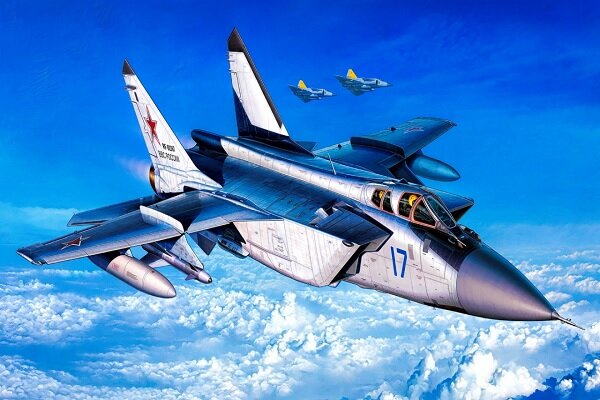
“The Federal Security Service (FSB) uncovered and thwarted an operation by the Main Intelligence Directorate of the Ministry of Defense of Ukraine and British personnel to hijack a Russian MiG-31 supersonic high-altitude fighter jet equipped with Kinzhal hypersonic missiles,” the agency said in a statement.
According to the FSB, Ukrainian intelligence attempted to recruit a Russian pilot and offered him a $3 million reward in exchange for flying the aircraft to a NATO-aligned location, adding: “Subsequently, (Ukrainian) intelligence planned to send an aircraft equipped with Kinzhal missiles to the deployment area of NATO’s largest air base in southeastern Europe, in the Romanian city of Constanta, where it could be shot down by air defense systems.”
FSB officials revealed that Bellingcat, an investigative reporting organization based in the Netherlands, was involved in the operation. The group is accused of acting as a recruitment agent. “When contacting the commander of the aircraft, the intelligence services used a journalistic organization called Bellingcat, which was already under our surveillance,” the officer told Russia 24 broadcaster.
Earlier in the day, the FSB reiterated that the attempted hijacking was part of a broader intelligence operation organized by Ukrainian and Western actors, particularly Britain.
On the same day last year, the FSB announced that it had also thwarted an attempt by Ukrainian military intelligence to seize an electronic warfare helicopter belonging to the Russian Aerospace Forces.
“The Federal Security Service discovered and thwarted an operation by the Main Intelligence Directorate of the Ministry of Defense of Ukraine to hijack a Mi-8MTPR-1 electronic warfare helicopter of the Russian Aerospace Forces,” the FSB said in a statement.
It also said that Ukrainian military intelligence officers had recruited Russian pilots to hijack the aircraft and transport it to areas controlled by the Ukrainian military.
According to the FSB, the information collected by Russian counterintelligence services that disrupted the Kiev operation allowed the Russian military to effectively target Ukrainian air defense positions and the positions of Ukrainian military units.
MNA