
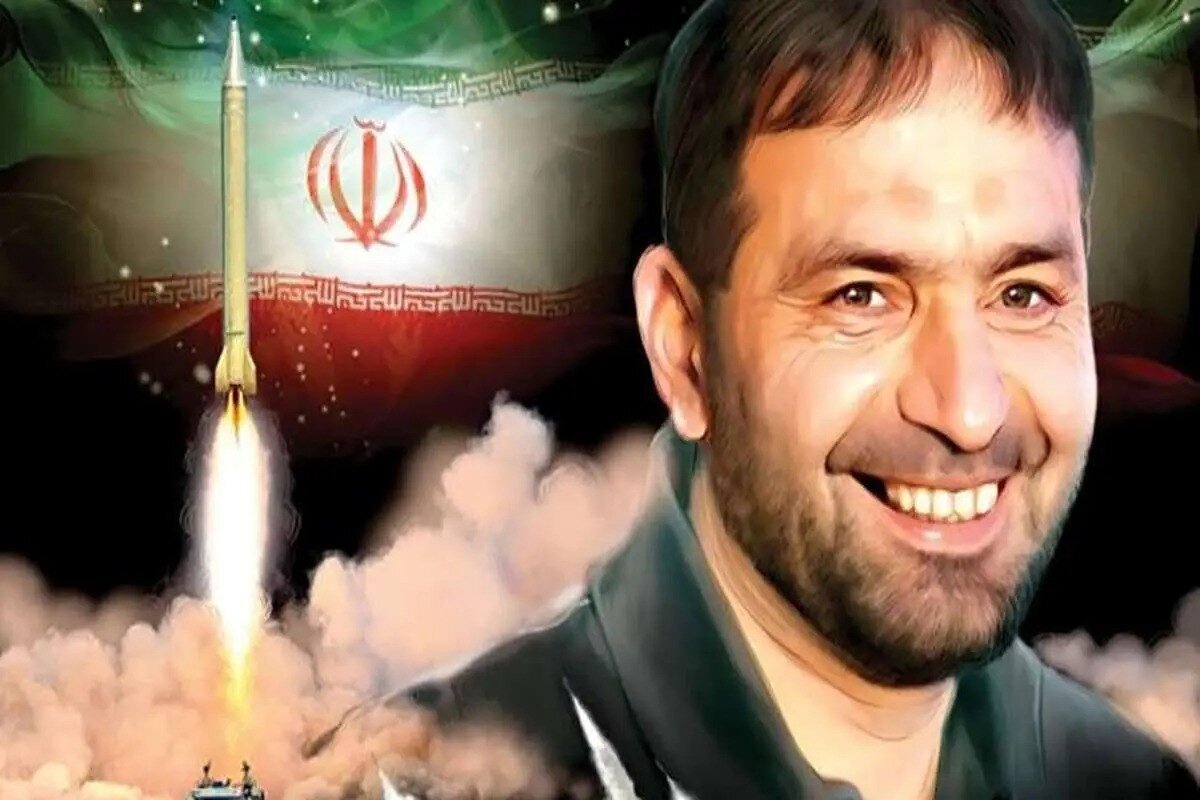
He played a key role in developing Iran’s indigenous missile capabilities during the war imposed in the 1980s, and trained a number of aerospace commanders to continue the mission, Press TV reported.
Born in 1959 in the Sarchesme area of central Tehran, Teherani Mokadam completed his high school education in 1977.
He received his bachelor’s degree in mechanical engineering from Sharif University of Technology in 1979 and his master’s degree in industrial engineering from Khajeh Nasir al-Din Toosi University two years later.
When the Islamic Revolutionary Guards Corps (IRGC) was created, at the young age of 21, Tehrani Moqaddam joined the intelligence branch of the Third Region in northern Iran as a young cadet.
After the success of Operation Samen ol-Aymeh, which liberated the city of Abadan in southwestern Khuzestan province from Western-backed Iraqi Baathist forces in 1981, it recognized the urgent need to increase fire support on the front lines.
Inspired by this realization, he drafted a plan to meet this challenge and submitted it to Hassan Bagheri, then head of intelligence for the Revolutionary Guards. Following his proposal, the Revolutionary Guard Artillery Unit and the Ahvaz Artillery Research Center were established.
Tehrani Mokadam played a leading role in establishing the Revolutionary Guards Artillery, using 155 mm and 130 mm towed shells, as well as Portuguese 105 mm shells.
In the mid-1980s, as Iraq escalated its missile attacks on Iranian cities with support from Western governments, including the United States, Iran sought to compensate for shortcomings in its missile defenses with limited foreign aid.
Utilizing the acquired technology and under his visionary leadership, the Revolutionary Guards began developing Iran’s first indigenous missile and successfully launched its first missile in the Iraqi city of Kirkuk in March 1985.
A second missile hit an 18-story military facility in Baghdad, followed by a second missile at an Iraqi military officer’s club in the same city, killing about 200 Ba’athist military commanders involved in the war against Iran.
In 1986, Tehrani Moqaddam was appointed commander of the Revolutionary Guard’s air and missile division, and a few months later helped establish the first missile force of the Lebanese Hezbollah resistance movement.
During the last two years of the war, he helped develop the Nazet, a short-range tactical ballistic missile or rocket artillery system, along with Ogav, one of the country’s earliest systems.
After the war, he continued to spearhead advances in Iran’s missile industry, increasing its range, destructive power, and technology, resulting in the Shahab and Zelzal missile series.
In the 1980s, Iran had the Oghab, which had a range of 45 km, and the Nazeat, which had a range of 100 km, which paved the way for intermediate-range ballistic missiles by the late 1990s, and a number of new models such as the Ashura and Sezir were introduced in the following decade.
Thanks to his efforts over the years, Iran has emerged as a major missile power with an extensive missile arsenal capable of overwhelming any enemy, including the illegal Zionist organization.
Tehrani Moqaddam was martyred on November 12, 2011, along with 16 of his comrades, at the Amir al-Muminin garrison in Marad, west of Tehran.
Tehran Moqaddam and his fellow martyrs were buried with the highest national honors in Tehran’s Behesht-e Zahra cemetery, along with many other martyrs, mainly from the wars of the 1980s.
At a commemorative event in Tehran last year, General Majid Mousavi, then deputy commander of the Aerospace Division of the Revolutionary Guards, paid his heartfelt tribute to Tehrani Moqaddam and his enduring legacy.
“A few days after the death of martyr Hassan Tehrani Moqaddam, his photo was circulated with a thought-provoking caption,” he said. “Few people realized its significance at the time, but it resonates deeply today.”
“The caption read, ‘Martyr Hassan Tehrani Moqaddam is the eternal nightmare of the Zionist regime.’” This truth is evident today across the terrain of resistance, in holy sites led by Iranian leadership and playing a key role in defending the Islamic Revolution. ”
Tehrani Moqaddam’s wish was, “When I die, please write this on my grave. Here lies the man who tried to destroy Israel.”
General Mousavi currently heads the Revolutionary Guard’s aerospace division after his predecessor, General Amirali Hajizadeh, was martyred in Israel’s military invasion of Iran in June.
General Hajizadeh was one of the greatest disciples of Tehrani Moqaddam’s School of Thought and Training and continued his unfinished mission until his martyrdom earlier this year.
His achievements, along with those of Tehrani Moqaddam, were visible to everyone during the 12-day war. Hundreds of Iranian high-precision missiles struck the occupied territory, penetrating the multi-layered air defense systems of Israel and the United States.
Today, Iran’s powerful missile and space programs are arguably the best in the world and stand as proud evidence of this great commander’s incredible legacy.
MNA/