
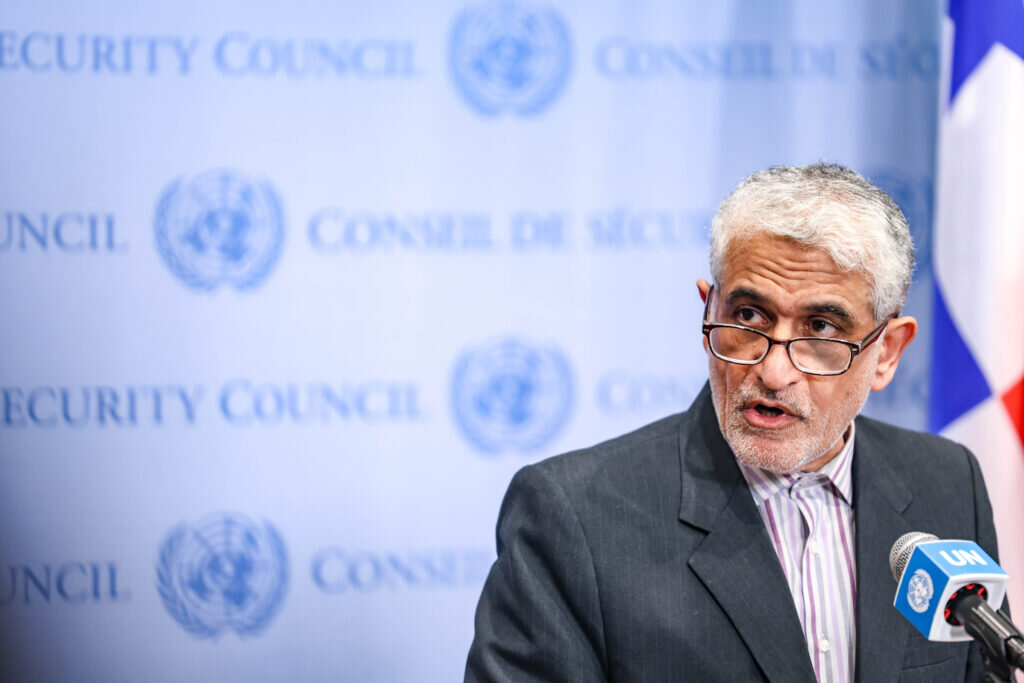
The Iranian ambassador made the remarks in a statement during a meeting to discuss the IAEA report. The full text of the statement is below.
Mr. President,
I would like to thank the Secretary-General for his report. However, such reporting must always be professional, fact-based, and free from political influence. The credibility of a government agency depends entirely on its impartiality.
Nuclear energy is essential for development and energy security, especially in developing countries. The transfer of nuclear science and technology guaranteed by Article 4 of the NPT and the IAEA Statute is an inalienable right and not a privilege. Safeguards must facilitate, not hinder, the peaceful uses of nuclear energy. Any attempt to exploit nuclear proliferation concerns to deny developing countries their legitimate rights constitutes a serious violation of the letter and spirit of the NPT.
What is alarming is that certain countries are systematically restricting developing countries’ access to peaceful nuclear technology, while at the same time arming and supporting the Israeli regime, a regime outside the NPT that secretly possesses weapons of mass destruction. Such double standards, coupled with unlawful unilateral coercive measures, seriously undermine the credibility of the non-proliferation regime and the Agency’s technical cooperation mission.
Mr. President,
In June 2025, the world witnessed a brutal invasion. The Israeli regime launched a major military attack on Iran’s secure nuclear facilities, which are under full IAEA surveillance, just hours after a politically motivated resolution at the IAEA Board of Governors. These criminal attacks targeted Iranian scientists and their families, killed and injured thousands of people, and caused extensive property damage.
On June 22, the United States, a permanent member of the Security Council and depositary state of the NPT, joined the invasion, directly targeting facilities monitored by the IAEA. These actions were in flagrant violation of international law, the United Nations Charter, the IAEA Statute, and Security Council Resolution 487 (1981), which expressly prohibits attacks on protected nuclear facilities.
This was not just an attack on one member state. It was an attack on the authority of the United Nations, the credibility of the United Nations, and the integrity of the safeguards system itself.
Relevant General Assembly resolutions, in particular GC(XXIX)/RES/444 and GC(XXXIV)/RES/533 Although the United Nations clearly affirms that armed attacks or threats against nuclear facilities intended for peaceful purposes violate the principles of the Charter of the United Nations, international law and the Statute of the Atomic Energy Agency, the Director-General reiterates that nuclear facilities must never be attacked under any circumstances, as such actions pose significant risks to people, the environment and nuclear weapons. In the interests of security, safeguards and safeguards, as well as regional and international peace and security, it is extremely unfortunate that this illegal attack on Iran’s peaceful nuclear facilities was not condemned by the Organization, the Security Council, or even the Director-General himself.
Unfortunately, neither the President of the General Assembly nor the Director-General of the IAEA were once again able to condemn these unlawful attacks in their statements on this topic.
Mr. President,
Iran has been a responsible party to the NPT since 1970. However, the E3 and the United States go along with the Israeli regime’s fabrications and continue to misrepresent Iran’s peaceful nuclear activities, while the Israeli regime, the region’s only nuclear-armed state and the main obstacle to a nuclear-free Middle East, acts with complete impunity.
Despite sabotage, assassinations, illegal sanctions, and direct attacks on currently secured facilities, Iran has never violated its JCPOA, NPT, or security measures obligations and remains committed to diplomacy.
The Director-General’s recent report (GOV/2025/50-53) confirms that the suspension of inspections is a direct result of these armed attacks. The responsibility lies entirely with the perpetrator, not the victim. Currently, there are no safeguards provisions governing how to maintain hostilities in situations of armed invasion or continued threat. Therefore, a new framework is needed to ensure the safety of nuclear personnel and nuclear facilities under such extraordinary circumstances.
In a constructive spirit, Iran and Iranian government agencies signed a memorandum of understanding in Cairo on September 9, 2025, aimed at addressing these challenges. Unfortunately, this positive development was quickly undermined by the hostile actions of the United States and the E3, which continue to block any diplomatic initiatives, including balanced proposals by China and Russia in the Security Council.
E3’s activation of the so-called snapback mechanism is an illegal and reckless act aimed at destroying the last bridge to diplomacy and is invalid. Since they themselves are in violation of the JCPOA and Resolution 2231, they have no legal standing to enforce its provisions. Resolution 2231 will permanently expire on October 18, 2025, and all related restrictions will end. Any attempt to reinstate or enforce them is an unlawful abuse of process and must be rejected by this Parliament and the Secretary-General.
Mr. President,
Iran will never give in to threats or coercion. We only respond to respect, legality and equality. Military aggression and economic terrorism will not force Iran to abandon its legitimate rights.
Thank you, Mr. President.
MNA/