
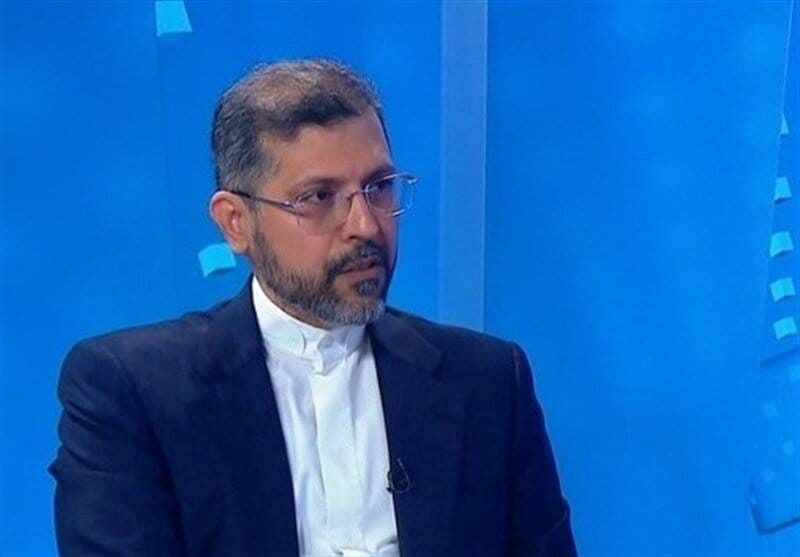
He made the remarks on the sidelines of the international conference “International Law Under Attack: Offense and Defense” held in Tehran.
Khatibzadeh told reporters that the United States had not shown any real readiness for results-oriented talks in recent months. “The Islamic Republic of Iran has made every effort in recent months to prevent escalation and war. Instead, what happened reflects misunderstandings and illusions,” he said.
He explained that Washington seeks to achieve its objectives through theatrical diplomacy rather than actual negotiations.
Khatibzadeh added that Iran is always ready to engage under the leadership of Islamic Revolutionary Leader Seyyed Ali Khamenei, prioritizing its highest national interests.
Elaborating on the use of the term “armed negotiations,” the deputy foreign minister said that given the United States’ maximum military arsenal and threat posture against other countries, any negotiations under such circumstances could not be fair. “This is not a neutral negotiation. The important thing is to pay close attention to the other party’s intentions and actions,” he said.
Khatibzadeh emphasized that Iran’s approach combines vigilance and preparedness. “Armed negotiations mean not only that we do not trust the other party, but also that we are fully prepared to take effective measures against any deception.”
He also highlighted Iran’s recent efforts to raise global awareness and build coalitions against U.S. and allied hegemony, noting that global militarization has reached unprecedented levels and must be stopped.
Khatibzadeh’s comments come at a time of heightened tensions between Iran, the United States and Israel. The statement reflects the Iranian government’s position that diplomacy remains a tool, but that negotiations will not take place under coercion or unilateral military threats.
This position complements a recent statement by Iranian Foreign Minister Seyyed Abbas Araghchi, who stressed that while renewed calls for dialogue have begun, negotiations must respect mutual interests, logic and good faith.
On June 13, while Washington and Tehran were in the process of nuclear negotiations, Israel launched a blatant and unprovoked invasion of Iran. The Israeli attack sparked a 12-day war that left at least 1,064 people dead in the country, including military commanders, nuclear scientists and civilians.
The United States also entered the war by bombing three Iranian nuclear facilities in a serious violation of international law.
In response, Iranian forces targeted strategic locations throughout the occupied territories, as well as Qatar’s Al Udeid Air Base, the largest US military base in West Asia.
On June 24, Iran successfully thwarted the invasion through successful retaliatory operations against both the Israeli regime and the United States.
MNA/3448852