
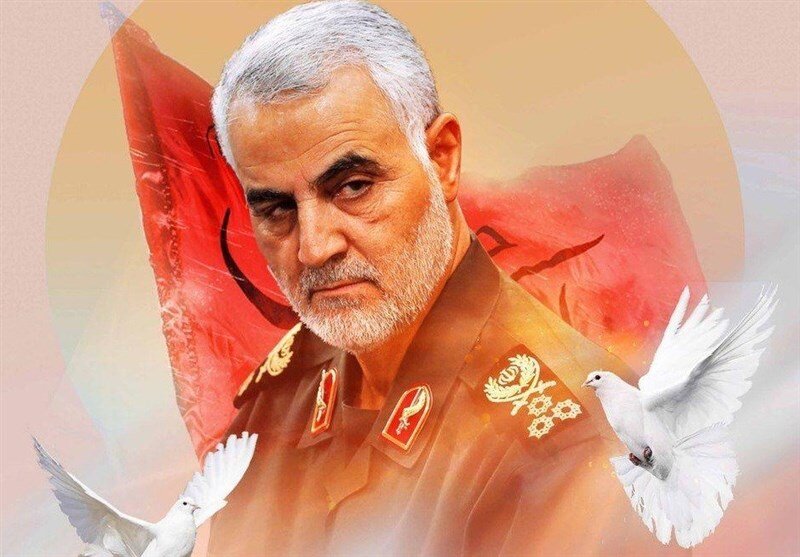
National Heroes Day is a day to remember how the martyr Lieutenant General Qassem Soleimani plotted the downfall of the ISIL terrorist organization.
On November 21, 2017, Iran’s parliament approved the establishment of National Heroes Day on the country’s official calendar, in recognition of the global courage of former Islamic Revolutionary Guard Corps (IRGC) Quds Force commander and martyr Lieutenant General Hajj Qasem Soleimani, who made great strides in the fight against the ISIL terrorist group in Islamic lands and territories.
On this day, the leader of the Islamic Revolution, Seyyed Ali Khamenei, sent a message of congratulations and condolences to the noble Islamic nation of Iran, saying that martyr Qassem Soleimani, former commander of the Quds Force of the Revolutionary Guards, belongs to the nation and is a “national hero.”
In a famous letter dated November 21, 2017, Iran’s iconic counterterrorism commander, Lieutenant General Qassem Soleimani, declared the fall of the ISIL terrorist group, which had ruled West Asia for years.
The letter was addressed to Ayatollah Seyyed Ali Khamenei, the leader of the Islamic Revolution, and announced that the “devastating storm” that had hit the Islamic world had ended.
To honor this monumental achievement, Iran officially designated November 21 as National Heroes Day, honoring the late counterterrorism commander’s pivotal role in ending a dark chapter in the region and commemorating one of his most important contributions to peace and stability in the region.
“This humble man, as a soldier called by His Holiness to serve on this battlefield, announces the end of the reign of this evil and cursed entity following the completion of the operation to liberate ISIL’s last stronghold, Abu Kamal,” excerpts of the letter read.
DAESH, also known as ISIL, emerged from Al Qaeda Remnants in Iraq (AQI), a local offshoot of the Al Qaeda terrorist organization, in the wake of the 2003 US invasion and occupation of Iraq.
However, it was not until 2011 that the group and its affiliates succeeded in capitalizing on Iraq’s growing instability and the Western-orchestrated crisis in Syria to consolidate their influence in two neighboring Arab countries.
By 2014, ISIL had taken control of Mosul and Tikrit in Iraq, and Raqqa and oil-rich Deir Ezzor in Syria. He then declared the establishment of a so-called caliphate, with Raqqa as its capital and stretching from Aleppo in Syria to Diyala in Iraq.
Remarkably, this feared terrorist group had already become so strict in its ideology and so aggressive in its approach that even al-Qaeda denied any association with it in February 2014.
In his letter, Soleimani revealed horrific crimes committed by Daesh in Syria and Iraq, including beheading children, skinning men alive in front of their families, raping young girls and women hostage, burning them alive, and massacring young people.
He said that by the time the terrorist group was eliminated, it had destroyed thousands of factories, roads, bridges, refineries, wells, gas and oil pipelines, power plants and historic sites, as well as thousands of mosques, Islamic holy sites, schools and hospitals in both Arab countries.
Confronting such atrocities required unprecedented synergy between regional resistance forces.
While the United Nations carried out highly publicized airstrikes in Iraq and Syria to defeat Daesh, regional resistance fighters and their heroes like General Soleimani rose up to end Daesh’s evil reign.
The famous Iranian counterterrorism general, in turn, played a central role in strengthening the axis of resistance in the West Asia region.
With his personal charisma, ability to unite diverse factions, and strategic genius, he coordinated between resistance forces and Iraqi and Syrian government forces to confront Daesh at its peak from 2014 to 2017.
“Iran is the center of resistance,” he once said when speaking about his country’s regional position.
The then-leader of Lebanon’s Hezbollah resistance movement, Saeed Hassan Nasrallah, had repeatedly praised Soleimani’s important role in coordinating and leading the regional resistance group’s efforts against Daesh.
In Iraq, Iranian generals worked closely with the Popular Mobilization Units (PMU), Kurdish forces, and government forces in key operations such as breaking the siege of Amirli in 2014 and liberating Tikrit in 2015.
His efforts helped stabilize areas such as Diyala and Saladin provinces, preventing Daesh from maintaining its territorial gains.
In Syria, it played a decisive role in military operations in Aleppo and Palmyra, coordinating with Russian air support to retake important territory.
He also reportedly visited Russia and persuaded Russian President Vladimir Putin to join military operations against Daesh in Arab countries.
Curiously, what stands out in this letter is Soleimani’s emphasis on the fact that Daesh was created by the enemies of Islam, particularly the United States and the Israeli regime, with the aim of “causing widespread war and inter-Islamic fighting within the Islamic world”, a “devastating and poisonous incitement”.
Quoting then-President Donald Trump, he wrote, “According to the knowledge of senior U.S. officials who currently serve as President of the United States, all of these crimes were planned and carried out by U.S. leaders and organizations.”
He further warned that the same plan “is still being modified and implemented by current U.S. leaders.”
Another notable aspect of Soleimani’s letter is that despite his heroic efforts, he selflessly attributes the credit for defeating Daesh to others and takes no credit for himself.
He graciously expressed his gratitude to the Islamic Republic of Iran and its government for its wise leadership and guidance, the Iraqi and Syrian governments and resistance forces, Hezbollah and its leaders, and the worthy support in the fight against Daesh.
In response to the letter later that day, Khamenei specifically thanked Soleimani for his valuable contributions “not only to regional countries and the Islamic world, but to humanity as a whole.”
He also stressed that Daesh was founded and supported by the United States and its client regimes in the region, saying the terrorist group was formed with the aim of strengthening the occupying Zionist regime’s strategic influence and control over the region.
Tragically, Soleimani’s life was cut short when he was assassinated in a US drone strike near Baghdad on January 3, 2020, nearly two years after his historic declaration.
Abu Mahdi al-Muhandis, deputy head of the PMU and iconic Iraqi Resistance Forces commander who played an equally important role in destroying the notorious terrorist group, was also assassinated along with Soleimani.
Despite this monumental and irreparable loss, Soleimani’s legacy lives on and is celebrated by millions of people who consider him a symbol of resistance and peace in the region.
National Heroes Day commemorates his contributions and honors a man whose determination and sacrifice brought hope to a region scarred by foreign-sponsored terrorism.
Perhaps Soleimani’s famous words – “We are a nation of martyrs. We are a nation of Imam Hussein” – best capture the spirit of heroic sacrifice and resistance that he embodied.
Edited and reported by Morteza Ahmadi