
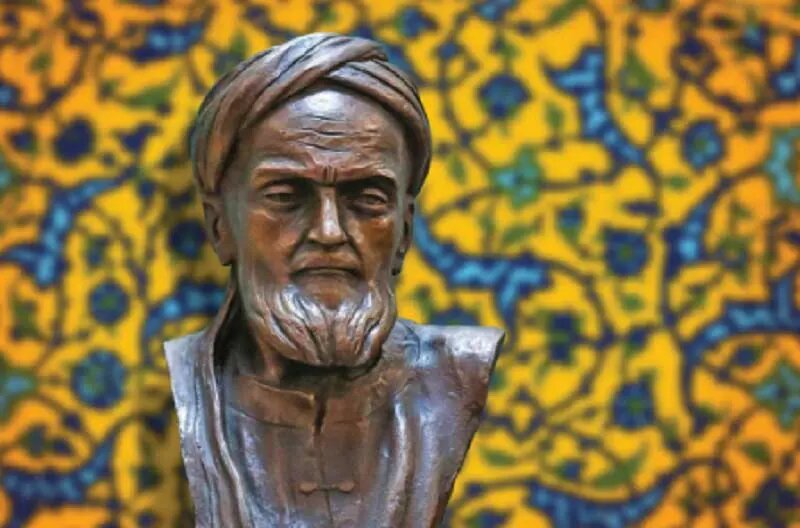
In the annals of Islamic intellectual history, few figures have a legacy as fundamental and enduring as that of Abu Nasr al-Farabi.
He is from Khorasan province and was born in the village of “Wasiji”, adjacent to the famous city of “Farab”.
It was in the heart of this city that he derived his famous name, a name symbolizing philosophical genius.
Bestowed with honorable titles such as “Second Teacher,” “Founder of Islamic Philosophy,” and “Transmitter of Greek Formal Logic,” al-Farabi is often regarded by historians and commentators as the preeminent philosopher in the Islamic tradition.
Al-Farabi’s early career path included serving as a judicial officer. However, his deep penchant for philosophical inquiry and metaphysical speculation forced a dramatic change.
At the age of 40, he resigned from his position and embarked on a journey to Baghdad, a vibrant intellectual hub of the time.
There he immersed himself in the study of logic and philosophy under eminent scholars and developed a special fascination with Aristotle’s corpus.

This deep engagement with Aristotle’s works cemented his reputation as the “Second Teacher,” the direct successor of the “First Teacher,” Aristotle himself.
Despite a life often marked by austerity, al-Farabi’s academic enthusiasm never waned. He enthusiastically expanded his expertise into a variety of fields, including mathematics, theology, alchemy, military strategy, music, and medicine.
The basis of al-Farabi’s work lies in his prolific writings in philosophy and logic, including extensive commentaries on Plato and Aristotle.
His most famous works include “The Opinions of the People of the Virtuous City,” a prescient treatise on political philosophy. “Risala fi’l-Aql” (“Treatise on Intelligence”), an incisive analysis of intelligence. and Tahsir al-Saada (The Achievement of Happiness), which outlines the path to human prosperity.
He wrote in nearly every scientific field except medicine, and established authoritative reference bibliographies in mathematics and musicology that remain influential.
Al-Farabi set himself apart from previous commentators in that he sought to comprehensively understand rather than simply explain.
In his seminal work, Al-Jam Bai La Yai Al-Hakimain (The Harmony of the Opinions of the Two Wise Men), he sought to reconcile the philosophical systems of Plato and Aristotle, insisting on the underlying commonality and shared divine inspiration of their core concepts.
Moreover, his ambitious Ihsa’ al-Ulum (‘Enumeration of the Sciences’) represents a systematic catalog of all modern knowledge, establishing him as perhaps the first Islamic scholar to devise a comprehensive encyclopedia.
In the area of logic, his contributions were particularly transformative. He mastered Aristotle’s entire logical system and created a detailed commentary on the complete “Organon”. His approach was active innovation rather than passive acceptance.
Al-Farabi is credited with making crucial conceptual breakthroughs, such as the division of science into “conceptualization” (tasawwur) and “assent” (tasdik), and the introduction of the important dichotomy between “necessary” (wajib) and “possible” (mumkin) existence.
These innovations provided a new and durable framework for Aristotelian logic. His tireless efforts effectively paved the way for subsequent luminaries such as Avicenna and Nasir al-Din al-Tusi to refine and mature the science of logic.
The repercussions of al-Farabi’s books and ideas caused significant changes in the subsequent scientific and religious environment. This monumental influence justifies his title of “Muslim philosopher”.
He was instrumental in incorporating philosophy into the Islamic world, demonstrating the convincing compatibility between austere rational discourse and Islamic thought.
His synthesis was so brilliant that philosophy and logic became, and remain, essential elements of advanced religious education.
Other scholars of comparable stature have emerged, but none have replicated the deep and fundamental influence al-Farabi had on the trajectory of Islamic philosophy and logic. This is evidence of al-Farabi’s unique synthesis of erudition, originality, and historical timing.
The lasting impact of al-Farabi’s book cannot be overstated. His seminal work, The Opinions of Good City People, provided a blueprint for ideal governance that influenced political thought for centuries.
By harmonizing Greek philosophy and Islamic theology in texts such as The Harmony of the Two Wise Men, he secured a permanent place for rational inquiry in Islamic scholarship.
His groundbreaking classification of the sciences in Enumeration of the Sciences systematically organized human knowledge, and his revolutionary refinement of Aristotelian logic created the very framework on which later giants like Avicenna would build.
After all, Alfarabi’s achievement is that he not only preserved ancient wisdom. He transformed it into a dynamic intellectual tradition, ensuring that philosophy and logic became the foundational pillars of education and scientific inquiry in the Islamic world and beyond.
Report by Tohid Mahmoodpour