
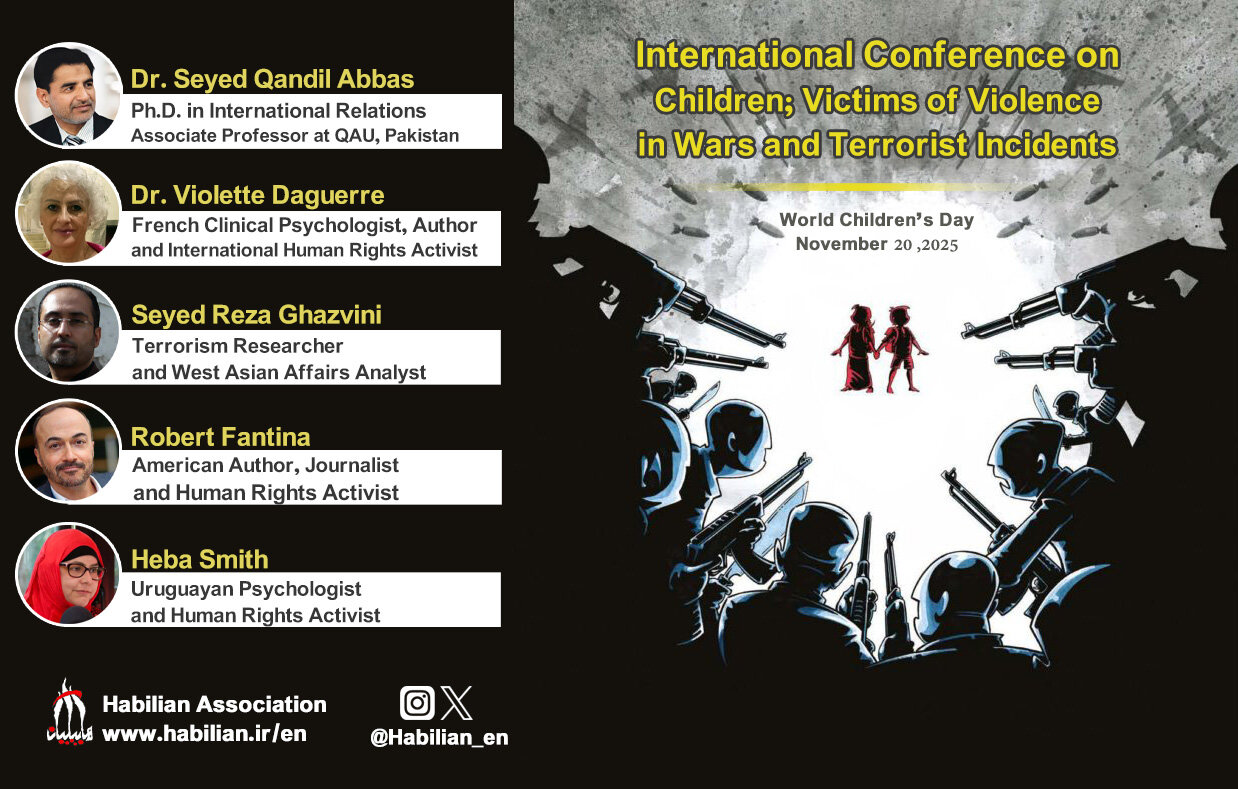
An international session titled “Children: Victims of Violence in War and Terrorist Incidents” was organized by the Habilian Society on World Children’s Day and brought together a group of experts and researchers from Pakistan, France, Iran, the United States and Uruguay.
The event featured testimonies and expert analysis on psychological trauma, physical casualties, international legal failures, and the systematic dehumanization of young victims. A recurring theme was a condemnation of the international community’s double standards and the urgent need for a united global response to protect the universal rights of children.
The conference began with a lecture by Mr. Seyed Qandil Abbas, an associate professor of international relations from Pakistan. He presented extensive data on the impact of terrorism in Pakistan, revealing that since 2003 more than 9,000 children have been killed or injured and 1,500 schools have been destroyed. Prime Minister Abbas highlighted the massacre of 132 children in the 2014 Army Public School attack at the peak of terrorism. He detailed serious indirect effects, including a 22-34% decline in school attendance, a 70% PTSD rate among conflict-affected children, and a 20-30% increase in child labor, and concluded that effective counter-terrorism efforts must incorporate psychological support and continuing education.
Next, Violette Dagher, a French-Lebanese psychologist and human rights activist, analyzed the emotional trauma inflicted on children in Gaza. She described their trauma not as simple PTSD, but as “complex and compound” historical and intergenerational trauma. Mr Dugger explained that due to constant exposure to shelling, loss of family members, evacuation and deliberate destruction of a stable environment, children are in a constant state of alert and suffer from anxiety, depression and behavioral disorders. She also raised alarming concerns about the exploitation of missing children for organ trafficking and sexual slavery.
The next speaker, Iranian terrorism researcher Seyyed Reza Ghazvini, recorded in his speech that approximately 2,000 Iranian children under the age of 18 were martyred during 40 years of terrorism. He pointed to the role of terrorist organizations, including the Mujahideen Khalq (MEK), in separating children from their parents and inflicting deep trauma on them, citing tragic examples such as terrorist attacks from the 1980s to the recent Kerman incident and the Zionist regime’s 12-day war against Iran. He also criticized the inaction of international organizations towards Iranian children who are victims of terrorism.
Also in the session, American author and human rights activist Robert Fantina referred to a report by Save the Children and UNICEF that said more than 20,000 children have been killed in Gaza and tens of thousands more injured or disabled. He described the differences in the global response to Ukrainian and Palestinian refugees as a clear example of political bias and discrimination, and in this context pointed to the differences in Canada’s response to the two groups of asylum seekers.
Heba Smith, a Uruguayan psychologist and human rights activist, was the final speaker and examined the situation in Gaza, focusing on the process of dehumanization of Palestinians and its devastating psychological effects. She said children in Gaza were battling depression, cognitive decline due to malnutrition and suicidal thoughts, and a collapsed health system was exacerbating the situation. Mr. Smith concluded his speech by emphasizing “sumud,” or the steadfast resilience and hope for justice of the Palestinian people.
The Habilian Society said the purpose of holding the meeting was to create international solidarity and form a more united intellectual front among experts and researchers to counter violence inflicted on children in conflicts and terrorist incidents. The full video and speech text of this international session will be available soon.
MNA/