
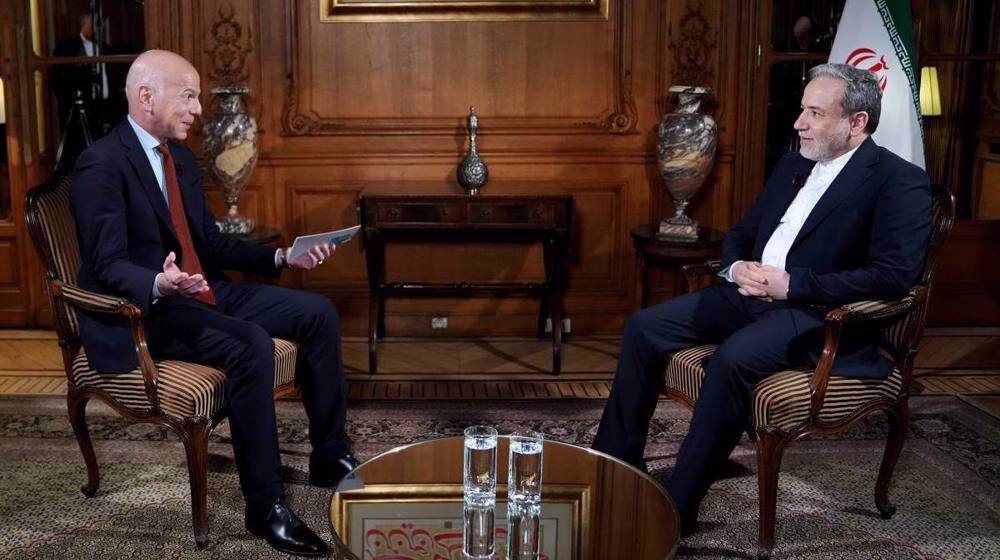
“Negotiations mean dialogue, not orders. We reject anything that is based on orders,” the top diplomat said in an interview with France 24 in Paris on Wednesday.
He went on to criticize a lack of real intent on the U.S. side and the absence of an ongoing negotiation trajectory.
“The reason is clear: the United States has no will to seek real and fair negotiations,” he said, recalling that Iran had long demonstrated its willingness to engage in diplomacy.
The official cited the Islamic Republic’s participation in the negotiation process that led to the 2015 nuclear deal between Iran and world powers, which was abandoned during President Donald Trump’s tenure.
He also referred to the negotiation process that began earlier this year but was irrevocably disrupted by the imposed and illegal joint Israeli-American war against Iran.
Despite all this, Araghchi said the Iranian government’s stance is tantamount to a refusal of diplomacy, but a refusal of negotiations shaped by coercion.
“Iran will never say ‘no’ the day Washington announces its readiness to put aside the excessive demands imposed on it and pursue a serious, win-win dialogue based on mutual benefits,” he said.
“But I don’t think we are ready for that now. We are not in a hurry. We are waiting. We will be patient until the United States shows real intentions, not exaggerated demands,” the foreign minister said.
The interview also touched on regional diplomacy and recent media claims regarding President Massoud Pezeshkian’s letter to Saudi Crown Prince Mohammed bin Salman.
Araghchi flatly denied claims that the communication was about potential Riyadh-mediated talks between Iran and the United States.
However, he said the Islamic Republic had “complete trust” in Saudi Arabia on nuclear issues, and insisted that bilateral relations and trust between the two countries had improved in recent years.
Meanwhile, the official reiterated that the challenge facing Iran on the nuclear issue lies not in a lack of mediators, but in the US approach to negotiations.
Objection to IAEA Board resolutions
Aragushi went on to refer to the Islamic Republic’s rejection of the International Atomic Energy Agency (IAEA) Council’s latest anti-Iranian resolution, which called for immediate and unconditional access to Iran’s nuclear facilities, which were devastated during the Israel-US war.
He said the resolution ignores “the reality on the ground,” including the attack and its aftermath.
The official noted that such a bombing of a civilian nuclear facility was unprecedented and that government agencies had no procedures in place to inspect nuclear facilities damaged by bombings.
“Negotiations mean dialogue, not orders, and we reject anything that is based on orders,” the diplomat said in an interview with France 24 in Paris on Wednesday, according to Press TV.
He went on to criticize a lack of real intent on the U.S. side and the absence of an ongoing negotiation trajectory.
“The reason is clear: the United States has no will to seek real and fair negotiations,” he said, recalling that Iran had long demonstrated its willingness to engage in diplomacy.
He said access to attacked sites remains dangerous due to unexploded ordnance, chemical and radiological contamination, and the risk of a new attack by Israel or the United States, and a new safety-focused framework is essential before inspectors approach affected areas.
He called on board members to avoid further escalatory decisions until a new framework defining how affected facilities will be inspected is finalized.
“Israel and the United States underestimated Iran’s power.”
Touching on the issue of war, Aragushi said the Israeli regime and the United States misread Iran’s level of power during the war, and in retaliation Iranian missiles struck enemy targets with “increased power and precision.”
He reminded that although both Tel Aviv and Washington had earlier called for Iran’s “unconditional surrender,” retaliation forced calls for a ceasefire.
About prisoner exchange with France
Aragushi also commented on the case involving French nationals Cécile Kohler and Jacques Paris.
The men, who were previously held in Iran on suspicion of espionage, are now waiting at the French embassy in Tehran for permission to leave the country and are expected to be exchanged with Iranian scholar Mahdiye Esfandiari, who was arrested in France in February for his pro-Palestinian activities.
“This exchange has already been negotiated and agreed between Iran and France. All preparations on our side are in place. We are currently waiting for the legal and judicial procedures on both sides to be completed,” the foreign minister said.
However, it added that the exchange schedule would depend on France’s judicial schedule, particularly Mr. Esfandiary’s upcoming hearing.
“Her court hearing in France is scheduled for mid-January. Depending on the duration of the judicial process, the process could end within a month or two. However, if the French court finalizes the process, the prisoner exchange could take place by mid-January at the latest.”
MNA