
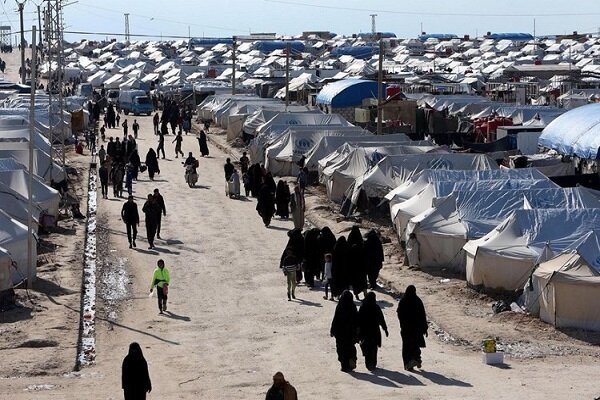
Al-Hawl Refugee Camp is a refugee camp located on the southern outskirts of the town of Al-Hawl in northern Syria, close to the Syria-Iraq border. The camp is considered one of the most complex and difficult places in the region, where thousands of women and children affiliated with ISIL live, and its unstable and abandoned atmosphere provides conditions for the reproduction of extremist ideology and the formation of a new generation of terrorist groups.
Initially a temporary refuge for war refugees, recent developments have turned al-Hawl into a de facto “mini-caliphate.” ISIL ideology is constantly reproduced here, and children who are out of school, without ID, and without a future are easily drawn to it.
The camp, which currently houses more than 50,000 people, is not only a humanitarian and moral challenge, but also a strategic threat to the security of Syria, Iraq, and even Europe. Many security analysts believe that if ISIL were to regain power, the starting point for its resurgence would be this besieged camp rather than the Syrian desert. There, extremist ideology continues to thrive amid global apathy.
Internal violence, organized breakouts, and ISIL sleeper cells
Countless incidents have occurred over the past year, showing that the security system in SDF-controlled garrisons is becoming increasingly weak. An operation to free dozens of women associated with ISIL was thwarted. Attacks were carried out against personnel of international organizations. There were also reports that some temporary schools were set on fire and explosives and knives were brought in. These incidents indicate that there is a crisis deep within the camp. Women in ISIL:
–Hold compulsory religion classes for children.
—Established a network to collect funds from outside Syria.
—Created a quasi-national structure.
— They are training children to become the second generation of ISIL fighters.
Children growing up in Al Hawl today receive little assistance from the outside world. They have no formal education system, no psychological counseling, no possibility of retirement, and no legal identity to secure their future. This widespread deprivation has made them susceptible to extremism.
ISIL returns amid lack of security and control in Iraq and Syria
Although ISIL has suffered setbacks since 2019, signs of its gradual resurgence are clearly visible in both Syria and Iraq. Past year:
ISIL attacks across Iraq have tripled.
ISIL sleeper cell in Syria reactivated.
Some of the group’s senior commanders have managed to form small but active networks.
The killing of commanders such as Zia Zoba al-Khardani only dealt a temporary blow to ISIL and did not prevent it from rebuilding its structure.
Meanwhile, al-Hawl serves as ISIL’s human and ideological base. A place where the hardcore of the group receives intellectual and human nourishment.
Diplomatic shift: From Damascus isolation to the need for security cooperation
Developments related to al-Hawl have led some countries that have long severed political ties with Damascus to recognize the need to cooperate with Syria’s new regime in addressing the ISIL threat. A clear sign of this change was the recent visit of the British Foreign Secretary to Damascus for the first time in several years, where he raised the issue of the “Al Khor threat” in official talks.
This political shift undoubtedly indicates that the threat posed by the tens of thousands of radical women and children in al-Hawl has reached a level that cannot be ignored by old policies. Additionally, Western countries are gradually coming to the conclusion that without Damascus’s active participation, or at least security coordination with Damascus, resolving the al-Hawl crisis is almost impossible.
International Summit on Al-Hawl. political agreement without implementation
At a recent UN summit, dozens of countries expressed concern about the humanitarian and security situation in al-Hawl. However, a political agreement does not mean that a practical solution has been reached. Western countries remain reluctant to accept nationals affiliated with ISIL. Asian countries are deferring this issue to an unknown future. And Iraq is the only country with a systematic plan to repatriate its citizens. This international indecision has effectively forced hundreds of children and adolescents down a path that closely aligns with the recruitment of ISIL ideology.
conclusion
Al-Hawl camp is more than just a crisis camp. It is a dangerous breeding ground for ISIL reproduction. While the world has not yet been able to find a realistic solution to this challenge, time is moving rapidly against regional and global security. If things continue as they are, a new generation of ISIL may emerge from this camp, far more dangerous, crazier, and better trained than the previous generation. The future of security in Syria, Iraq, and even Europe depends on how quickly the international community takes responsibility for this crisis and finds a way out of it.
MNA/6674236