
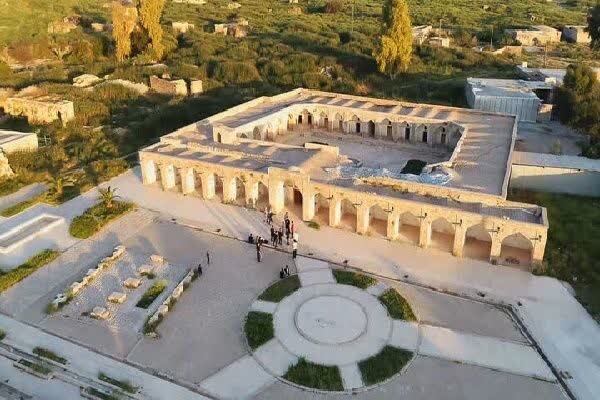
According to Mehul news agency, the head of archaeological excavations in Dehadasht has announced the discovery of a 7,000-year-old village within the historical city of Beladshahpur.
Zabihora Masudiniya announced on Saturday morning that evidence of a prehistoric village dating back to 5000 to 6000 BC has been discovered in the heart of the historic Dehadasht region.
He pointed out that no archaeological survey had been carried out in the historical city of Dehadasht so far. These excavations were the first exploration activities in the area, and several test trenches were dug after formal permission was obtained.
Masoudiniya explained that while the upper layers contained evidence from the medieval and late Islamic periods, removing these layers revealed surprising prehistoric layers. Early research indicates that these layers belong to the 5th millennium BC.
Masoudinia went on to point out that this discovery is very important and could greatly increase Dehadasht’s historical importance.
He added that architectural remains from the last centuries of the Islamic period can be seen on the surface. Archaeologists set up a small workshop to carefully examine the underlying layers of possible Seljuk and Safavid structures. Excavations have uncovered pottery shards and cultural materials dating back to 6,000 to 5,000 BC.
Archaeologists highlighted an interesting find: heated stone fragments. This shows a particular technique used by people at the time to heat liquids such as milk and water by placing heated stones in containers.
Referring to an aerial photograph from 1956, Masoudiniya pointed out that the historic mounds near Dehadasht Caravanserai were visible, but were largely destroyed by subsequent urban development. Nevertheless, evidence of a Neolithic village has now been recovered.
He added that the excavations helped to more precisely identify the main layout of the historic site, revealing that the majority of today’s streets, houses and alleys are located on top of this ancient mound. During the investigation, the remains of the qanat water transmission system were also discovered in the northern part of the city.
MNA/6679287