
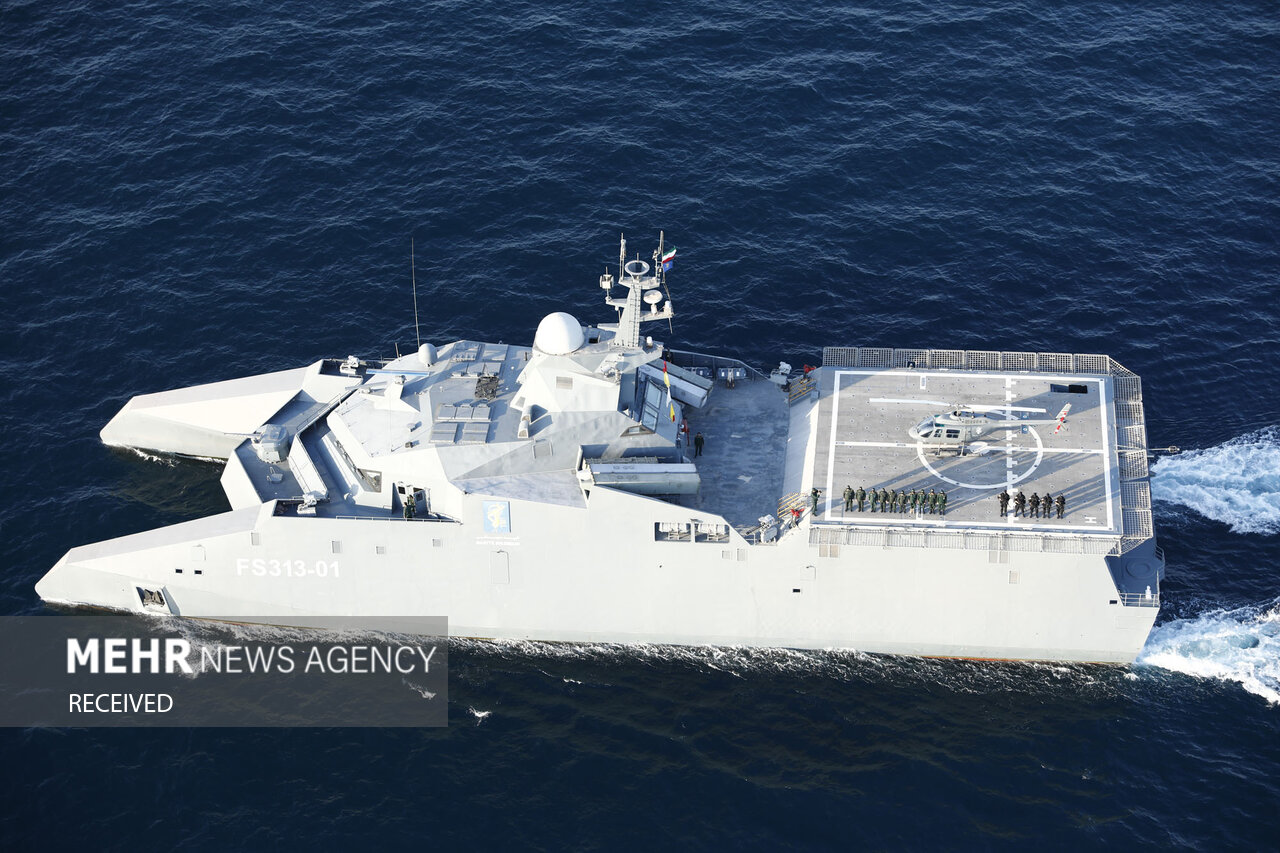
In early December, Iran’s Islamic Revolutionary Guards Corps (IRGC) navy conducted a two-day military exercise across the Persian Gulf, Strait of Hormuz, and Gulf of Oman, one of the largest in recent years. The exercise, titled “Eghtedar” (“Authority”), brought together Iran’s latest indigenous missile system, advanced air defenses supported by artificial intelligence, electronic warfare forces, and simultaneous launches of ballistic cruise missiles, sending a clear strategic message about Iran’s deterrence capabilities.
Integrated weapons and wide operational range
The training took place in strategic waters such as Abu Musa, Greater Tunbu, Lesser Tunbu and Siri islands.
During the exercise, Iran activated its latest carrier-based air defense systems (Navab, Majid, Misag) under electronic warfare conditions. According to official information, these systems were enhanced with AI-assisted target recognition to detect and engage air and sea threats within seconds.

The final stage involved a coordinated launch of cruise missiles and ballistic missiles.
Cruise missiles: Qadr-110, Qadr-380, Qadir
Ballistic missile: 303 system
These were launched from deep within Iranian territory and struck designated targets in the Gulf of Oman with high precision. Drone units simultaneously carried out attacks on simulated hostile targets, while Revolutionary Guard naval air defense formations trained to counter air threats against warships and coastal infrastructure.
Direct Messages: Practicing Active Deterrence
Officials stressed that the exercise served not only as a training operation but also as a clear warning to foreign navies, especially U.S. ships, stationed in the region.
On the first day of the exercise, Revolutionary Guard naval units issued operational warnings to nearby foreign warships, demonstrating Iran’s readiness to respond to any aggressive moves.
The integration of long-range missiles, unmanned aerial vehicles, AI-enabled air defense systems, and electronic warfare capabilities reflects the emergence of a “total deterrence architecture” capable of dealing with threats ranging from aircraft and missiles to large ships.

Political and geopolitical aspects
Conducting such an exercise on a waterway that is central to the world’s energy transport would highlight Iran’s role in regional security and its ability to influence critical international shipping lanes. The show of power reinforces the Iranian government’s message that its national defense strategy is based on indigenous capabilities and strategic autonomy.
The announcement of a successful operation, along with the release of new systems, will act as a deterrent by demonstrating that any hostile action against Iran will be costly.
Completely domestically produced arsenal
Iran emphasized that all equipment deployed in the exercises was indigenously produced. Long-range, precision-guided, smart weapons produced by Iran’s Ministry of Defense and Revolutionary Guards Navy formed the backbone of the operational phase of the exercise. The emphasis on domestic production is part of Iran’s broader strategy to protect its defense capabilities from sanctions and external pressure.
One of the systems on display was a new naval ballistic missile with a range of more than 1,375 km (the length of the Persian Gulf). The missile, developed by Iranian experts, is maneuverable after launch and can be guided by command. Officials said its accuracy was proven during the exercise.

Operational superiority in close-range combat
Iran’s naval doctrine places great emphasis on asymmetric capabilities. The Revolutionary Guards Navy is using a network of state-of-the-art drones that can fly directly over U.S. warships to provide continuous aerial surveillance of foreign vessels sailing in the Persian Gulf, according to published information. Officials noted that Iranian forces approached such ships at close range without being detected, evidence of Iranian situational awareness and the limits of foreign surveillance systems in the region.
Historical incidents such as the detention of American and British sailors and the seizure of foreign vessels were cited as examples of Iran’s readiness to respond decisively when its maritime interests are challenged.
Responsiveness as a strategic principle
Organizers of the exercise emphasized that full readiness is a continuing requirement for the Iranian military. The message sent at home and abroad is clear: Any attempt to violate Iranian territory or damage Iranian maritime assets will be met with a firm response.
conclusion
The IRGC Navy’s Egtedar exercise demonstrated the coordinated integration of long-range missile power, AI-enhanced defense systems, unmanned aerial vehicles, and electronic warfare capabilities in a comprehensive combat scenario. More than a military exercise, the event served as a declaration of Iran’s evolving defense principles, combining active deterrence with rapid retaliation capabilities.
In the current regional climate, the exercise served as more than a show of force. It was a statement of strategic intent that any act of aggression against Iran would have significant political and security consequences for regional and extra-regional actors.
MNA