
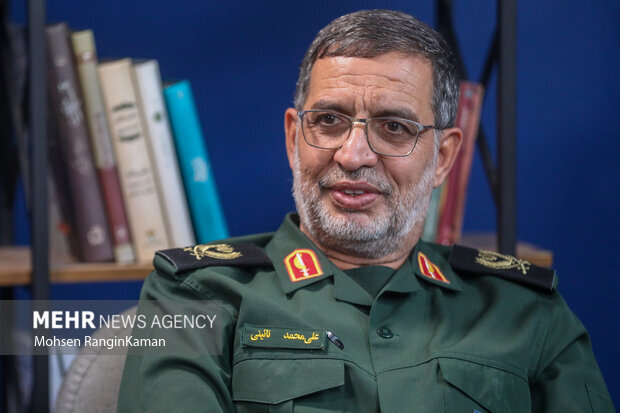
Brigadier General Ali Mohammad Naini, spokesman and acting spokesperson for the Revolutionary Guards, speaking at a Student Day event on Sunday, outlined Iran’s military actions during the 12-day war with Israel, saying the initial response was immediate and coordinated.
He said that after Israel attacked a fuel depot in Tehran, Iran carried out two attacks targeting the Haifa refinery within five hours, which Israeli intelligence sources themselves described as “Iran’s missile masterpiece” that put the facility out of commission, according to a Naini report cited by Mehr news agency. He said that after Israel attacked an Iranian intelligence center, Iran retaliated by attacking a Mossad stronghold, resulting in 36 deaths.
Naini said Iran’s Operation True Promise 3 began just hours after the conflict began and characterized it as a multi-layered and innovative operation that combined electronic warfare, cyber operations, missiles and drones. He emphasized that Iran entered the conflict with complete information superiority and a comprehensive databank.
He claimed that the Israeli military and intelligence services suffered “definitely more casualties” than Iran, and pointed to Iran’s precision capabilities, including an attack on the minus one floor of a 32-story building used as a stock exchange data center in occupied Palestine.
Naini said Israel fully utilized its air defense network with the support of US assets in the region, but was still unable to stop Iranian missiles. He stressed that a single Iranian missile caused several times more damage than expected, after Israel had initially warned of a “massive attack.”
He emphasized the role of young Iranian experts in building Iran’s defense capabilities and reiterated that the country’s doctrine after the Iran-Iraq war is based on human-centered defense and asymmetric warfare, where fronts cannot be compared “symmetrically.”
Naini described the 12-day war as an important case study for military analysts, saying Iran’s rapid restoration of command, its ability to carry out 22 consecutive missile wave attacks against Israel, and its ability to neutralize the impact and regain control were decisive factors.
He also said that U.S. and Israeli think tanks now advocate that the postwar period be divided into “before and after the 12-day war,” calling the conflict “unprecedented” and suggesting that the conflict remains a major subject of global strategic research.
He also said that Iran faced 400 to 500 cyber attacks during the conflict and conducted its own cyber operations. Many aspects of cyber and intelligence warfare cannot be disclosed publicly, Naini said.
On June 13, while Washington and Tehran were in the process of nuclear negotiations, Israel launched a blatant and unprovoked invasion of Iran. The Israeli attack sparked a 12-day war that left at least 1,064 people dead in the country, including military commanders, nuclear scientists and civilians.
The United States also entered the war by bombing three Iranian nuclear facilities in a serious violation of international law.
In response, Iranian forces targeted strategic locations throughout the occupied territories, as well as Qatar’s Al Udeid Air Base, the largest US military base in West Asia.
On June 24, Iran successfully thwarted the invasion through successful retaliatory operations against both the Israeli regime and the United States.
MNA/3465719