
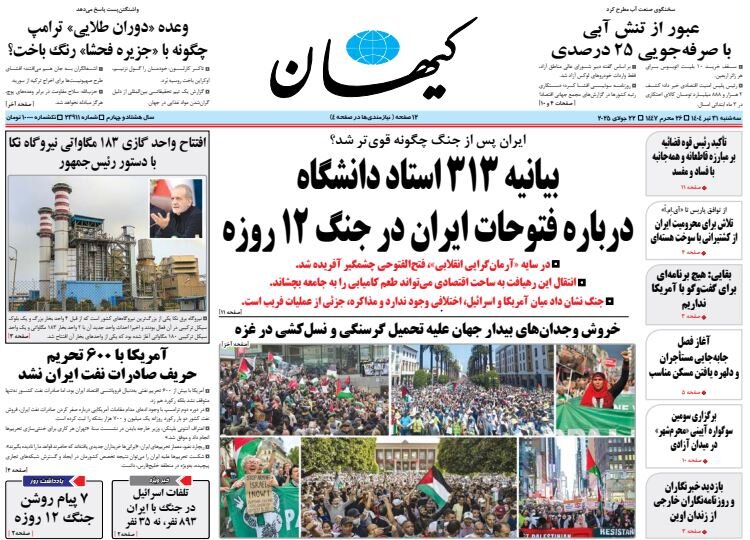
Tehran-Keyhan, compiled on Iran’s achievements after the 12-day war with Israel, wrote: Iran’s Islamic Republic on one hand, while the US, the Zionist regime and the other European government had very important results.
This war once again marked the world of deterrent in Iran. One of the key achievements of the war was the strengthening of Iran’s national unity and unity. It has also proven more than ever that the defense industry and research and development in this area is essential. Another most important achievement was a change in the balance of power in West Asia, showing that Iran as a regional power has significantly strengthened its defense and military capabilities. The war had a major impact on the political and international position of the Zionist regime. It also had a major impact on the international community’s understanding of Iran’s legitimacy. In a world where “Jungle Laws” are dominated by destructive and criminal governments or regimes, it is military authority and dignified diplomacy that brings respect.
Etemad: Measures must be taken to prevent the revitalization of snapbacks
In an interview with foreign policy expert Morteza Makki, Etemad evaluated Russia and China’s possible approach as a Tehran partner in the face of the revitalization of snapbacks by the European troika in the UK, France or Germany. He said: The recent 12-day war clearly shows that Iran is facing a kind of strategic isolation in the international field. Russia’s stances towards China and Iran may be partly aimed at weakening the United States, but this by no means implies unconditional support for Iran. The reality is that when snapbacks are activated, even the hands of China and Russia are tied for political, economic, or military support for Iran. Therefore, it is unlikely that they will confront the Security Council resolutions that could be reinvigorated under the snapback. Iran needs to focus all their efforts on preventing the activation of snapback mechanisms, as tensions will reach unprecedented levels when this process is completed and the country’s political, economic and security conditions will become much more complicated.
Farhikhtegan: Trump administration’s impact and maximum pressure
In an interview with Fahhictegan, Reza Jalali, a faculty member of the Department of Political Science at Islamic Azad University, examined the strategic and political aspects of the Israeli war with Iran last month. He said: Since the beginning of the Second Trump administration, the focus of US policy decisions has been on strengthening Israel, comprehensively defending it, and strengthening its policy of maximum pressure on Iran. The influential Zionist lobby has played a key role in Washington’s decision-making. In addition to political and economic pressures, Iran has been a target of Israel’s direct attacks on military and nuclear infrastructure, claiming that Israel’s claims is a “precautionary measure.” The US policy was to create internal disruptions and launched a broad psychological war against Iran. And by relying on the power of its weapons and US support, Israel is trying to limit the threat to Iran. Given the sensitivity of the region, military action can disrupt the balance of power and put security in the Middle East at risk. Iran must develop new strategic policies with a sensible approach to maintain deterrence over the broad campaigns of Israel and its allies.
Arman-e-Milli: Preparing for Kremlin mediation
In the commentary, Ahman Emily dealt with the Kremlin announcement that he was ready to act as a mediator between Iran and the United States. The publication writes: The Russian mediation claims were made public after meeting with President Putin during a recent trip to Moscow. Russia is one of the key players in international relations and one of the strategic partners of Iran’s Islamic Republic, and has worked in recent years to alleviate tensions and lay the foundation for the Tehran-Washington dialogue. These efforts were primarily made in the context of efforts to revive the regional development, nuclear negotiations and the JCPOA agreement. Despite existing complexities such as strategic conflict, mutual mistrust and internal pressures in both countries, Russia’s role as a potential mediator remains important from the perspective of political analysts and diplomatic institutions. However, the success of these efforts depends on the political will of the parties, the construction of mutual trust, and the acceptance of the impartial role by the mediator. Continuing diplomatic efforts involving the participation of other countries such as Russia could be an effective step to alleviate tensions and create an atmosphere of rational dialogue between Iran and the United States.